This film by Rik and Jane Gadsby of the May 2006 London launch of the second edition of my book The Look has just been posted online; it really evokes the good time that everyone had that night.
Pippa Brooks and her band All About Eve Babitz played and DJs included George O’Dowd.
The party was held at the premises of Raymond Revuebar, which by that time was Two II Much (dunno what it is these days). I was very touched when Kevin R. talked about how important he viewed the book and my work. “This is our culture,” he says in the clip above.
//Robert Watts in front of Products by Implosions Inc. Photographer: unknown//
Malcolm McLaren’s adaptation of the infamous Tits t-shirt is one of punk’s most familiar designs, as applied by he and Vivienne Westwood to shirts sold in SEX and Seditionaries, worn by members of the Sex Pistols and replicated hundreds of thousands of times since.
Such is its distorting androgynous power that a version was chosen along with another McLaren/Westwood design – the Cowboys shirt – to represent the core aesthetic of the movement when the forthcoming Costume Institute exhibition Punk: Chaos To Couture was announced earlier this month.
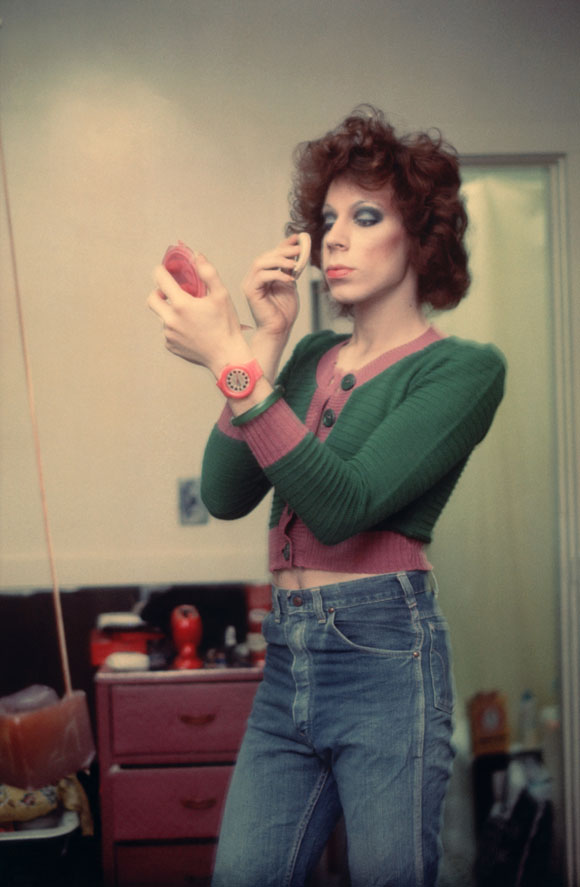
//Kenny putting on make up, Nan Goldin, Boston, 1973 //
Perhaps it is a matter of displacement – that slippery moment when art becomes commerce, shifting back again into the cultural arena as another kind of commodity. The fact is, even today, few among us are willing to acknowledge that certain mass culture forms and practices may comprise the most significant ‘culture’ of our time, precisely because of their ‘popular’ characteristics.
Marcia Tucker and William Olander, New Museum Of Contemporary Art, 1988.
In the 25 years since Tucker and Olander made this statement, the displacement they sought to define has become, if anything, more slippery.
For this reason alone, Liverpool Tate curator Darren Pih must be applauded for negotiating such tricky waters with Glam! The Performance Of Style, the exhibition he has curated in an attempt to locate the early 70s glam-rock phenomenon in the context not just of a certain area of artistic practice of the period but also more broadly the interplay between “high” and mass culture.
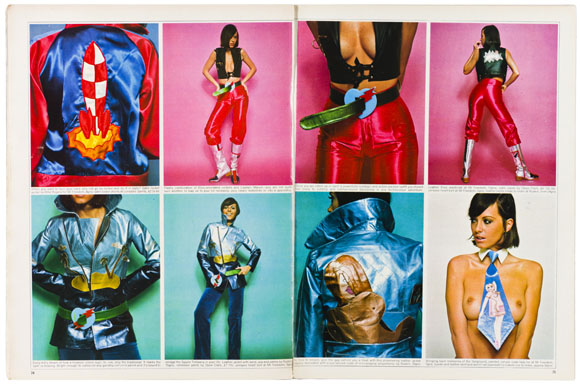
//Fashion spread featuring Mr Freedom and Ossie Clark designs, Nova, May 1970 //
I’m quoted in today’s article in UK Sunday newspaper The Observer about the factual failings surrounding the punk clothing collection of the New York Metropolitan Museum Of Art’s Costume Institute.