
Preparations are well underway for the next phase of the Malcolm McLaren exhibition: a room dedicated to the late cultural iconoclast’s work as a visual artist at group show Art In Pop, which opens next month at France’s National Centre Of Contemporary Art space Magasin in Grenoble.
Art In Pop will also feature rooms dedicated to paintings by the late Don Van Vliet (aka Captain Beefheart) and documentation of the artist John Miller’s exploits in music with the likes of Tony Conrad, Kim Gordon, Mike Kelley, Takuji Kogo and Thurston Moore.
And there will also be artworks by such musicians as the late Jerry Garcia of The Grateful Dead, Daniel Johnston, Cris Kirkwood of The Meat Puppets, David Thomas of Pere Ubu and Mayo Thompson of The Red Crayola.
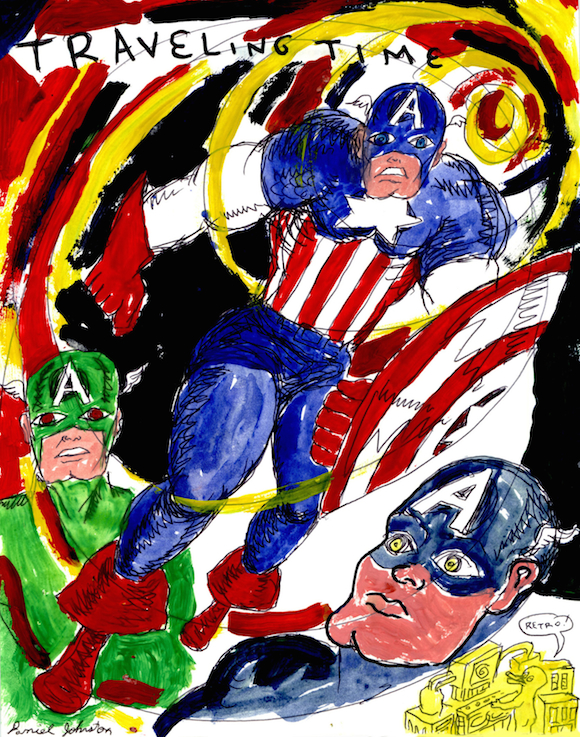
//Alix Lambert is featured on this 2008 Buckethead track//
These will be exhibited with pieces by artists who have investigated music, including John Armleder (who will be showing a work created with Genesis Breyer P. Orridge and Alan Vega), David Bowes, Alix Lambert (creator of 90s fictional all-girl punk band Platipussy, described as an “oestregen-powered Spinal Tap), Randy Ludacer, Tony Oursler and Greg Parma Smith.
The Malcolm McLaren element of Art In Pop will include many of the exhibits displayed at Let It Rock in Copenhagen this summer along with some exciting additions which I will be previewing here over the coming weeks.
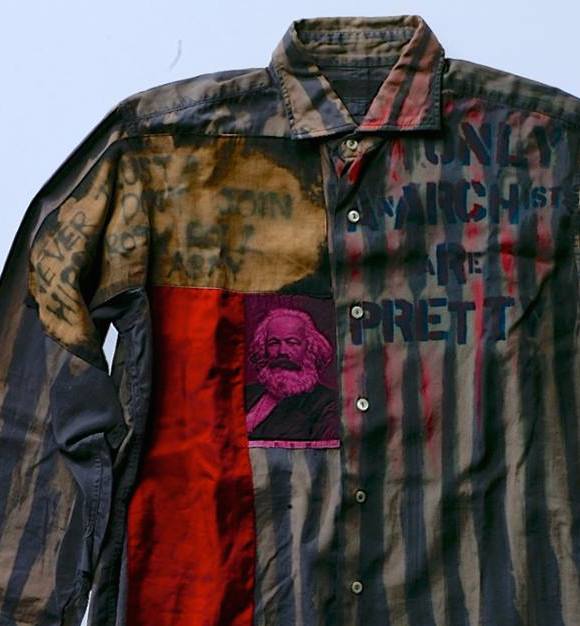
Among them will be paintings produced by McLaren as an art student in the 60s as well as an original example of one of the most “painterly” works McLaren created with Vivienne Westwood: The Anarchy Shirt.
This is being loaned by fashion guru and musician Hiroshi Fujiwara, who has one of the most important collections of McLaren & Westwood designs in the world.
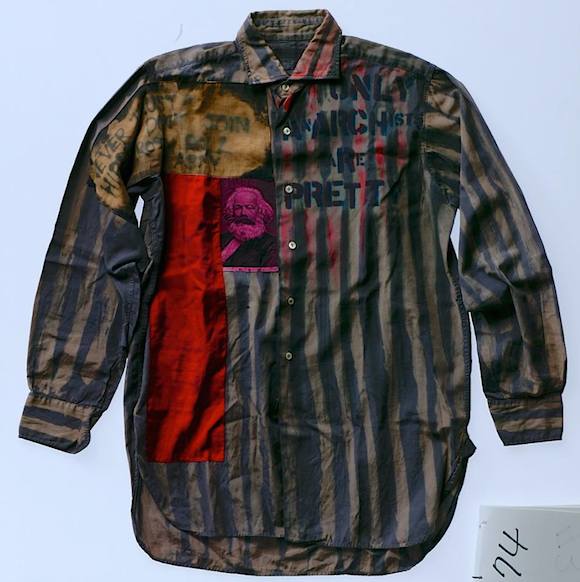
The shirt is a fine example of the extraordinary design first introduced in September 1976, and was originally owned by writer and cultural commentator Jon Savage.
“I bought it in late 1978 from Seditionaries,” says Savage. “It had a swastika applique which I immediately took off, not wishing to be the bearer of that particular insignia.”
Savage has described the Anarchy shirt as McLaren & Westwood’s “masterpiece… an inspired collage, using second hand clothes, craft and revolutionary slogans – an extraordinary package of compressed content”.
Art In Pop – which is curated by Magasin’s Yves Aupetitallot with John Armleder, me, Young Kim of the Malcolm McLaren Estate and John Miller – is at Magasin from October 11 to January 4 2015.
Details here.
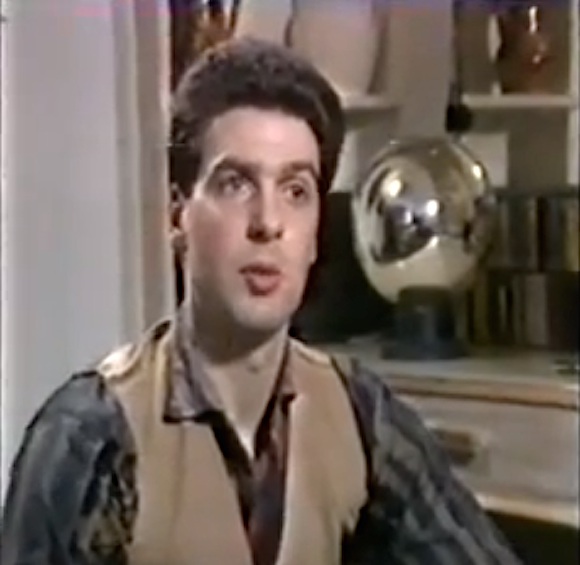
Here is the first part of the 1983 Positive Punk documentary, shown as part of ITV’s South Of Watford strand (Savage appears towards the end of this segment):

Muzz
September 10, 2014 at 7:52 amThat ISN’T the same shirt.as the one in the picture Savage is wearing in the clip from South Of Watford.
Paul Gorman Author
September 10, 2014 at 8:01 amJon has confirmed he wore this shirt on the programme. He also confirmed the chain of ownership.
rob cruickshank
November 13, 2014 at 12:46 amHello Paul!
I have been a fan of your web site for many years now (too many).
I am always really interested to read about the AnaRcHY shirts and the clothes designed by M & V. I will include Muzz in this email. Hello Muzz! Why do you think the shirt ISN’T the same shirt.as the one in the picture Savage is wearing in the clip from South Of Watford?, it is very hard to see the shirt in the video! I would be really interested to hear what you know and why you think that. Back to you Paul, the chain of ownership list would be most interesting. I would love to read about what you know of any of the other AnaRcHY shirts that still exist. Re Mr Cooks parachute, the one in the met etc. From what I have read Malcolm McLaren said perhaps a half a dozen of the original Wemblex shirts were turned into the amazing creations we love so much. Perhaps the two of you could work in tandem and produce the definitive article regarding the AnaRcHY shirt with all the pics that are out there included. Some of the replicas out there are really good and could be included to show what was available back in the day!
All the best to you both!
Yours
Rob Cruickshank.
paul
April 29, 2016 at 1:42 pmWhoever said all that time ago that this shirt isn’t the one worn by Jon Savage is wrong. I have a huge collection of photos of original Westwood/Mcclaren items and I use it as a database so I know what labels belong to which dates. I have a lot of images of this shirt as there aren’t many real ones. Malcolm borrowed this one from Jon Savage for an exhibition years ago. I simply looked at the bleach patterns on the collar and where the patch joins and it’s the same shirt. You couldn’t fake those patterns if yo tried. Bleach is hard to work with. I have made a few copies of his style shirt. I have a large collection of photos of copies and original ‘Destroy’ shirts. I can tell if one is genuine. I do collect real prints and copies. T shirts now have no side seams and back in the 70’s they did. I even study the seam stitching. I see so many fakes online. Some are so obvious as they go over the top with stains and tearing. If you were selling one you would wash the stains out first obviously. I do think that a good screenprinted copy is cool and perfectly valid. It’s not a copyrighted design. You have to overlap prints which means no two are ever the same. The good copyists like Debden don’t flood the market. I think they are art as much as clothes. Cheers, Paul
Paul Gorman Author
April 29, 2016 at 1:56 pmThank you for your comment.
One point you should be aware of. Whether the designs were “copyrighted” or not (and publishing them with labels clearly denoting the designers is as good as that), these are original expressions and artworks wholly owned by their creators and widely recognised as such. That they have in general chosen not to assert their rights (though there was a potential game-changer a few years ago in respect of a Manchester-based business which attempted to register the IP of ‘Destroy’ and was blocked by Vivienne Westwood Ltd and seriously condemned by the court) is neither here nor there.
The entire body of designs 1971-1984 belongs to the designers to exploit (or not) as they see fit separately upon dissolution. That is in effect the substance of the copyright laws governing this work – for further guidance I’d recommend Daniel Maclean’s essay in In Deed: Certificates Of Authenticity In Art which does not directly refer to MM/VW’s ouevre but is very helpful when assessing it.
Also, it is a misconception that, on the dissolution of the partnership in 1984, McLaren relinquished authorship of this body of work. He did not; see Ancien/Dead In England 1994-5 as just one example.