
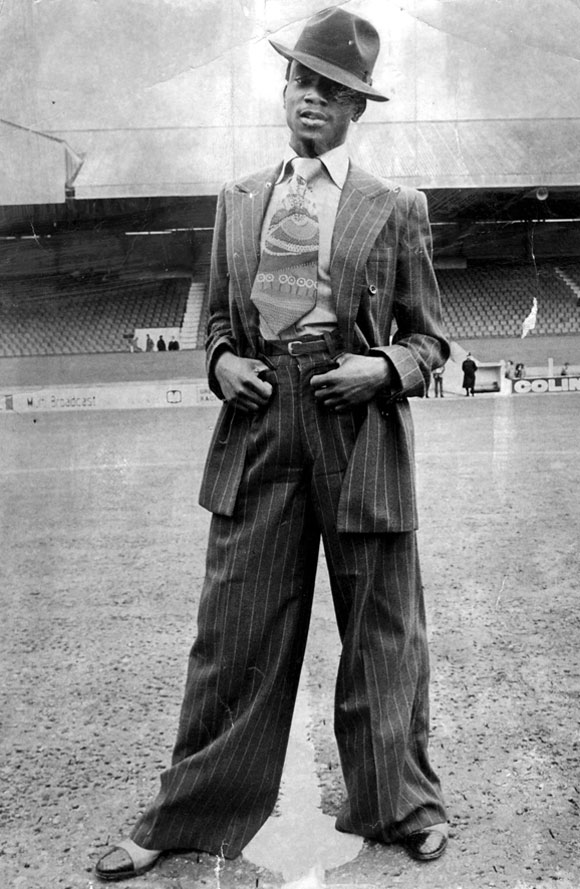
In 1989, footballer Laurie Cunningham’s life was cut short by a car crash on the outskirts of Madrid. He was 33 years old.
By that time Cunningham had notched up a series of sporting firsts which resonated through the wider culture: a teenage signing to east London team Leyton Orient, Cunningham was the first black player to represent England (in 1977 as an under-21, scoring a winning goal against Scotland) and the first Englishman to play for Spanish giants Real Madrid (in 1979).
The subject of a mid-70s Sunday Times Magazine cover story, Cunningham was also an early example of the pop culture footballer, a north London soul boy interested in highly stylised personal presentation and fully engaged with London’s emerging club scene.
Born in Archway to Jamaican immigrant parents, like his hero Fred Astaire, Cunningham delighted in dancing, winning cash prizes for his moves out on the floor, and was keen on bespoke tailoring (accessorised with hats and shoes bought in Camden Market).
In the Sunday Times piece, journalist Brian Glanville noted that Cunningham designed his own clothes, painted portraits and was redesigning the interior of his car: “If there is a doubt about his future success in football, it may reside precisely in this relaxed versatility, this pleasure in the variety of life.”
Professionally, Cunningham benefited from the forward thinking of George Petchey, the Orient manager who signed him and four other black players at a time when people of colour were not fairly represented (the Sunday Times listed just 22 who had broken through by the mid-70s).
Now journalist Dermot Kavanagh is paying tribute to this largely forgotten but hugely significant and attractive figure with a project which will include an exhibition in Cunningham’s neighbouring locale Islington next year.
“I hope to raise awareness about Laurie and his story, which I think is radical and very British, one which deserves to be brought to the attention of a contemporary audience,” says Kavanagh.
He has made contact with Cunningham’s circle but is also seeking information and background detail from those who associated and socialised with the flamboyant footballer in the period from 1972 to 1979 (Cunningham left London for the Midlands to play for West Bromwich Albion in 1977 but returned to the capital regularly before joining Real Madrid).
“I’d really like to draw local people out, those who knew Laurie and grew up with him, as well as those on the London soul scene at the time,” says Kavanagh.
If you ever came across Laurie Cunningham personally or feel you have a contribution to make to Dermot Kavanagh’s project, contact him via this blog.

Ed Aarons
February 26, 2013 at 4:30 pmHi
Was just hoping to find out more info on the Laurie Cunningham exhibition? I’m a football journalist who has researched a lot about Laurie’s life.
Please let me know
Paul Gorman Author
February 28, 2013 at 7:35 amHi Ed
Dermot is making progress – will make sure readers are updated.
colin yates
May 9, 2013 at 3:57 pmLaurie Cunningham was a truly amazing footballer and very talented individual. I have created a couple of prints illustrating the ‘Black Pearl, details on my website http://www.footballfineart.com See The Three Degrees and Black Looks. Cheers Colin Yates
Laurie Cunningham: Back in the Sunday Times with a major biography and a blue plaque on the way « Paul Gorman is…
March 13, 2016 at 2:08 pm[…] first wrote about Cunningham four years ago – read the post here – and have been happy to provide support and advice to Kavanagh in his ambitions to publish a […]