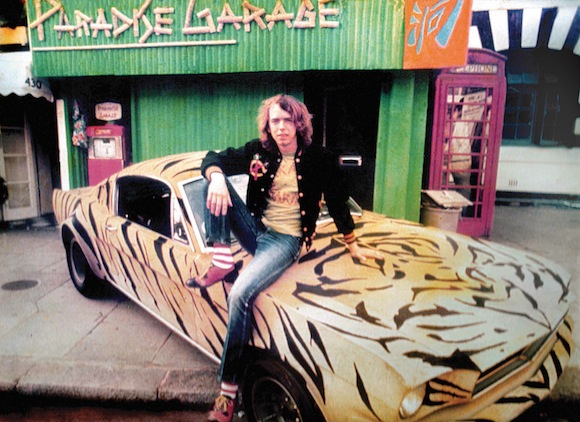
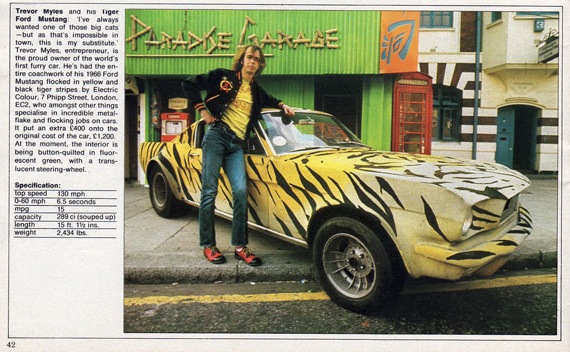
//Trevor Myles, Mustang and 430 King's Road, late summer 1971. Photo: Michael Roberts////From Michael Roberts' article Men & Their Machines, Club, October 1971//
Trevor Myles’ decision to incorporate a flocked and tiger-striped 1966 Ford Mustang as part of his retail space Paradise Garage naturally attracted a lot of attention during the brief existence of this unusual fashion outlet at 430 King’s Road in Chelsea’s World’s End in 1971.
//Dany Bubbles, 1963-66. Pencil and acrylic, 29" x 20" (framed)//
I sourced one of the paintings which is in More Than Fair, the exhibition of Ian Dury’s artworks which opens at his alma mater, London’s Royal College of Art, next month.
Dury gave the ultra-Pop Dany Bubbles to his friend and designer Barney Bubbles in the late 70s during their spell of collaboration which resulted in a series of triumphs: single sleeves such as Sex & Drugs & Rock & Roll, What A Waste and Hit Me With Your Rhythm Stick, the 28 wallpaper covers of the album Do It Yourself, the Blockhead logo…
The spirit of great British boutique culture is summoned by a couple of lots in next week’s Pop Culture sale at Christie’s.
One is a previously unpublished June 1967 photograph of Jim Hendrix not in Carnaby Street as captioned, but outside the tobacconist Finlay’s, which was in Foubert’s Place. It’s evident from the carrier bag in his famous left hand that the guitarist had just visited I Was Lord Kitchener’s Valet, which was next door to Finlay’s and the place where he bought the Hussar’s jacket worn in this photograph and at Monterey Pop that same month.
//George O'Dowd in Street Theatre, 12 Ganton Street, central London, 1978. Photo (c): Boy George Collection//
I’ve been acting as a consultant to artist Lucy Harrison on her latest site specific project Carnaby Echoes, which focuses on the culturally fertile area of central London adjacent to Soho.
With the starting point of the opening of Murray’s Club in Beak Street in 1913, Harrison is mounting her artistic response to 100 years of musical history with archival material and fresh interviews with some of the area’s leading lights.
//Photographer Kate Simon and performer Chrissie Hynde (lifting the front of her mohair jumper from Sex), London, 1976. (c) Joe Stevens//
This photograph – taken by Joe Stevens in early 1976 in Fulham, west London – is featured in the exhibition Just Chaos!, which opens tomorrow (May 7) at Marc Jacobs’ Bleecker Street NYC bookstore BookMarc.
The T-shirts worn by Simon and Hynde were among the first variants of a limited edition designed by Malcolm McLaren to promote the newly formed Sex Pistols. A few were also sold in Sex, the environmental installation/shop operated by McLaren with Vivienne Westwood at 430 King’s Road in World’s End, Chelsea.
“Malcolm dropped the shirts off at my Finborough Road studio; they were freshly silk-screened from a limited edition,” says Stevens, then working for the NME and living with Simon (who was employed by rival music paper Sounds). “Chrissie was living in a squat and cleaning offices for a living. She’d drop by the pad to take showers. I’d hear her singing in there and realised she had a wonderful voice.”
McLaren produced the designs with the express aim of promoting the new group. “This was my first attempt at making a Sex Pistols T-shirt,” he told me in 2006. “I wanted to create something of a stir.”
Fashion shoots were little known aspect of the practice of design studio Hipgnosis, whose co-founder Storm Thorgerson died on Thursday.
In line with the approach Thorgerson and his partner Aubrey Powell took with their raft of album sleeve commissions, the series of fashion spreads Hipgnosis produced for Club International in the early 70s were visually arresting and often high concept.
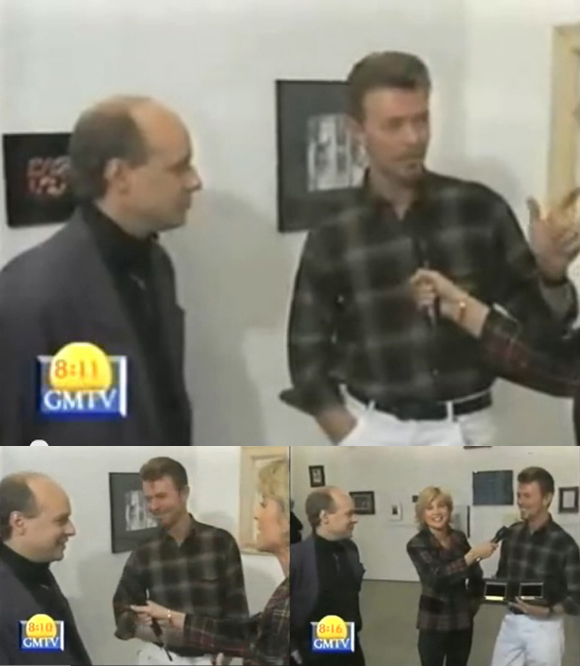
//Brian Eno + David Bowie interviewed by Anthea Turner for British breakfast TV at Flowers, east London, October 1994. This was to publicise the charity art show/auction Little Pieces From Big Stars. By this time the pair were collaborating again, on 1. Outside. For reasons now lost to me, I drove Brian to the gallery early that morning.//
I interviewed David Bowie a couple of the times in the 90s, having met him via fund-raising idea contributions I made to the music industry’s favoured charity, War Child. In the preceding months he had been an enthusiastic contributor to the art events Little Pieces From Big Stars (1994) and Pagan Fun Wear (1995).
This interview took place in the summer of 1995 when Bowie was promoting 1.Outside, notable in that it marked a return to collaboration with Brian Eno (who I also interviewed at the time for his work on that as well as another collaboration, with Jah Wobble on the ambient project Spinner).
Bowie had emerged from the maligned Glass Spider/Tin Machine period a couple of years earlier with more creditable, if not particularly memorable efforts, including The Buddha Of Suburbia soundtrack. He was also actively ploughing a furrow into the visual arts and already mutating as a musician and performer, soon to become a familiar presence on the international festival circuit and engaging in sorties into jungle manifested in the follow-up album Earthling (for which I also interviewed him).
Ideas crackled off Bowie throughout the conversation; Eno once told me that working with him on a song in the studio was like watching a fast-motion film of a flower blossom.
In our chat, Bowie even flew a kite about producing an album based around a fictional character Nathan Adler every year until 2000 culminating in a Robert Wilson-style epic theatrical production at the Brooklyn Academy Of Music. Of course these never came to fruition.
How did you come to hook up with Brian Eno again?
When Brian came to my wedding in 1992, I had instrumental pieces for what would eventually become a third of Black Tie White Noise – music that I composed to be played in the church and at the party afterwards. He explained he was working in a not dissimilar area and I was starting on The Buddha Of Suburbia, where I pretty much started to survey the territory I wanted to be involved in. After a series of conversations, working with Brian really came together in early March 1994. Continue reading Journalism: Interviewing David Bowie on working with Eno + engaging with visual arts, 1995
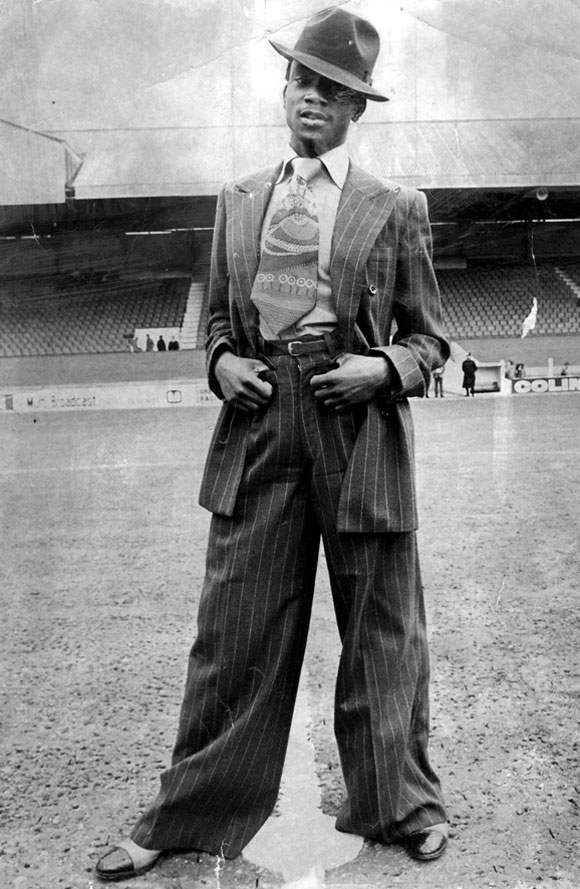
//Laurie Cunningham aged 17, at Brisbane Road, home to Leyton Orient FC, 1973.//
In 1989, footballer Laurie Cunningham’s life was cut short by a car crash on the outskirts of Madrid. He was 33 years old.
By that time Cunningham had notched up a series of sporting firsts which resonated through the wider culture: a teenage signing to east London team Leyton Orient, Cunningham was the first black player to represent England (in 1977 as an under-21, scoring a winning goal against Scotland) and the first Englishman to play for Spanish giants Real Madrid (in 1979).