“Within the slippery divides between disciplines and media – fashion, art, music, interiors, commerce – one finds Malcolm McLaren, roaming and creating.”
Lou Stoppard in her essay in The Life & Times Of Malcolm McLaren
Disruption to the publication of a book is extremely small beer at a time when the COVID-19 pandemic has set the world in disarray, so I’m sanguine about the postponement of several events and signings which were due to occur around the publication of my biography The Life & Times Of Malcolm McLaren.
//The back of the book jacket features this 1976 portrait by photographer Joe Stevens//
Back cover of the group’s 1973 LP released by Mint Records. No photo or design credit.Front cover. No photo or design credit.
I’m grateful to Peter Stanfield, media and arts professor at the University of Kent, for alerting me to these great images of members of Shakin’ Stevens’ backing band The Sunsets sporting T-shirts designed by the late Malcolm McLaren for sale in his shop Let It Rock at 430 King’s Road in the early 70s.
I’m really proud of my niece Esme Bradbury, whose exuberant handmade designs via her label EsDes have received a boost with inclusion at the Craft Council’s Established East London pop up shop at Westfield Stratford.
//Detail, Ian Dury's Billy Bentley boxing gown, commissioned from Sex, 1974. Photographer: Adrian Turner.//
Ian Dury was as much a visual as verbal stylist.
The late performer’s wordsmithery comes into focus in daughter Jemima’s soon-to-be-released book ‘Hallo Sausages’, which also conveys his rich and idiosyncratic sartorial presence.
Published by Bloomsbury on October 28, ‘Hallo Sausages’ presents lyrics to 170 of Dury’s songs, some scribbled and heavily anotated, others meticulously typed and displayed to best effect in the book design by another member of Dury’s extended family, Jake Tilson (brother of Dury’s widow Sophy; their father is the eminent British artist Joe Tilson).
Making a merit of the archival jumble Dury left behind on his death in 2000 (a bunch of lyrics were found in a carrier bag bearing Barney Bubbles’ familiar Blockhead logo), this is a lovingly put-together document, the songs and Jemima Dury’s reminiscences adorned by a bank of rare, personal and professionally-taken images.
To celebrate the publication of ‘Hallo Sausages’, here’s a selection of key items from Jemima’s Dad’s wardrobe with some background material sourced from my recent book about one-time Kilburn & The High Roads manager Tommy Roberts. Jemima has also contributed a couple of images from her own archive.
Meanwhile, at the end of this post, there’s an opportunity to win a signed copy of ‘Hallo Sausages’.
//Onstage at London's Lyceum, 1981. Photographer: David Corio.//
Pearly King jacket
Rooted as he was in London lore, Dury added this authentic Pearly King jacket to his stage ensemble in the late 70s. According to Sophy Dury, he later found out it had belonged to an Eastender named John Snow (hence “JS Of Mile End” on the back). Snow’s mother had loaned the jacket to her friend Mrs. E. Rainbird, who wore it on VE Níght.
In a 1985 letter to the BBC radio broadcaster Libby Purves (who interviewed Dury that year) Mrs Rainbird wrote that she recognised the jacket from his TV appearances. Purves complied with her request to pass the letter outlining the provenance to Dury, who put it in one of the jacket pockets, where it remains.
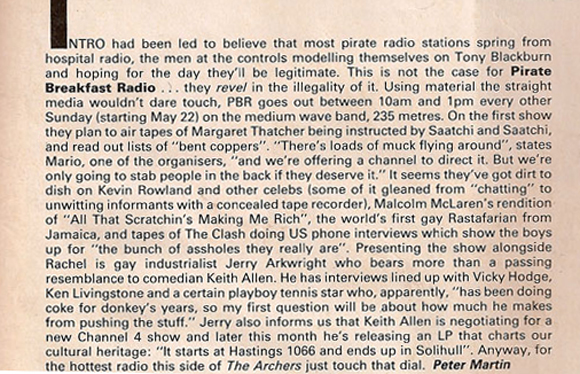
Tucked away in the June 1983 edition of The Face was this news story about a brave broadcasting venture, the scabrous and short-lived Breakfast Pirate Radio.
//Proof of front cover of Programme 1 by Station BPR, Utility, 1983. Design: Barney Bubbles.//
This morning I am participating in the V&A’s study day From Biba To Topshop with a presentation on the rise and fall of boutique culture in London’s King’s Road, starting with the opening of Bazaar by Archie Nairn, Alexander Plunket-Green and Mary Quant at 138a in 1955 and closing with the establishment of World’s End at 430 by Malcolm McLaren and Vivienne Westwood.
Yesterday I was visited by a camera crew for an interview about the behind-the-scenes individuals who have made the difference to British popular music over the years.
The team, from Kobalt Productions in Berlin, are producing the documentary for Franco-German arts channel ARTE. The director is Simon Witter, who has a fine pedigree in journalism and broadcasting.
Malcolm McLaren’s musical brilliance was first showcased on the seamless + timeless Duck Rock; it’s a really jumping record and this is one of the many highlights.
Sure Malcolm would have appreciated this Youtube collagist’s approach; the footage is from David Hoffman’s 1965 film “Bluegrass Roots”, shot in Madison County, North Carolina. There’ll be contributors to online Ivy League forums creaming their chinos to the gear worn in this (I like the Elvis-style bell sleeve shirt worn by one chap).
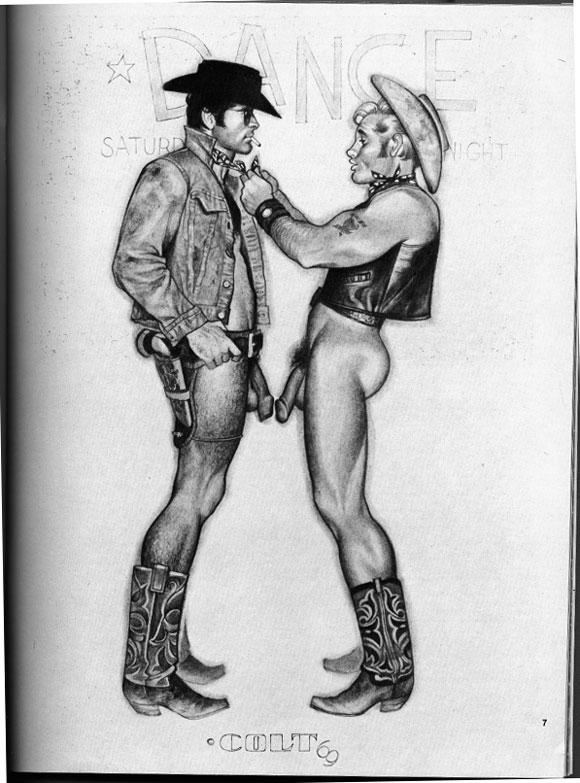
//Longhorns Dance by Colt (Jim French) from Manpower! issue 7, 1974.//
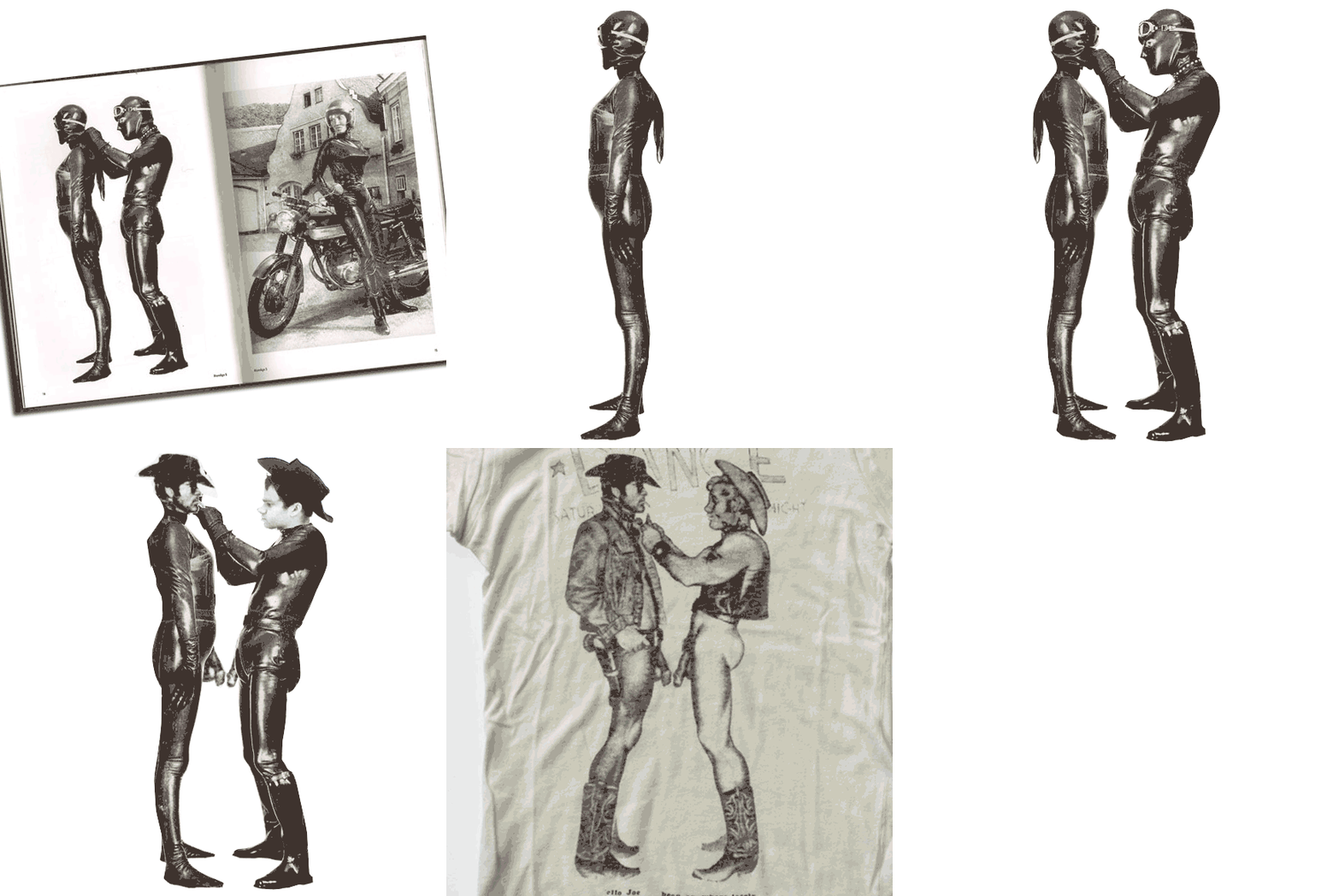
My theorising over the roots of the Cowboys t-shirt has uncovered the true source of the main image: a 1969 drawing by the artist Jim French reproduced in a 1974 issue of his magazine Manpower!.
French has an international following for his gay-themed photographic + illustrative work, via his Colt Studio image-bank and work as “Rip Colt” and “Luger”.
MY SPECULATION HERE SPARKED A TRAIL TO THE TRUE SOURCE OF THE MAIN IMAGE: THE ARTIST/PHOTOGRAPHER JIM FRENCH, WHO DREW THE COWBOYS FOR A SERIES CALLED LONGHORNS IN 1969 (SEE LINK AT END OF THIS POST).
The late Malcolm McLaren said he could never remember the origins of one of the most potent designs to emanate from 430 King’s Road in its six-decade history as a fashion emporium: the Cowboys t-shirt.