Tinker, Tailor, Soldier, Sailor is an exhibition of Polaroids taken by artist, illustrator and print-maker Jim French which opens tonight at New York’s ClampArt gallery.
These include studies for French’s 1969 Colt Studio print Longhorns Dance, incorporated by Malcolm McLaren in 1975 in his notorious Cowboys t-shirt design, as sold in Sex and Seditionaries at 430 King’s Road and worn by the Sex Pistols and others.
//Longhorns Dance by Colt (Jim French) from Manpower! issue 7, 1974////Wearing their Cowboys (clockwise from top left): McLaren 1975, Sid Vicious 1977, Siouxsie 1976, Steve Jones 1975. Photographs: Bob Gruen; Dennis Morris; Ray Stevenson; Mick Rock.//
This year’s presentation of the Malcolm McLaren Award at the finale of performance arts biennale Performa will celebrate the 30th anniversary of the iconoclast’s game-changing LP Duck Rock.
Hosted by eminent writer Glenn O’Brien and McLaren’s widow Young Kim, the event on Sunday will culminate in the presentation of the award by sound artist Christian Marclay to the artist under 40 who has demonstrated “the most innovative and thought-provoking performance” during Performa’s three-week run.
Designed by Marc Newson, the Malcolm McLaren Award was inaugurated at the last Performa in 2011, where it was presented by the late Lou Reed.
In the period 1972-78 when the body of the partnership’s punk fashions were created, Malcolm McLaren’s art education and development as a largely conceptual visual artist was applied with Vivienne Westwood’s intuitive and sophisticated technical skills.
The resultant potency of the work was achieved by such factors as: balance in the proportions; deft use of juxtaposition; confidence in realisation; jarring harmony in the use of colour; wit in the application of motifs; and astute sense of framing, particularly of text and visual imagery.
Excerpt from introduction to my review of the McLaren/Westwood designs in the Costume Institute collection of the Metropolitan Museum of Art, summer 2013.
Precision, deftness, balance, harmony, these are terms unjustly omitted from the standard critical lexicon applied to punk’s central design aesthetics as conceived and realised by Malcolm McLaren and Vivienne Westwood and their coterie.
Which is why Punk @ ShowStudio, the elegant exhibition which is now moving into its final week at photographer Nick Knight’s Belgravia gallery, is to be applauded, since it avoids the run-of-the-mill in favour of recognition of the importance of these qualities.
“I was very impressed. It was inspiring to see what I like to call ‘the origins of Punk’ as opposed to the usual well documented ‘greatest hits of Punk’,” the collector/archivist/author Paul Burgess wrote to me recently.
//Part of Judy Blame's contribution to the exhibition//
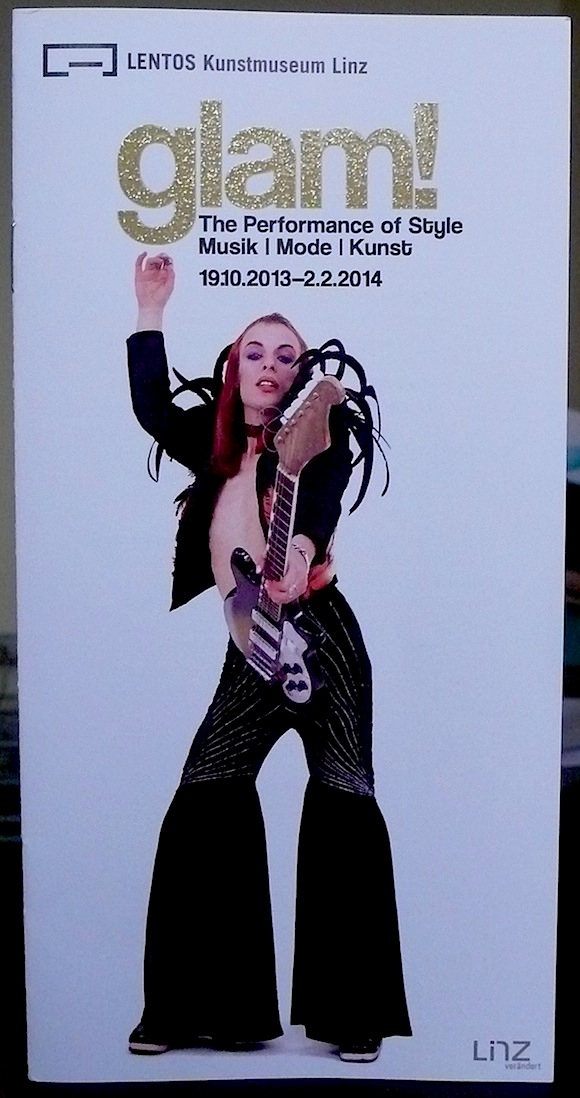
//Front cover of booklet for the Linz show features this 1973 Karl Stoecker portrait of Brian Eno in Roxy Music stage costume designed by Carol McNicholl//
Glam! The Performance Of Style – the exhibition which locates early 70s glam rock in the context of fine art and the interplay between “high” and mass culture – is opening at the Lentos Kunstmuseum in Linz, Austria later this month.
I was a consultant to Glam!’s curator Darren Pih of Tate Liverpool, where the show opened at the beginning of this year before moving on to Frankfurt’s Schirn Kunsthalle for the summer.
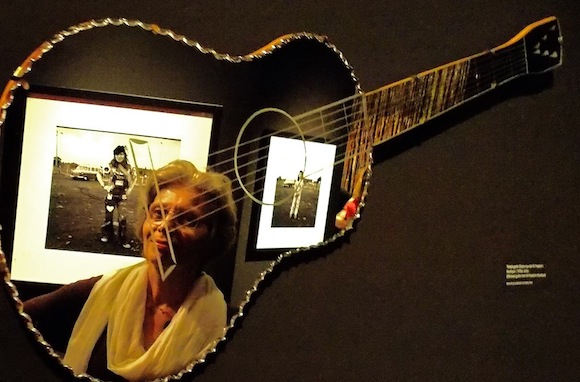
//The Let It Rock guitar mirror as exhibited at Glam! in Frankfurt. Photo: Andrei Luca//
//Clockwise from top left: Cover, Helen And Desire, 1970; George O'Dowd, photo: Richard Bevan, 2013; Carnaby Street book and Palisades swing tag, 1970 and 1966; front cover, Anarchy In The UK newsprint fanzine, 1976//
I’m involved in a couple of events which open in London this week: artist Lucy Harrison’s multi-layered project Carnaby Echoes in the West End and photographer Nick Knight’s exhibition Punk at his Showstudio space in SW1.
“The black gay community has given kids with holes in their trousers the opportunity to look as glamorous as mannequins on a Paris runway.
“By imitating the Great White Way of success – Vogue magazine, the profiles of glamour, the poses that intimate that…we’re not gonna criticize it, we’re gonna celebrate it, because that’s the Great White Way…
//Clockwise from top left: Sissy Spacek and Martin Sheen, Badlands, 1973; Arnella Goes Rodeo, West One, 1974; Malcolm McLaren, January 1972; clothes from The Emperor Of Wyoming, 1973//
A fashion shoot styled by Pru Walters and photographed by Karl Stoecker for a 1974 issue of Janet Street-Porter’s secretarial magazine West One foregrounds the importance of Westernwear to London street style in the early to mid-70s.
//West One, May 14, 1974, p14: Fringed blouse from Kweens, 109 King's Road; shorts Stirling Cooper; boots + hat The Emperor of Wyoming, 404 King's Road//
I Always Remember A Face, Especially When I’ve Sat On It is the arresting title of a great 14-track vinyl-only compilation from artist of the fantastical, Maurizio Cattelan.
This is the tracklisting:
A Side
1 Bernard Herrmann – Brave New World (Excerpt)
2 The Cheers – Black Denim Trousers & Motorcycle Boots
3 Pierre Schaeffer – Etude Aux Chemins De Fer (Excerpt)
4 Judy Garland – The Trolley Song
5 Coldcut – Stop This Crazy Thing (Excerpt)
6 Malcolm McLaren – Miss Belle
7 Gene Vincent – Jezebel
B Side
1 Les Paul & Mary Ford – Bye Bye Blues
2 Hoosier Hot Shots – I Like Bananas Because They Have No Bones
3 The Dorsey Brothers – Lullaby Of Broadway
4 F.T. Martinetti & A.Guintini – Sintesi Musicali Furutiste (Excerpt)
5 Malcolm McLaren – Ride A Fashion Horse Pt.2
6 Cornelius – Fantasma
7 Ozzie Nelson And His Orchestra – Dream A Little Dream Of Me
//From Maurizio Cattelan, Fondation Beyeler, Basel, June 8 - Oct 6//
The LP – produced under the auspices of his online magazine Toilet Paper, marks Cattelan’s current show at Basel’s Fondation Beyeler. See here.
A collaboration with The Vinyl Factory, I Always Remember A Face, Especially When I’ve Sat On It has been produced in a limited edition of 1,000 copies and is available here.
This is designer Ben Kelly at his 1974 degree show at London’s Royal College Of Art.
Kelly adopted the alter-ego The Photo Kid, who is portrayed in the work by which he is standing. The Photo Kid wore clothes – in particular brothel creepers – from Malcolm McLaren and Vivienne Westwood’s shop Let It Rock, as did Kelly; the shoes, pink socks and belt in this photograph all came from there, while the Hopalong Cassidy & Topper top (see Ian Harris’s comment below) was picked up at a Paris flea market.
Paris, Capital of the XXIst Century is a personal and subjective journey that began firstly by ambling through a century’s archive of thousands of cinema commercials about the city (its inhabitants, what it sells, how it looks…), secondly by gathering impressions (choosing what to exploit, covet and keep), jotting them down only when I returned to my studio. Then, using these specific scenes as a palette and my voice as a brush, twenty-one portraits emerged of a Paris I had never witnessed before.
Malcolm McLaren November 2009
Tomorrow (June 10), Art Basel will host a screening of Malcolm McLaren’s final artwork, Paris, Capital of the XXIst Century.