Chrissie Hynde + Kate Simon in Malcolm McLaren’s Sex Pistols Smoking Boy T-shirts

//Photographer Kate Simon and performer Chrissie Hynde (lifting the front of her mohair jumper from Sex), London, 1976. (c) Joe Stevens//

This photograph – taken by Joe Stevens in early 1976 in Fulham, west London – is featured in the exhibition Just Chaos!, which opens tomorrow (May 7) at Marc Jacobs’ Bleecker Street NYC bookstore BookMarc.

The T-shirts worn by Simon and Hynde were among the first variants of a limited edition designed by Malcolm McLaren to promote the newly formed Sex Pistols. A few were also sold in Sex, the environmental installation/shop operated by McLaren with Vivienne Westwood at 430 King’s Road in World’s End, Chelsea.

“Malcolm dropped the shirts off at my Finborough Road studio; they were freshly silk-screened from a limited edition,” says Stevens, then working for the NME and living with Simon (who was employed by rival music paper Sounds). “Chrissie was living in a squat and cleaning offices for a living. She’d drop by the pad to take showers. I’d hear her singing in there and realised she had a wonderful voice.”

McLaren produced the designs with the express aim of promoting the new group. “This was my first attempt at making a Sex Pistols T-shirt,” he told me in 2006. “I wanted to create something of a stir.”

Continue reading Chrissie Hynde + Kate Simon in Malcolm McLaren’s Sex Pistols Smoking Boy T-shirts

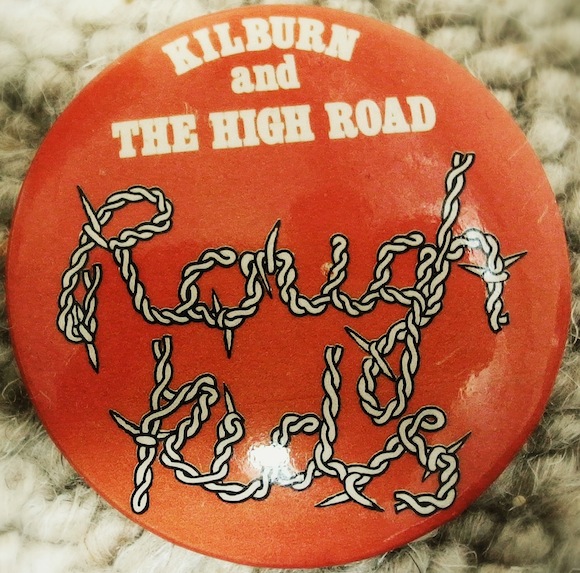
Rough Kids badge for Kilburn And The High Road (sic)

//Photo: Tom Sheehan Collection//

As an addendum to my recent post about the staging of the very special late night London concert given by Ian Dury’s art-rock ensemble Kilburn & The High Roads in 1974, here’s the badge commissioned by manager the late Tommy Roberts to flag up the concurrent release of the group’s single Rough Kids.

Then a neglected pop promotional medium – badges were considered kids’ stuff; the sole prominent champion was Barney Bubbles, who produced a range to go with his branding of space rockers Hawkwind and pub-rock outfit Chilli Willi And The Red Hot Peppers – the pre-punk barbed wire logo button was conceived and executed by Simon Haynes, designer of the ambitious stage set for the Kilburns’ gig at the King’s Road Theatre.

Continue reading Rough Kids badge for Kilburn And The High Road (sic)

When Kilburn + The High Roads played the King’s Road Theatre 1974: Ian Dury in Let It Rock ‘Alan Ladd’ suit + feather tie and Sue and Simon Haynes’ extraordinary Tower Bridge stage set

//Keith Lucas and Ian Dury onstage at the Kings Road Theatre, November 1974. Photo: Simon Haynes Collection//

As these rarely seen photographs show, when the subject of my last book the late Tommy Roberts took over management of Kilburn & The High Roads he sought to elevate them from the pub-rock scene by upping the visual ante on every front.

//From left: Lucas, Dury, David Rohoman, Charlie Sinclair and Davey Payne//

Continue reading When Kilburn + The High Roads played the King’s Road Theatre 1974: Ian Dury in Let It Rock ‘Alan Ladd’ suit + feather tie and Sue and Simon Haynes’ extraordinary Tower Bridge stage set

The origins of the Tits tee: Robert Watts + Products for Implosions Inc

Robert Watts, Implosions Inc, 1966.
//Robert Watts in front of Products by Implosions Inc. Photographer: unknown//

Malcolm McLaren’s adaptation of the infamous Tits t-shirt is one of punk’s most familiar designs, as applied by he and Vivienne Westwood to shirts sold in SEX and Seditionaries, worn by members of the Sex Pistols and replicated hundreds of thousands of times since.

Such is its distorting androgynous power that a version was chosen along with another McLaren/Westwood design – the Cowboys shirt – to represent the core aesthetic of the movement when the forthcoming Costume Institute exhibition Punk: Chaos To Couture was announced earlier this month.

Continue reading The origins of the Tits tee: Robert Watts + Products for Implosions Inc

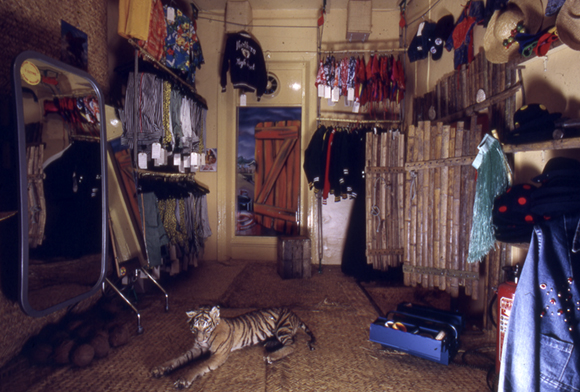
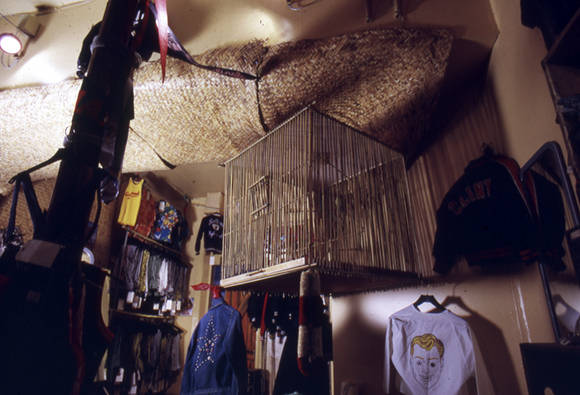
Exclusive: Inside Paradise Garage at 430 King’s Road with Electric Colour Company, 1971

//Interior, 430 King's Road, Chelsea, May 1971. Note coconut matting, shack-style dressing room doors, trompe de l'oeil gate painted on stockroom door... and fake tiger. Photography: David Parkinson.//

I first wrote about Electric Colour Company – the design studio formed in the East End by four fine art students in the late 60s – in The Look and then in more detail here.

//Amid the singlets, printed sweatshirts and appliqued denim, a bamboo cage housed birds of paradise, suspended from the matting covered ceiling.//

In my view, ECC deserves much greater recognition for executing some very clever work in the field of retail design and interiors in the period 1969-1973.

Continue reading Exclusive: Inside Paradise Garage at 430 King’s Road with Electric Colour Company, 1971

At Johnny Rotten’s pad in Malcolm McLaren’s leather jeans 1978: The story behind the photograph

This just in from Joe Stevens, following yesterday’s post about his new website: the story behind the photo with Johnny Rotten above, taken in London in 1978.

We were at his Gunter Grove digs in Fulham. Malcolm (McLaren) had left his grotty leathers in my flat in NYC during the Sid and Nancy murder doings. I had them dry cleaned. Never got the $90 for that one.
He had Glitterbest problems in London. So did Rotten. I was over there to do pictures of Public Image Limited.
He made a nice curry. I crashed there with him and Nora (Forster). Ari (Up, Forster’s daughter) would pop by often.
We watched her and The Slits record Heard It Thru The Grapevine and Chrissie (Hynde) rehearsing with her new Pretenders.
Yeah, he’s holding up his trousers with a strand of white cord.
I was later a witness at the High Court trial involving the band versus Glitterbest.
I tried on Malcolm’s leather trousers. Fell in love. It was a first. Went to London in them. Never took them off. Returned two weeks later to NYC wearing them.
Had them cleaned again. This time they didn’t survive. All I got back was swatches of leather in a bag.

Stevens’ new website is here.

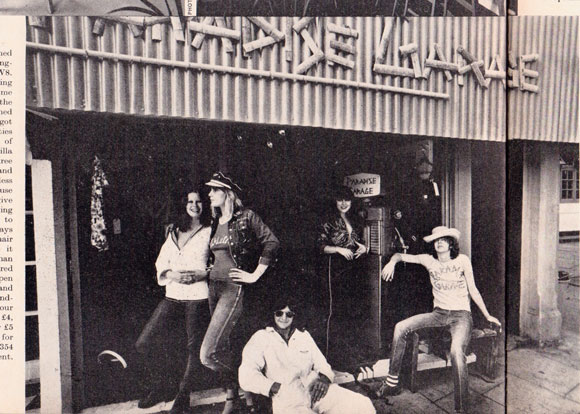
“I’m very earthy”: Trevor Myles and his Paradise Garage in Harpers & Queen 1971

//Outside 430 King's Road (from left) summer 1971: Unknown, assistant Lisa Petersen, manager Roly Poltock, designer Diana Crawshaw and founder Trevor Myles. Photograph: Julian Allason.//

Harpers & Queen ran this photograph of the short-lived but significant World’s End boutique Paradise Garage in the Shopping Bazaar section of the September 1971 issue.

Continue reading “I’m very earthy”: Trevor Myles and his Paradise Garage in Harpers & Queen 1971

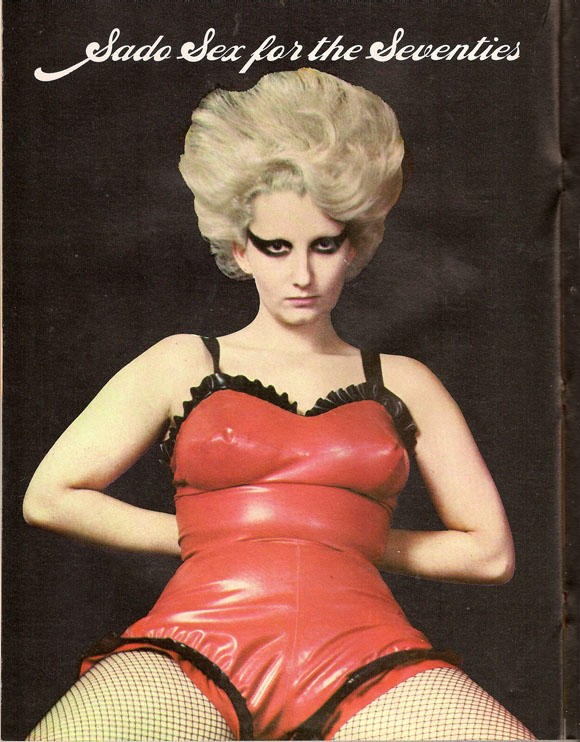
For the first time in 36 years the whole article: Forum June 1976 featuring SEX + Incognito Leather

//Photo detail (from left): SEX customers Danielle, Alan Jones + Chrissie Hynde; Vivienne Westwood; assistant Jordan.//

As a follow-up to my recent post about the rarely seen 1975 interview with Malcolm McLaren in soft porn mag Gallery International, here is another exclusive: for the first time since publication in June 1976, the full article featuring McLaren and Vivienne Westwood’s shop SEX in British sex guide Forum.

Continue reading For the first time in 36 years the whole article: Forum June 1976 featuring SEX + Incognito Leather

‘Because of the economic crisis, people are trying to consume as fast as possible. Ideas are dead; there aren’t any to express the mood. Fashion is irrelevant’: Malcolm McLaren + SEX, November 1975

//Sex assistant Jordan, Gallery International, Vol 1, no 4.//

It’s unlikely that cities will shake or nations start to rock under the impact of Malcolm McLaren’s sexual revolution. A few people might die though.

Malcolm McLaren, at 30, is a mixture of entrepreneurial cultist, sexual evangelist, businessman, artist, fetishist and political philosopher; a psychotic visionary in the ephemeral subculture of the fashion world.

David May, Gallery International Vol 1 no 4.

In November 1975 – by which time his charges the Sex Pistols had just embarked on live performances – Malcolm McLaren was interviewed by journalist David May at 430 King’s Road, then in full bloom as radical retail venture SEX.

Continue reading ‘Because of the economic crisis, people are trying to consume as fast as possible. Ideas are dead; there aren’t any to express the mood. Fashion is irrelevant’: Malcolm McLaren + SEX, November 1975