Photography: Kate Simon

This portrait of David Bowie was taken by Kate Simon at Olympic recording studios in Barnes, west London, on January 14, 1974.

Simon’s photograph captures a man on the cusp; furiously occupied in the studio, Bowie was tying up loose ends ahead of his departure for America 10 weeks later. He hasn’t lived in Britain since.

Three days before this was taken, Bowie’s production job on Lulu’s version of The Man Who Sold The World was released as a single. Applying himself to finishing Diamond Dogs, Bowie also recorded such eventually unreleased tracks as Take It Right (to become Right, a “plastic soul”  anthem on Young Americans) and a try-out of Bruce Springsteen’s Growin’ Up.

Sessions with vocal trio The Astronettes – including paramour Ava Cherry – had proved inconclusive, though an olive branch recently extended to erstwhile producer Tony Visconti soon bore fruit in the form of renewed collaboration.

A month after the shot was taken, Rebel Rebel was released ahead of the marathon US touring schedule over 1974/5 which marked the severing of business relations with Tony Defries and the faltering of his marriage to Angie.

I wanted to talk to Simon about the stories behind this image and others which deliver an emotional charge yet retain the reportage stance of the cool documentarist.

Continue reading Photography: Kate Simon

Memories of SEX in Forum magazine

//Steve Jones, Unknown, Alan Jones, Chrissie Hynde, Jordan, Vivienne Westwood. Photo: David Dagley/Rex Features.//

SEX became a magical place.  People spent hours there; no one wanted to leave.  In it, I created a feeling that was both euphoric and hysterical. You felt an enormous range of possibilities – that whatever was happening couldn’t be predicted, but it was a movement toward a place unknown.

Malcolm McLaren, Musical Paintings [JRP Ringier 2008].

One of the most prescient pieces published about 430 King’s Road in its incarnation as SEX appeared, appropriately enough, in sex magazine Forum in the mid-70s.

And, after more than 35 years, I’ve tracked down the writer and the photographer who, for the first time anywhere, recall the revolutionary retail environment and the sexually-charged photo-shoot featuring future Sex Pistol Steve Jones, performer Chrissie Hynde, radical shop assistant Jordan, film-writer Alan Jones and, of course, Vivienne Westwood.

The feature appeared in the June 1976 issue of the magazine and was written by expat American Forum staffer Len Richmond, later to pen hit British sitcom Agony and Three’s Company (the US version of the UK’s Man About The House). The photographer was Chelsea-based freelance David Dagley.

“In 1973 I’d arrived in the UK from San Francisco with 300 bucks in my pocket and found that I could work as a journalist because nobody cared about whether I had a green card,” explains Richmond down the line from Los Angeles.

Continue reading Memories of SEX in Forum magazine

Anita Pallenberg: 1967 and all that

//Anita Pallenberg + film-maker Harmony Korine, 2008. Photo: Eva Vermandel.//

A couple of years back I interviewed Anita Pallenberg – who celebrated her birthday yesterday – for Mojo magazine.

The subject was the scene in and around the King’s Road in 1967. Crisp and funny, Pallenberg was just as buzzed about the present;  visiting Karl Lagerfeld in Paris the next day, her interests in gardening and photography, the bargains to be found in charity shops and the notion of a collection based on the MA show from her studies at Saint Martins in the 90s.

A few months later, with her friend Anna Sui, Pallenberg participated in a rock & roll event I organised at the Port Eliot LitFest; after the show it was an honour to give her a vintage Vive Le Rock tee, which, of course, she wore with her trademark élan.

Here’s a refreshed and re-edited chance to appreciate this bewitching figure whose combination of innate style, fashion-savviness and earthy sexuality brought Continental sophistication to Swinging London and turned it on its head:

Gawky gamins and dolly-birds melted into insignificance in the presence of the impressive 21-year-old who arrived in London in 1965 having already studied graphic design in her native Rome, assisted Vogue photographer Gianni Penati and modelled in Paris.

Continue reading Anita Pallenberg: 1967 and all that

When Charlie met Malcolm

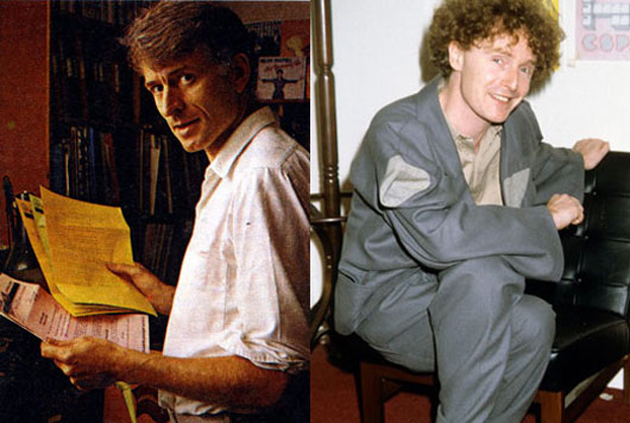
//Gillett + McLaren, 1983.//

Year-ends and beginnings naturally bring a sense of loss, of time passed and experiences weighed.

For me, 2010 will always mark the deaths of two individuals of personal import and also of lasting significance to our culture: Charlie Gillett and Malcolm McLaren.

These apparently disparate individuals – Gillett 68 and McLaren 64 at their time of passing on, respectively, March 17 and April 8 – shared several characteristics, not least idiosyncratic and uncompromising viewpoints and an abiding interest in bringing vanguard music into the mainstream.

Charlie was among folk and popular music’s most prominent enthusiasts – though he never liked the phrase, it is his achievement that “world music” entered western lives – and, as art consultant Bernd Wurlitzer wrote in 2008: “Malcolm McLaren is and has been an artist in the purest sense of the word for his entire adult life.”

Continue reading When Charlie met Malcolm