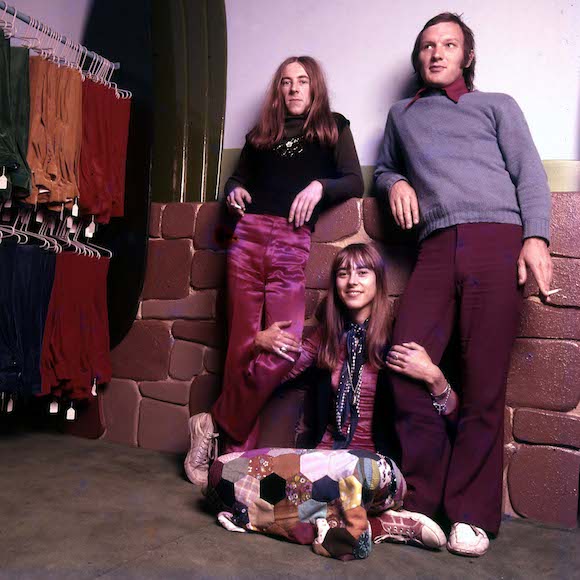
Electric Colour Company: Blueberry Hill – London’s shortest-lived boutique – and the customised Ford Fairlane 500

R, C & D, 1971
//Electric Colour Company’s Roderic Stokes and David Smith with Carol Davey at Blueberry Hill, 91 King’s Road, London, 1970//

Here are a couple of images relating to late 60s/early 70s British design studio Electric Colour Company; I’m writing a magazine feature about their exceptional body of work which ran from signage, custom-built furniture and shop designs (notably Mr Freedom, Paradise Garage and City Lights Studio) to lighting modules, display objects, interior decoration, murals, custom cars and fashion accessories.

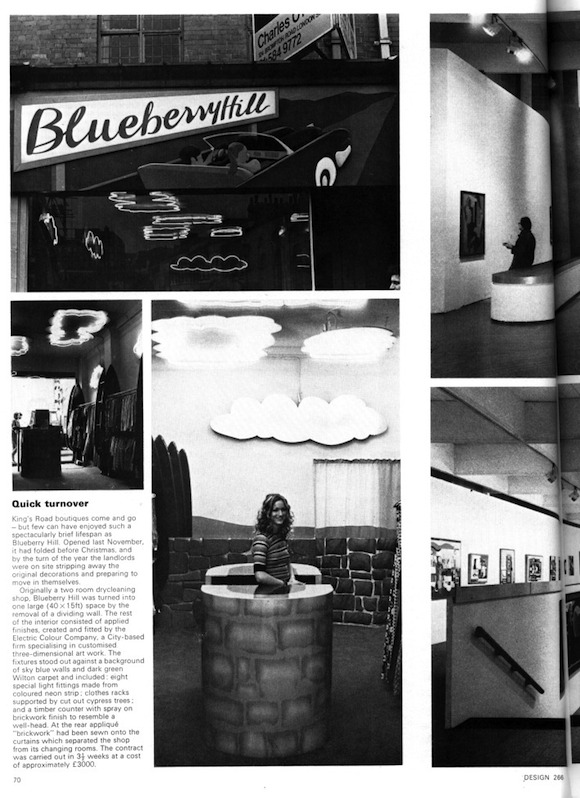
In November 1970 the King’s Road boutique Blueberry Hill was launched with a comprehensive fit-out – reported at a substantial-for-those-days £3,000 – by the ECC team of Andrew Greaves, Jeffrey Pine, David Smith and Roderic Stokes.
70
//By the time this coverage appeared in the February 1971 issue of Design magazine, Blueberry Hill had been closed for several weeks//

Despite the extraordinary nature of the shop design – which included cloud-form light fittings in neon strip  and a timber counter with spray-on brickwork finish resembling a well-head – Blueberry Hill closed after just six weeks when the landlords opted to replace it with a more bankable betting shop.
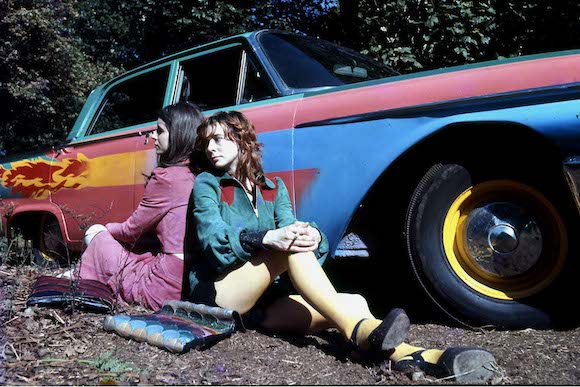
I & D & Fairlane, 1970
//Irene Smith and Dinah Adams with the ECC-customised Ford Fairlane 500, 1970//
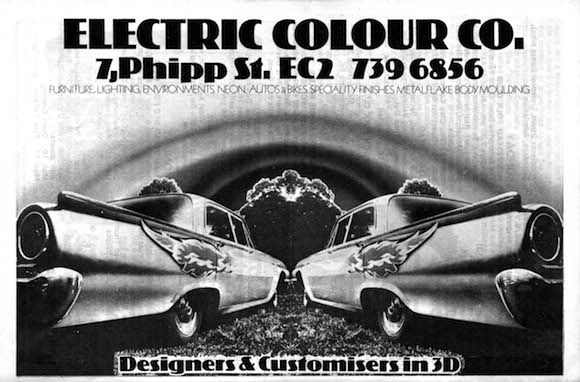
Full-Page  ad.  'TIME OUT' 1970
//Advert, Time Out, 1970//

The other photograph shows ECC fellow travellers Dinah Adams – who designed clothes for Mr Freedom, Paradise Garage and Granny Takes A Trip – and Irene Smith with the customised Ford Fairlane which also appeared in the East End company’s advertising.

I’ll give the nod when my piece on Electric Colour Company is nearing publication.

Visit the ECC site here.

Thanks to Andrew Greaves for the photographs.
Unbelievable rarity: Undocumented Let It Rock clothing featured on 1972 budget LP + previously unpublished views of stock inside 430 King’s Road

lir-rockarchive580
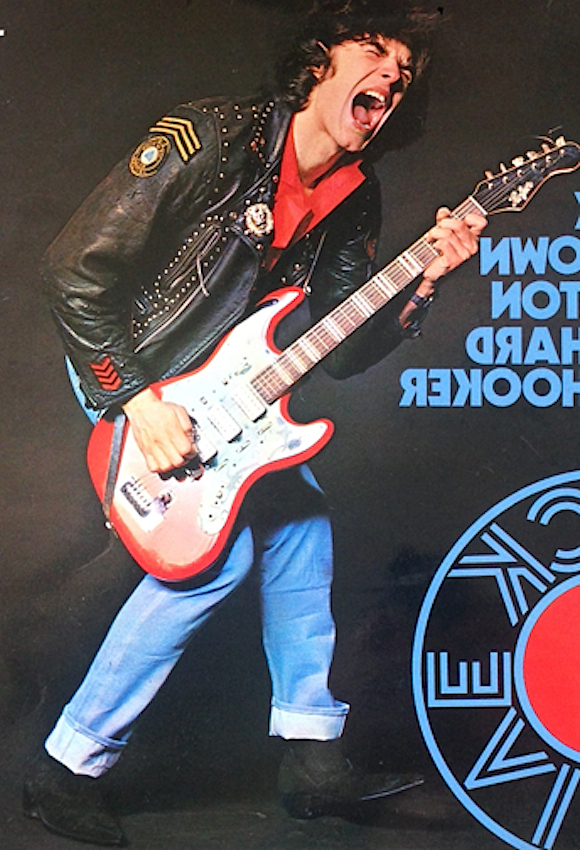
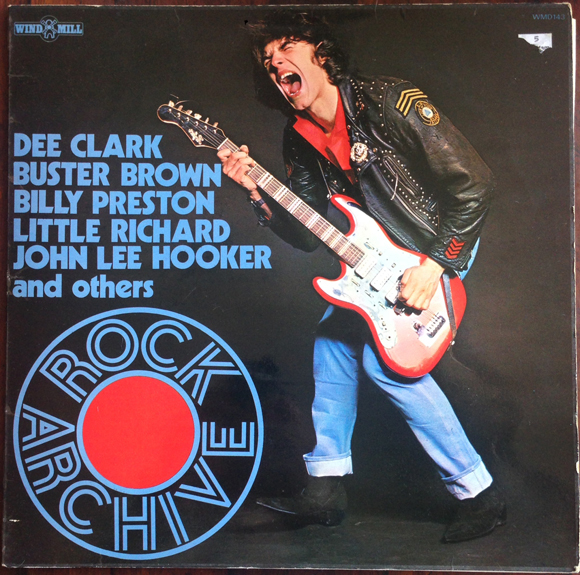
//Front cover, Rock Archive, Various Artists, Windmill Records, 1972//

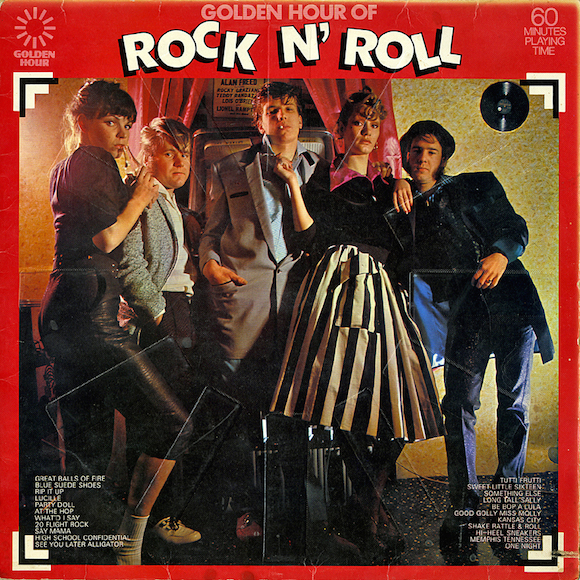
It is relatively common knowledge among those interested in the careers of Malcolm McLaren and Vivienne Westwood and their series of extraordinary shops that they supplied clothes to the 1973 album Golden Hour Of Rock & Roll; Let It Rock at 430 King’s Road was clearly credited on the back of the record sleeve.

Let It Rock-Golden Hour Of Rock & Roll
//Front cover, The Golden Hour Of Rock N Roll, Various Artists, Pye/Golden Hour, 1973//
lir-rockarchiveflipped
//The photograph on the Rock Archive cover was flipped to better accommodate the text. Here it is as originally shot//

But I have fresh information which helps towards a greater understanding of McLaren’s project to investigate the detritus of popular culture’s recent past. During a bout of research recently I came across this earlier and hitherto undocumented use of Let It Rock clothing in a music context: the front cover of Rock Archive, a budget LP compilation released by the specialist British independent label Windmill in 1972.

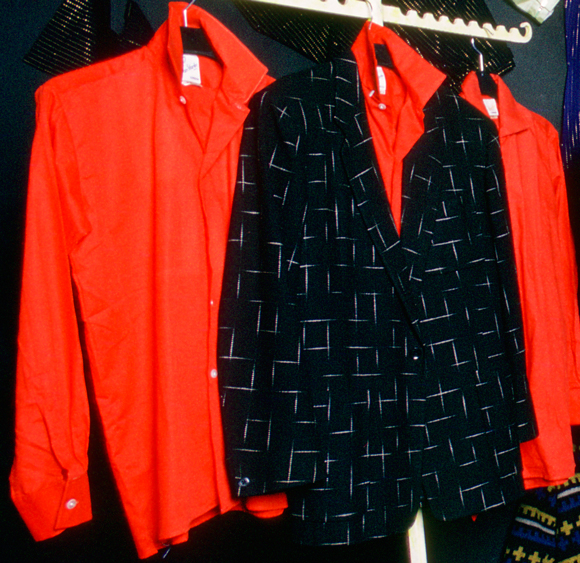
And I am detailing the clothes on the cover with images taken inside Let It Rock which have never been previously published.

lir-redshirts
//Starke shirts with 50s sports jacket on Let It Rock wall, January 1972. Photograph: David Parkinson//
lir-starke
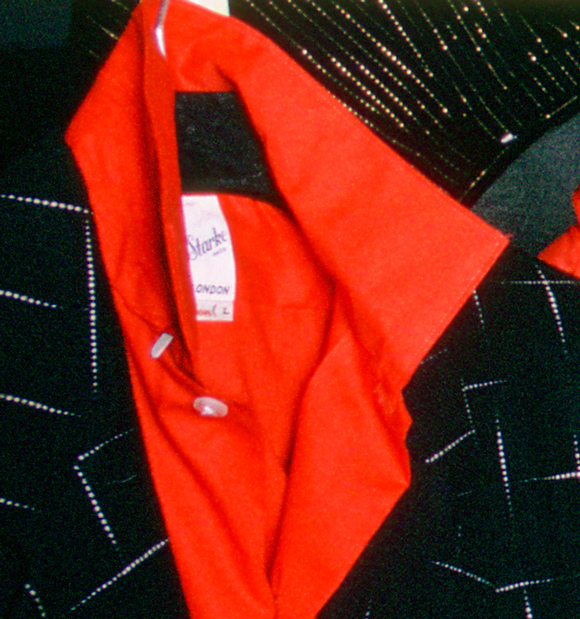
//Starke label detail//

Each garment worn by the model – whose attempts at rocking out resulted in his giving every appearance of suffering considerable pain – comes from the deadstock of British brands assiduously assembled by Malcolm McLaren and his art-school friend Patrick Casey for the opening of the world’s first avowedly post-modern retail outlet in November 1971.

From the ground up, the Rock Archive cover star wore black suede Denson’s Fine Poynts, ice-blue Lybro jeans with 5in cuffs, a Frederick Starke flyaway collar shirt and a studded and decorated Lewis Leathers early 60s Lightning jacket (which featured a highly collectable 6-5 Special patch).

Continue reading Unbelievable rarity: Undocumented Let It Rock clothing featured on 1972 budget LP + previously unpublished views of stock inside 430 King’s Road

Last days of Derek Boshier’s Change at Tanya Leighton Berlin

06_LEIGHTON_BOSHIER_CHANGE_9b
//Derek Boshier, Reel, 1973. Still from 16mm film transferred to video, colour, sound, 6:00 minutes//
03_LEIGHTON_BOSHIER_CHANGE_7a
//Best Foot Forward, 2014. Still from HD video, color, sound, 5:00 minutes//

Today and tomorrow are the closing days of Change, the Derek Boshier exhibition at Berlin’s Tanya Leighton Gallery.

On art-agenda, Ana Teixeira Pinto writes: “Providing a comprehensive view of his unfairly under-appreciated oeuvre, this extremely well-curated exhibition pairs the artist’s historical films with more recent work such as Best Foot Forward and Did You See… That? (both 2014).”

02_LEIGHTON_BOSHIER_CHANGE_1

Continue reading Last days of Derek Boshier’s Change at Tanya Leighton Berlin

One of the unpindownables of the counter culture: Jack Henry Moore 1940-2014

jhm-melkweg
//Jack Henry Moore (right) outside the Melkweg, Amsterdam with fellow film-makers Kit Galloway and Dave Jones, early 70s. Photo: The Generalist/The Videoheads//

Jack Henry Moore – who has died aged 73 – was one of the unpindownables of the counterculture in the 60s and 70s.

Known principally as a pioneering video film-maker and sound recordist (the archive he leaves behind is estimated to contain more than 70,000 hours of tape compiled over five decades), Moore was central to the establishment of many of the foundation stones of the underground in London and other European cities.

jhm-john+yoko
//With Lennon and Ono 1968. Photo: The Generalist/The Videoheads//

Moore joined fellow ex-pat American Jim Haynes in his theatrical experiments in Edinburgh in the mid-60s, where they staged productions by the likes of Lindsay Kemp. As in his native Oklahoma, Moore’s openness about his homosexuality necessitated a geographical shift, this time south to London.

Continue reading One of the unpindownables of the counter culture: Jack Henry Moore 1940-2014

Viennese Season: Feminism – VALIE EXPORT and Friedl Kubelka at Richard Saltoun

Valie3
//Genitalpanik (Genital Panic), 1969. VALIE EXPORT. Poster, silk-screen print. 69.5 x 49.5cm. Copyright the artist. Courtesy Richard Saltoun Gallery//
fkb012
//Untitled (Pin-Up), 1973. Friedl Kubelka. Black and white photograph mounted on cardboard, 16.8 x 11.6cm//

This week sees the opening of the second of London gallery Richard Saltoun’s two-part exhibition of Viennese art: Feminism presents the work of VALIE EXPORT and Friedl Kubelka.

Valie2
//Smart/Export II, 1968/1970. VALIE EXPORT. Vintage gelatin silver print, 60.7 x 40.5 cm. Edition of 5 plus 2 artist’s proofs. Copyright the artist. Courtesy Richard Saltoun Gallery//

Continue reading Viennese Season: Feminism – VALIE EXPORT and Friedl Kubelka at Richard Saltoun

All The Way From Louisville: Leee Black Childers

The last time I saw photographer/manager Leee Black Childers – who has died aged aged 69 – was fleetingly, a year or so ago at the crowded launch of his book and exhibition at London’s The Vinyl Factory.

The first time I saw Childers was at The Speakeasy at a March 1977 concert by his charges The Heartbreakers. The poster for that gig, featuring his London rooftop portrait of the band, hangs behind me as I type.

That night and for the rest of his London stay over the next couple of years this Southern gent could be spotted at such haunts as The Ship in Wardour Street, his presence notable for lacquered pompadour, authentic sharkskin suits and slick black winklepickers, his reputation bolstered by the knowledge that Ian Hunter had dedicated Mott The Hoople’s All The Way From Memphis to Childers – who, in fact, was raised near Louisville, KY – and that he created the apocalyptic collage on the inner gatefold of David Bowie’s Diamond Dogs LP (which now appears spookily prescient of the devastation of 9/11).

3b0572a4be3211e39934128dfbc5ee3d_8
//The inner gatefold of my well-worn copy of Diamond Dogs showing Childers’ apocalyptic photographic collage//

Childers appeared awfully frail at the Vinyl Factory launch, so news that he had been rushed to LA’s Cedar Sinai hospital during another bout of book promotion a few weeks back was worrying but not unexpected.

In conversation in 2009 Childers revealed a promotional plan for his book then in preparation: he wanted it to be published after his death so that he could be utterly honest about his extraordinary life and set of acquaintances. The promotion would consist of a series of pre-recorded chat show appearances, all ready for broadcast as soon as he expired. He wondered whether the likes of Jay Leno and David Letterman would be up for it.

Well, it wasn’t to be. The book came out and though unwell he appeared to be enjoying being back in the spotlight.

I am told Childers’ archiving was ramshackle and can find no website dedicated to his photographic work. This is shame because no one was embedded in and simultaneously chronicling the demi-monde of glitter, glam and punk, of Warhol’s Manhattan, Iggy’s LA and McLaren’s London, in the manner of this charismatic soul.

Sayonara Leee.

David Parkinson: Fashion photography’s forgotten figure to be a GQ Icon

DP-CIVol3No4cover copy
//Front cover, Club International, 1974. Paul Raymond Publications. Photo: David Parkinson//

Ahead of the publication of my piece about the late photographer David Parkinson in GQ UK in a few weeks, here are a couple of masterful images which demonstrate his stylised,  simultaneously gritty and glamorous approach.

DP-ManOnlyPGscan
//Front cover, Man Only, 1974//

Both stem from issues of men’s magazine Club International; the 1974 cover shot model is wearing Parkinson’s decorated Lewis Leathers jacket which he used to dress other fashion photo-sessions. The image was also used on the cover of Italian soft-porn title Man Only.

DP-CIVol4No5BarnersShopQuintet copy
//Acme Attractions photoshoot for Club International 1975 including (left) Martin Brading and Don Letts and far right Steph Raynor. Photo: David Parkinson//

The spread above focused on the suits and menswear available at Acme Attractions, the Kings Road vintage/retro outlet co-owned by Parkinson’s Lesicester friend Steph Raynor, who appears in the photograph with Acme’s manager, filmmaker/DJ/BAD member Don Letts, and Parkinson’s assistant, photographer Martin Brading.

Raynor is among those who contributed to my feature on Parkinson, who is granted the accolade of ‘GQ Icon’ in the June issue (available at the beginning of May).

This is Now: Film + Video After Punk to screen John Maybury’s Solitude featuring David Holah

Solitude
//David Holah in Solitude, directed by John Maybury. 11mins, 1981//

One of the choice selections to be screened as part of this month’s post-punk film season This Is Now is Solitude, the 1981 John Maybury short featuring David Holah, then a fashion student, soon to launch the era-defining label Bodymap with Stevie Stewart.

Put together by British Film Institute curator William Fowler, This Is Now is on at London’s South Bank and explores the early 80s explosion in DIY creativity in this field among UK art students, clubbers, New Romantics and members of the post-punk scene, all of whom embraced inexpensive domestic technology such as VHS and Super 8 to make often bold and uncompromising statements.

Solitude 2
//Holah in Solitude//

tumblr_n3dge1xGoZ1sj5zn6o4_1280

Continue reading This is Now: Film + Video After Punk to screen John Maybury’s Solitude featuring David Holah

Only Anarchists Are Pretty: New Fragment x Peel + Lift Anarchy Shirt goes on sale as The Pool opens in Aoyoama

image-1

Among the lines launching Tokyo’s new fashion and music retail outlet The Pool is a collaboration between Japanese streetwear labels Fragment and Peel + Lift on a fresh version of the 1976 Anarchy Shirt design by Malcolm McLaren and Vivienne Westwood.

thepool

AnarchyShirt-HiroshiFujiwara2014ThePool

ec7fd5eab8f311e3a8701285f9dba909_8

The reissue, in four versions, is a stripped down reproduction of one of the original variants created by McLaren and Westwood to be worn by the Sex Pistols and for sale in their shop at 430 King’s Road in its incarnations as Sex and Seditionaries.

“I had been a student in the 60s, and the anarchic student movements in France really framed my critique,” McLaren told me in 2007.  “This particular shirt celebrated that.”

The original designs used as a base the deadstock Wemblex brand shirts stored in boxes at McLaren & Westwood’s flat in Clapham, south London in the mid-70s. “They were pin-striped and made in cheap cotton in the early 60s when the ‘pin-through’ collar style – an American look – was fashionable,” said McLaren.

“I wore and wore them and then, one day, Vivienne decided to paint stripes over one. She showed it to me and together we customised it, using my son’s stencil set, with slogans such as “Only Anarchists Are Pretty” and “Dangerously Close To Love”.

“As well as layering the stencils to increase the impact, I attached silk patches of Karl Marx I discovered in shops in Chinatown which sold Maoist literature.  I chose him because his book started the Socialist and workers’ movements in the 19th century. Also, Vivienne and I liked his beard.

“Marx was a writer/author, a creator of ideas, not a politician like Lenin. Marx represented a greater significance and was important to us because he lived in London at one point.”

Continue reading Only Anarchists Are Pretty: New Fragment x Peel + Lift Anarchy Shirt goes on sale as The Pool opens in Aoyoama

The Teds are back: McLaren + Westwood’s Let It Rock in the NME and the Evening Standard August 1972

LIR-NME+ESAug72
//TOP: From the NME’s coverage of the Wembley Rock N Roll Show – staff model Let It Rock clothing outside 430 King’s Road. Photo: Robert Ellis./ABOVE: From the Evening Standard special issue – Teds and (left) LIR assistant Addie Isman outside Let It Rock.//

As a follow-up to my recent post about the Rock N Roll revival show held at London’s Wembley Stadium in August 1972, here is another selection from the media surrounding the event.

The New Musical Express dedicated a section to reviewing the show, decking staffers Danny Holloway, James Johnston and the late Tony Tyler in appropriate clothing from Let It Rock. The journalists were photographed outside Malcolm McLaren and Vivienne Westwood’s outlet at 430 King’s Road by Robert Ellis.

Wembley-EveningStandardSpecial72TakeshiHosoyacover copy
//Bo Diddley on the cover of the ES special//
Wembley-EveningSTandardSpecial72TakeshiHosoyaspread copy
//Angus McGill and Geoffrey Aqulina Ross were among the journalists who contributed to the ES special. I love the juxtaposition with the knife and fork/skull and crossbones logo promoting a Sunday Times feature by the architectural writer Ian Nairn, whose work has recently undergone critical appraisal//

The capital’s daily paper the Evening Standard’s special issue – billed as the official programme – also included images taken outside Let It Rock, including assistant Addie Isman in one of the store’s then-new studded t-shirts (this one emblazoned with the phrase Rock N Roll Ruby) and customer and prominent London Ted Bill Hegarty in full regalia.

The images of the Evening Standard special issue are from the copy owned by collector Takeshi Hosoya, whose Japanese clothing label Peel + Lift can be viewed here.

Many thanks to Robert Ellis for permission to use his shot in the scan from the NME. Visit Robert Ellis’s Repfoto site here.