‘The impossibility of fair play in democratic society because of loneliness’: Emmett Grogan on To Tell The Truth

emmett2
//Emmett Grogan, contestant 2 on the CBS gameshow To Tell The Truth, 1972//

Emmett did enough, rest assured. He proved with his existence that each of us could act out the life of our highest fantasies. This was his goad and his compassionate legacy. Don’t minimise it or let yourself off the hook of his example by quibbling over details. Think about what you read, but more important, as Emmett would have said, “Dig yourself!”.

Peter Coyote, introduction to Ringolevio: A Life Played For Keeps, 1989.

I’m a recently converted disciple of Emmett Grogan.

I was turned on to Grogan’s epic meta-memoir Ringolevio by the persuasive pairing of beat music entrepreneur Kosmo Vinyl and writer Steven Daly when hanging out with them in a series of New York bookshops last year. By the time I was home a few days later I’d devoured Ringolevio’s 500 pages twice and still refer to it constantly. It is a masterpiece.

This morning this absolute delight appeared as if from out of the blue: Grogan – in his capacity as founder of The Diggers – promoting the newly published Ringolevio by participating in a 1972 episode of the guess-the-guest game show To Tell The Truth.

And naturally Grogan does tell the truth. Asked to differentiate between hippies and Yippies he caustically defines the latter group as attracted to “morons like Abbott Hoffman and Jerome Rubin”.

P1150581
//My copy of the New York Review Of Books 2008 paperback edition. Cover: Grogan on the steps of the San Francisco Municipal Courthouse, 1966. Photo: Bob Campbell/San Francisco Chronicle//
ringocover
//First edition, Little, Brown, 1972. Jacket: Larry Rivers//

Grogan also tells host Gary Moore – who praises the Larry Rivers cover of the first edition of Ringolevio – that he is working on a new book, entitled The Impossibility Of Fair Play In Democratic Society Because Of Loneliness.

Put-on or not, the sad fact is that this was just one of a number of Grogan’s projects which failed to see the light of day in the wake of Ringolevio. As Peter Coyote wrote in 1989: “Emmett’s road petered out at the end of the line of the Coney Island subway April Fools Day 1978 – where his body was found, dead of an overdose.”

Bob Dylan subsequently dedicated his album Street Legal to Grogan’s memory.

TTTT from Eric Noble on Vimeo.

If you don’t already own a copy do yourself a favour and buy Ringolevio.

As Coyote also wrote: “Think about what you read, but more important, as Emmett would have said, “Dig yourself!”.
The London Rock n Roll Show at Wembley Stadium 1972: Memories of Oz, Frendz and the Let It Rock stall

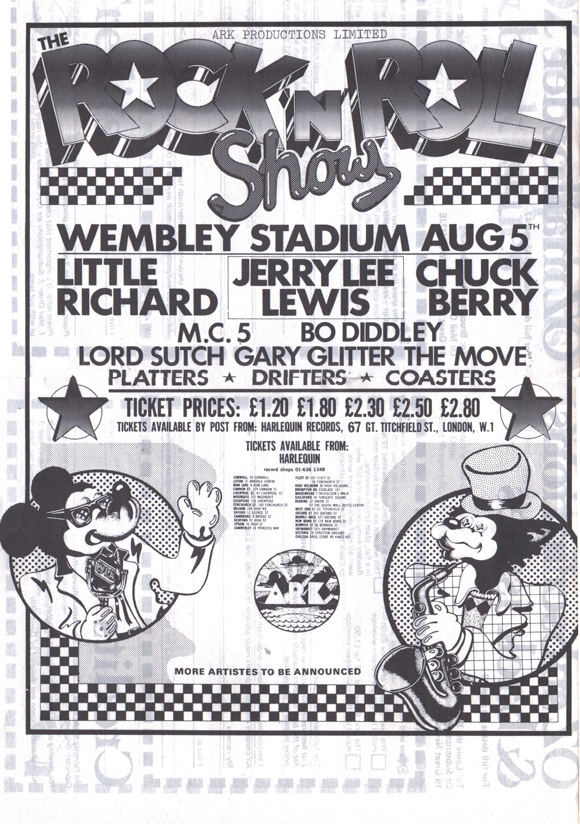
wembleyrnr-flyer
//Flyer for The Rock n Roll Show printed on the back of a subscription form for Oz magazine, July 1972. The Move were replaced by lead member Roy Wood’s new band Wizzard; this was their first gig. Original Brit-rocker Heinz was added to the bill; his backing band would soon become Dr Feelgood//

I acquired my first underground press publications in the summer of 1972, at about the point when the sector was taking the nosedive from which it never recovered.

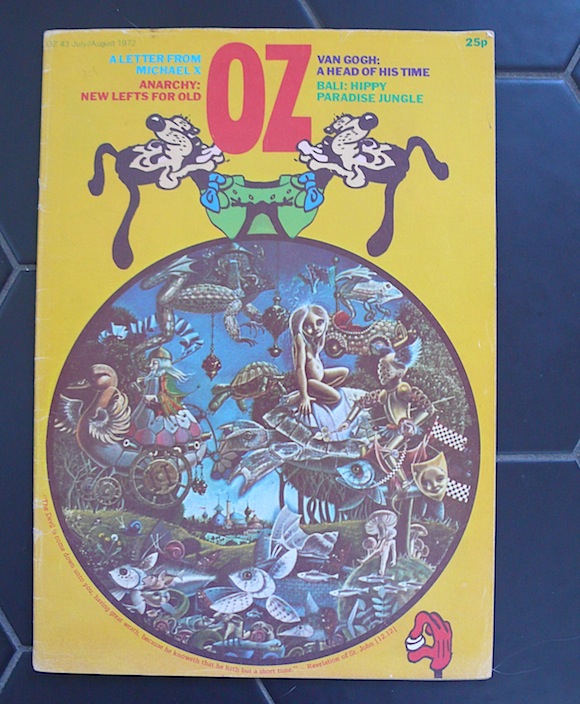
Still, better late than Sharon Tate, as they say. Aged 12, my taste had been whetted by sneak peeks at an older brother’s collection of magazines when a guy called Kevin O’Keefe who lived down the road gave me a few copies of Oz, including number 43, the July issue.

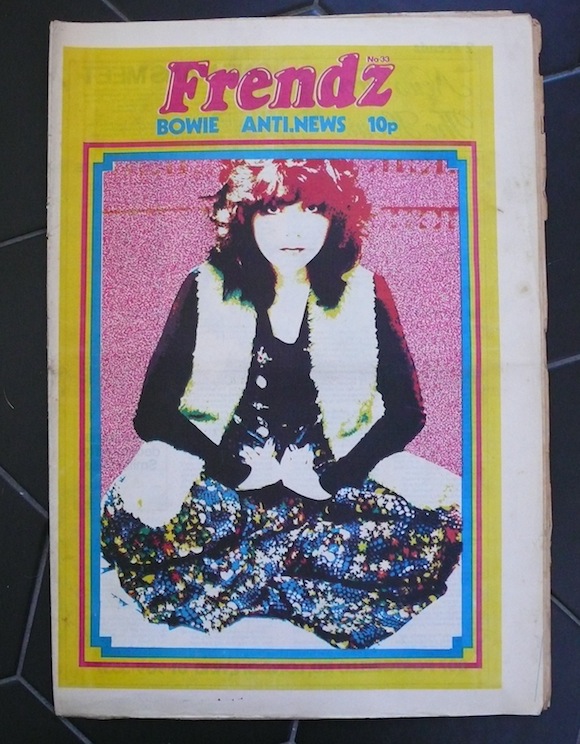
A few weeks later, to my astonishment, the newsagents in Hendon’s Church Road started stocking Frendz. I folded issue 33 between a couple of music papers and pored over it in my bedroom.

P1150578
//Front cover of OZ 43, the issue which included the Wembley flyer//
P1150560
//Front cover, Frendz 33, September 1972//
LetItRock-standWembley72
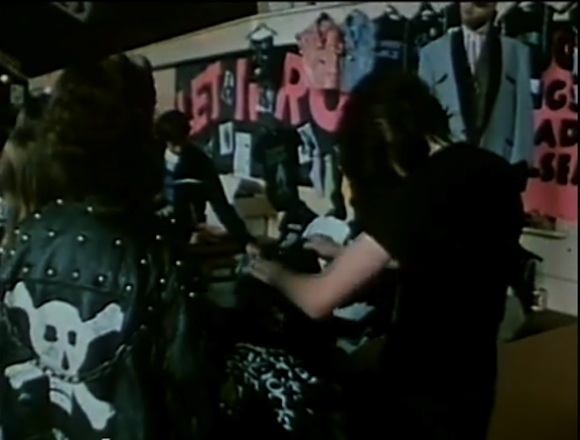
//Crowds around the Let It Rock stand. From the 1973 film London Rock N Roll Show directed by Peter Clifton//

Neither of the magazines are shining examples of the genre, but they had something in common: the centre spread of OZ 43 contained a subscription form back-printed with a flyer for the London Rock N Roll Show, a one-day festival of original 50s acts and those who could claim kinship held at Wembley Stadium on August 5 that year.

And for me the most beguiling article in Frendz 33 was a two-page stream-of-consciousness report of the event filed by one Douglas Gordon and illustrated with photographs by Pennie Smith, soon to leave for the NME and carve out her reputation as one of rock photography’s all-time greats.

Continue reading The London Rock n Roll Show at Wembley Stadium 1972: Memories of Oz, Frendz and the Let It Rock stall

All about Eve this spring: Ferret Up The Arts, Don’t Be So Shellfish and her first-ever album release

eve2
//At The Wallace Collection last month//

Lovely to see the gorgeous Eve Ferret out and about this spring with a series of live dates to celebrate the long-overdue release of her first album.

I fell under Eve’s spell in the summer of 1978, witnessing performances at Covent Garden’s pre-New Romantic Blitz club with her-then partner James “Biddie” Biddlecombe. More recently we connected via the late Tommy Roberts, at whose memorial she sang a version of Rawhide which rocked ’em in the aisles and nearly blew the roof off St Giles in the Fields.

Continue reading All about Eve this spring: Ferret Up The Arts, Don’t Be So Shellfish and her first-ever album release

‘I work in the belief – or dare – that I remain a perennial beginner’ Rose Finn-Kelcey: 1945-2014

Neg6.tif
//Divided Self, 1974. Black and white silver gelatine print. 46.6 x 70cm//
Sad_and_Lonely1
//Sad And Lonely, 2006. Wood, paint, aluminium, fairground lights. 7.4 x 3.7 x 1.5m//

“I work in the belief – or dare – that I can continue to reinvent myself and remain a perennial beginner.”

Sad to note the death of the British artist Rose Finn-Kelcey.

Read Guy Brett’s obituary for this “wonderful artist and great person” here.

Ridinghouse’s recently published monograph Rose Finn-Kelcey – which contains essays by Brett, Sarah Kent and Michael Stanley – is available here.

Visit the artist’s website here.


Lunch with Messrs Hell + Riviera

photo 3-2
//Richard Hell + Jake Riviera, outside the Chelsea Arts Club, London, Feb 2014//

I’ve had few, if any, lunches as enjoyable as last week’s hook-up with Richard Hell and Jake Riviera for a piece I am writing for GQ magazine.

Richard and Jake first met outside CBGB in March 1976, having been introduced by photographer Roberta Bayley, who was working the club door that night.

With Dr Feelgood’s Lee Brilleaux, Jake had witnessed Richard in performance the night before with Johnny Thunders in the first – and soon to disintegrate – line-up of the Heartbreakers at Max’s Kansas City.

We dined less than half a mile away from Chelsea embankment, where Richard and the rest of his next band the Void-Oids spent a pretty miserable-sounding sojourn on a leaky boat when in the UK on tour with The Clash in 1978.

As Richard recounts in his fabulous memoir I Dreamed I Was A Very Clean Tramp, he and Jake have shared a series of adventures over the years, some of which I will be covering in my GQ feature which should be out in the summer.

I Dreamed I Was A Very Clean Tramp is out in paperback this week; buy here.

Derek Boshier: Rethink/Re-Entry – assembling the materials for long overdue monograph

3c0379fe8e4811e398be0a56c26576e4_8
//Exhibition cards and private view invitations, 1973 to date//

I’m assembling materials for Rethink/Re-Entry, the long-overdue monograph of the great British artist Derek Boshier I am currently editing.

The book takes its title from the early Boshier painting which inspired rock’s ultimate art-directed star Bryan Ferry to choose the name Remake/Remodel for the first track on Roxy Music’s game-changing debut LP.

rethink
//Rethink/Re-entry, oil on canvas, 1962//

Continue reading Derek Boshier: Rethink/Re-Entry – assembling the materials for long overdue monograph

When Jesus danced with the Sex Pistols

jesusnash
//From Vacant by Nils Stevenson, photo: Ray Stevenson//

If you are of a London gig-goer of a certain (getting on to be advanced) age you will remember “Jesus”, an enthusiastic audience member at many musical events in the capital from the 60s to the late 70s.

jesus1
//Detail: Hynde, Rotten, Matlock and Jesus. Photo: Ray Stevenson//

Jesus was notable because a) he was personable and b) would often discard his clothes as he energetically idiot-danced stage-front. Jesus liked to frolic with abandon, more often than not exposing much, or even all of his rail-thin body.

Continue reading When Jesus danced with the Sex Pistols

Photography: David Parkinson shoots Acme Attractions

Gorman_01.tif
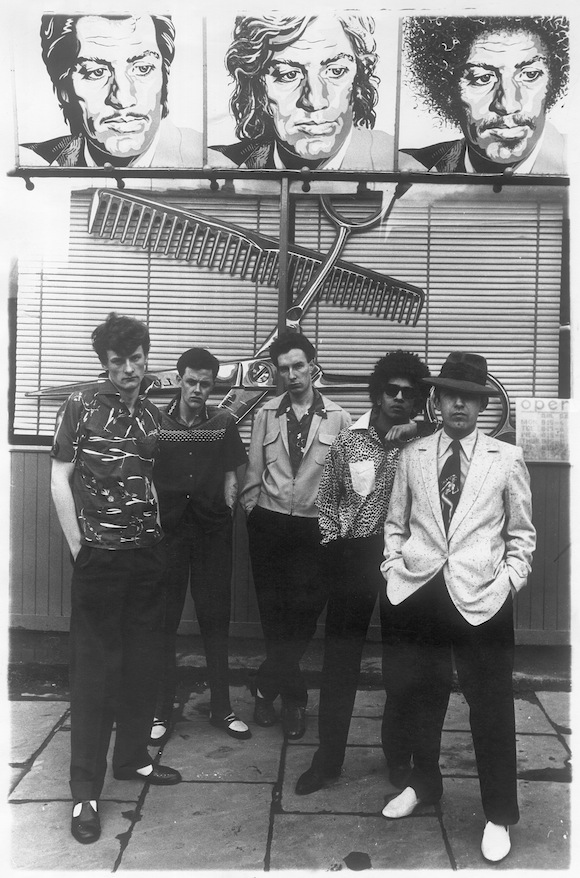
//Original print of photo for Club International, 1975. Models include, from far right, Stephan Raynor, Don Letts and Martin Brading. Photo: David Parkinson//

I’ve been enjoying researching materials relating to the late photographer David Parkinson for a feature for GQ magazine, so thought I’d share some of the images I dug out of the Parkinson archive concerning the 70s King’s Road retro clothing store Acme Attractions.

Parkinson’s position as fashion editor of Paul Raymond’s sophisticated soft-porn magazine Club International enabled him to style and present Acme clothing for a wide readership, on occasion using the shop team as models.

Acme was opened by Parkinson’s friend Stephan Raynor (they’d known each other since they were part of a gang of style-obsessed teenagers in Leicester in the early 60s) with John Krivine, previously a Brixton-based jukebox dealer, in 1974.

DP-AcmeBarnersShopQuintetPGscan
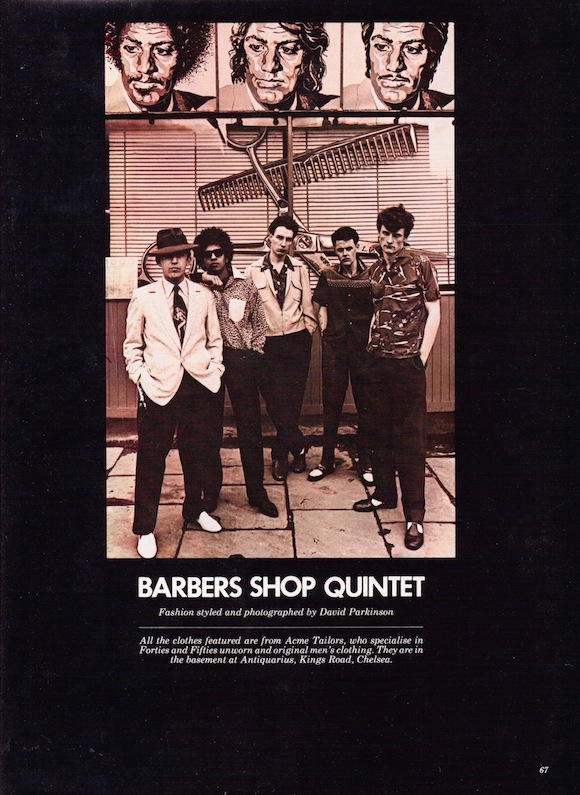
//As the Parkinson photograph appeared in the magazine, flipped and tinted. Note ref to “Acme Tailors”//
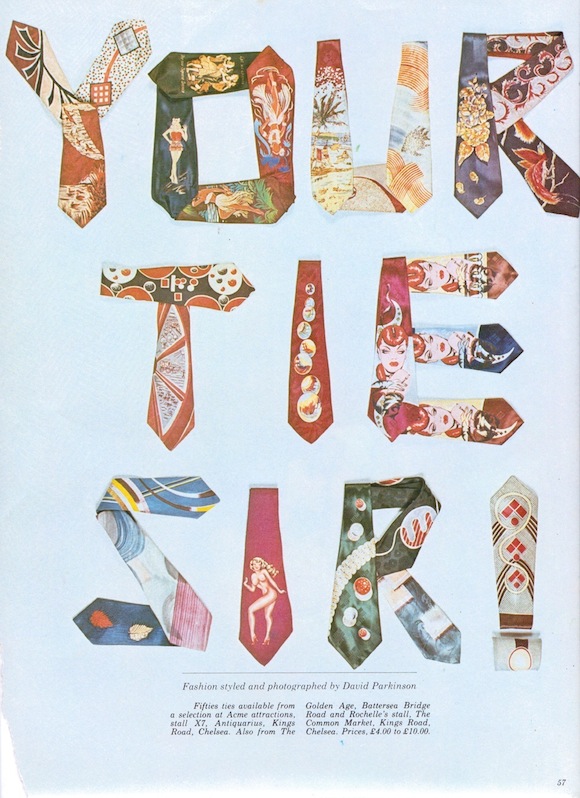
DP-YourTieSirPGscan
//Parkinson used ties from his collection – including some sourced from Acme – for this March 1975 Club International feature//

Continue reading Photography: David Parkinson shoots Acme Attractions

SEX Cowboys return to Situationist roots in new T-shirt inspired by one of my posts

SONY DSC
//Drift: New t-shirt from Japanese streetwear company Peel + Lift//

My 2011 post unraveling the threads running through the notorious Naked Cowboys punk t-shirt has itself inspired a new shirt.

The Cowboys t-shirt was designed by Malcolm McLaren in 1975 for sale in SEX, the shop he ran with Vivienne Westwood at 430 King’s Road in London’s World’s End.

Popular with punks and worn by members of the Sex Pistols and their coterie, it was initially known as the Saturday Night Dance shirt because of the presence of the dancehall sign in the appropriated homoerotic cowboy illustration by Jim French.

cowboys-auction
//Cowboys t-shirt sold at auction in London last year//

The new t-shirt has been produced by Japanese streetwear company Peel + Lift, which reproduces many McLaren and Westwood designs. It is entitled Drift, making overt the presence of 60s radical thinking in McLaren’s artwork: the drift, or the dérive, was a major theme of the Situationist International, which believed individuals should allow themselves to wander urban landscapes and become either repelled or enchanted by what they found (in the manner of the archetypal French urban explorer the flâneur).

Le Retour de la Colonne Durutti
//Panel, p3, Le Retour de la Colonne Durutti, 1966//

Continue reading SEX Cowboys return to Situationist roots in new T-shirt inspired by one of my posts

Recommended: Where The Bodies Are Buried – Mick Brown on Kenneth Anger in Esquire

kenneth-anger-promo-43
//Photo: esquire.co.uk//

Do yourself a favour and read Mick Brown’s interview with Kenneth Anger on the Esquire website.

We were fortunate to sit with Mick during part of his preparation for the piece, attendance to the screenings of contemporary work and  a q&a with the magus during last summer’s brief Anger season at the ICA. As Brown’s article confirms, Anger’s powers appear undimmed by age; his presence that night was enhanced by a beautiful suit by Agnès Troublé (Agnes B); the pair’s friendship goes back to 1959.

There are few exponents of popular journalism to rival Brown for economy, precision and wit in delivery. Read this fine example of a writer at the top of his game here.