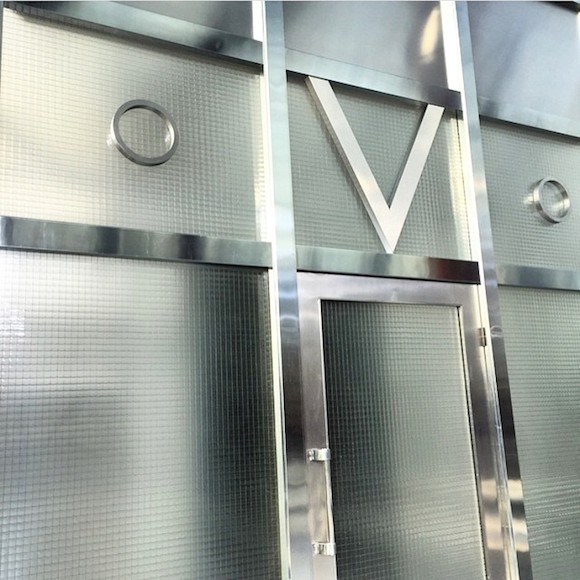
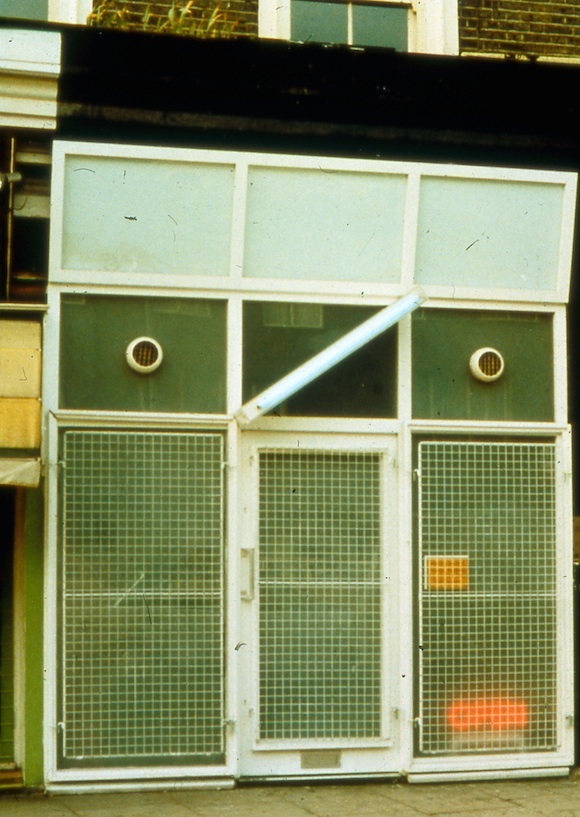
//The simulation of the Seditionaries facade in industrial materials provided the entry and exit point for models on the runway today////With rings representing the positions where designer Ben Kelly exposed air conditioning vents to view, Kim Jones replaced the diagonal bar which occupied the central square over the door with the trademark Vuitton ‘V’////Ben Kelly’s portfolio shot of the facade he designed and installed at 430 King’s Road in December 1976//
Amid the references to the late Christopher Nemeth in today’s Paris show of the Louis Vuitton A/W 15 menswear collection (see my last post), artistic director Kim Jones used the staging to pay subtle homage to the two great maverick figures of London street culture – namely Malcolm McLaren and Vivienne Westwood and specifically their 70s punk store Seditionaries.
//Malcolm McLaren in a previously unpublished shot wearing original 50s George Cox Bingley D-ring brothel creepers to match his detail-perfect Teddy Boy garb. Photo taken inside Let It Rock, 430 King’s Road, January 1972. (c) David Parkinson//
//Left, Saint Laurent point-toed patent brothel creepers, A/W 2014. Right: George Cox Buckle Diano made to the 1950s last//
Last season’s foregrounding by Saint Laurent of the pointed brothel creeper is just one of a run of examples of fashion brands plugging into the purity of this quintessentially British rock & roll style minted in 1949 by the UK independent footwear company George Cox.
Among the first stylistic innovators to take the design out of Teddy Boy revivalism and apply it to contemporary fashion was Malcolm McLaren, who had been selling creepers for a couple of years at Let It Rock, the boutique he operated with Vivienne Westwood, by the time he visited the Cox factory in Northampton in November 1973. Here he ordered samples for six styles, some of which went into production for sale at 430 King’s Road.
//Portfolio shot of the newly completed Seditionaries, 430 King’s Road, London SW10, December 1976. (c) Ben Kelly//
Interior Design: Dead Or Alive is the title of the symposium being organised by the prominent British designer Ben Kelly at London’s Institute Of Contemporary Arts on March 14.
I am a contributing speaker alongside writer/curator Michael Bracewell, designers Fred Deakin, Ed Barber & Jay Osgerby and Peter Saville, artists Lucy McKenzie and Bridget Smith and David Toop of the London College Of Communications and Tate Britain’s Andrew Wilson.
“We’re going to be taking stock of the ways in which iconic interiors affect and influence the direction of popular culture and the wider world,” says Kelly, who is putting the event together in his capacity as professor of interior design and spatial studies at the University of the Arts London.
//Portfolio shot of the freshly installed Seditionaries name plaque, December 1976. (c) Ben Kelly//
Among Kelly’s designs was the November 1976 transformation of Malcolm McLaren and Vivienne Westwood’s shop Sex at 430 King’s Road into Seditionaries. Knowing that I have researched and produced a substantial document on the history of 430 King’s Road, Kelly has asked me to address this little space with a big impact in terms of its importance as a cultural hub and incubator of often radical ideas.
//Malcolm McLaren, 1973. Photo: David Parkinson. Bryan Ferry, 1976. Photo Richard Wallis//
A couple of years back I showed examples of photography by the late David Parkinson to car-nut graphic design maestro Jules Balme; I knew he would be interested in the incorporation of a 1959 Cadillac Eldorado in a 1973 Let It Rock fashion shoot.
What drew Balme’s eagle eye was not the car fin detail, but the fact that Malcolm McLaren in the shot below sported a tie of the same distinctive Atomic-style 50s pattern as worn by Bryan Ferry in the video clip for his 1976 solo hit Let’s Stick Together (and subsequently on the sleeve of the compilation of the same name rushed out to capitalise on the single’s success that year).
//McLaren and models in Let It Rock attire – right are examples of the so-called “Alan Ladd” and “Jazz” suits – photographed in Acre Lane, Brixton for Club International by David Parkinson, summer 1973//
“More than anyone, Malcolm McLaren bursts the definitions as to what exactly constitutes an artist.”
Yves Aupetitallot, curator at Magasin, the Centre National d’Art Contemporain, in the introduction to Art In Pop
Due to popular demand, the run of Art In Pop – the French exhibition about the intermingling of artistic practice with popular music where the main space is dedicated to the work of Malcolm McLaren – has been extended by a month.
//Watched by the crowd, writers/poets/frontmen Robert Calvert and Michael Moorcock (left), drummer Simon King and bassist Lemmy prepare for lift off, August 25, 1973. Photo: Dave Walkling////Detail of pic above showing Bubbles’ drumheads and speaker designs//
Following my post of photos from the free music festival at Windsor Great Park to the west of London in 1973, attendee Dave Walkling has sent a couple of sharp images which capture the anticipation in the crowd just before Hawkwind’s set.
//Drumhead painted by Barney Bubbles in 1972. Photo: (c)////From left: Nik Turner, Stacia Blake, Simon King and Lemmy during Hawkwind’s set at the Windsor Free Festival on August 25, 1973. Note the drumhead on the left. Photographer: Unknown//
A rare design by the late graphics master Barney Bubbles has come to light after four decades; the psychedelic sci-fi drumhead was painted for Hawkwind when the space rocking Sonic Assassins undertook tours around the world following their success with the Silver Machine single in 1972.
//Photo: Alun Anderson////Stacia Blake relaxes amind Hawkwind’s equipment. Photo: Alun Anderson//
“When these photographs were taken, everything about them was everyday and unexceptional. These were the clothes we wore, the Hawkwind festivals that filled our summers, the drugs we took, the love we had, the way we moved. Only looked at from a distance does something extraordinary seem to emerge. Whether it is possible to live in the present with this view of what is around you, I don’t know.”
Alun Anderson, 2015
//Westside Sharpies Mick Emery and Steve M sporting Connies outside Flinders Street Station, Melbourne, 1978. Photo: Jacques Kosky, courtesy Stef Egan//
The ‘Connie’ cardigan was an essential element of dress for Sharpies, the tough and stylish Australian music/fashion youth subculture active in Melbourne’s blue collar suburbs from the 60s to the early 80s.
Designed by a Mr Conti, a Greek clothier in the Thornbury neighbourhood to the north of the city, Connies were picked up on by Sharpies for their tight fit.
I first met artist/curator Robert Gordon McHarg III two decades ago, when he was developing a sadly unrealised television project based around the annual Christmas extravaganza conducted by our mutual friend, Robert Lopez, aka El Vez The Mexican Elvis.