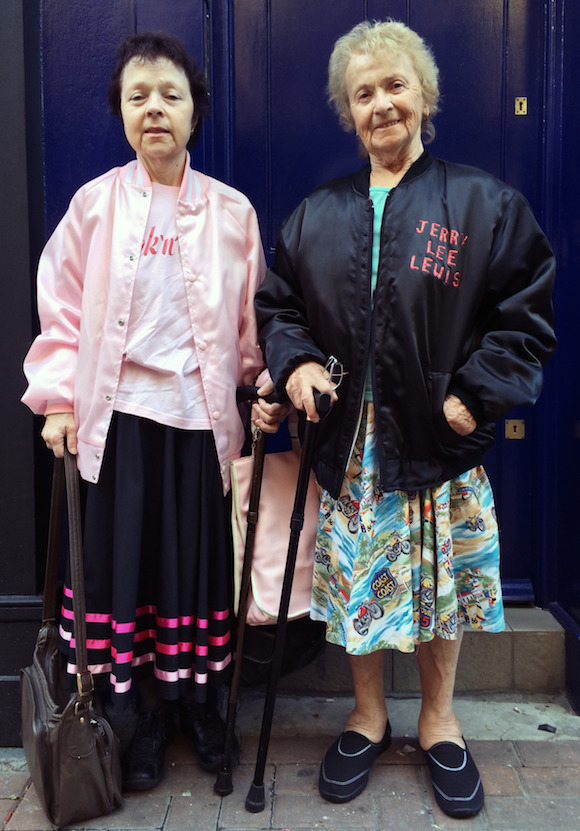
I’m indebted to New York pal Tim Broun for sending me the link to this photo by Jim Herrington of two 83-year-old Jerry Lee Lewis fans who travelled to London from Surrey on Sunday to witness the Killer’s performance at the Palladium.
I’m indebted to New York pal Tim Broun for sending me the link to this photo by Jim Herrington of two 83-year-old Jerry Lee Lewis fans who travelled to London from Surrey on Sunday to witness the Killer’s performance at the Palladium.

At all times, my acts and my actions in life have stemmed from love or eroticism, as you like it.
Pierre Molinier, The Shaman And Its Creatures
Pierre Molinier, “the man and the painter, the genius and the pervert, the ‘lesbienne’ and the guns lover” is not an easy figure to pin down.

Eyes For Blowing Up Bridges* is the title of the forthcoming exhibition about the creative interplay between a group of remarkable radical artists, poets, writers and activists who initiated, perpetrated and influenced a range of post-war alternatives.

From the SS16 menswear collections to the people flocking to Somerset House’s current celebration of The Jam, the aesthetic of “clean living under difficult circumstances” (as summarised by The Who’s first manager, Pete Meaden) is at one with what’s happening now in fashion…
Read the rest of my piece – with quotes from Dylan Jones of GQ/London Collections: Men, Soho tailor Mark Powell and Man About Town’s Ben Reardon – on the enduring appeal of Mod here.

Let It Rock was digging in the ruins of past cultures that you cared about. It was giving them another brief moment in the sun. It wasn’t about doing anything new. It was an homage. It was nostalgia.
Malcolm McLaren to Momus, 2002
Forty three years after its creation I can reveal the source of the Jerry Lee Lewis image which appeared on the Let It Rock t-shirt design “The ‘Killer’ Rocks On!”.
It is from a lobby card for Alan Freed’s 1958 rocksploitation flick High Street Confidential!; an original was just one of the pieces of 50s ephemera adorning Let It Rock’s premises at 430 King’s Road in 1972.
Continue reading Found! The source of the Jerry Lee image in Let It Rock’s Killer Rocks On t-shirt

Singer-songwriter Carlene Carter has posted a touching memoir of her mother, the country giant June Carter Cash who would have been 86 this week, at online music ‘zine Innocent Words.


A few years ago I attempted a dissection of the intriguing elements of the culture-shock t-shirt You’re Gonna Wake Up One Morning And Know What Side Of The Bed You’ve Been Lying On!, produced by Bernie Rhodes, Malcolm McLaren and Gerry Goldstein for sale in Sex at 430 King’s Road in the autumn of 1974.
In You’re Gonna Wake Up, the declamatory tone, aggressive punctuation, satirical bite and use of basic typographical emphases such as the repeated forward slash and random capitalised text combined to detonate a densely packed cultural device.

For its 75th anniversary issue, US visual culture publication Print has selected Barney Bubbles as one of six “unsung heroes of design”.

“Bad thing for a young man to lose his father” Charles Cheeryble, Nicholas Nickleby
My father died 35 years ago today.
I was 20 at the time, and witnessed him take his final breath. The narrow world of music and clothes I inhabited was preoccupied with Ian Curtis’s recent suicide; given the fact that my father had been diagnosed with cancer four years previously and spent the last 18 months on earth hospitalised and fighting like a bastard for his life, I couldn’t see what the fuss was about. PiL’s Death Disco was much more my speed.
Continue reading The Old Man: Philip “Staff” Gorman (April 25, 1903 – June 8, 1980)
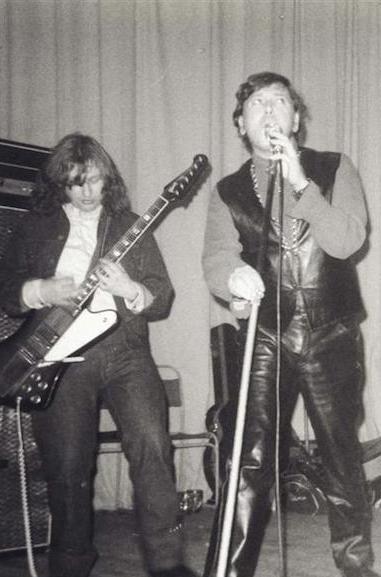
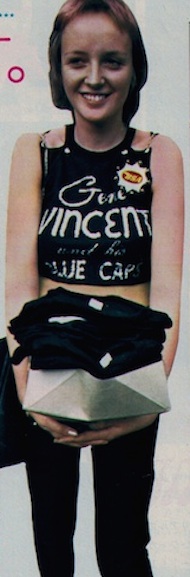
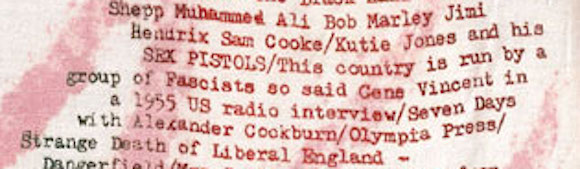
//Clockwise from top left: Gene Vincent with one of The Houseshakers, Magnet Club, Chelmsford, UK, February 1971. Photo: http://gene.vincent.fanclub.voila.net; Let It Rock assistant in Gene Vincent and the Blue Caps top, Wembley Stadium, August 5, 1972. Photo: Masayoshi Sukita; Vincent’s quote as featured on the Sex t-shirt You’re Gonna Wake Up, 1974//
‘Gene Vincent for me was the embodiment of rock’n’roll’
Malcolm McLaren 1997
On September 22 1971, Gene Vincent was a mid-week booking to play a “rock revival” night at central London club The Marquee.
Times were tough; at just 36, the soft-spoken American rocker was apparently way past his heyday and beset by severe health problems brought on by the combination of alcoholism and addiction to prescription drugs taken to dull the constant pain in his left leg. This was the result of a crippling motorbike accident in his youth and the lingering effects of having been in the 1960 car-crash which killed Eddie Cochran.