Tomorrow I’m a guest of historian Amber Butchart at London’s National Film Theatre for a conversation and q&a about Punk fashion with her special invitee Jordan Mooney, SEX and Seditionaries superstar and inner member of the Sex Pistols circle.
I’ve put together a presentation from my archive to run during our chat, including images of Jordan’s striking series of visual personae and slides showing how the designs by Malcolm McLaren and Vivienne Westwood at 430 King’s Road were regularly featured in the fashion and national press from the early 70s to the time of Punk later in the decade.
//Selection of Let It Rock designs showcased in a May 1972 issue of The Sunday Times Magazine. Photos: Hans Feurer. Paul Gorman Archive//
//Portfolio shot of the newly completed Seditionaries, 430 King’s Road, London SW10, December 1976. (c) Ben Kelly//
Interior Design: Dead Or Alive is the title of the symposium being organised by the prominent British designer Ben Kelly at London’s Institute Of Contemporary Arts on March 14.
I am a contributing speaker alongside writer/curator Michael Bracewell, designers Fred Deakin, Ed Barber & Jay Osgerby and Peter Saville, artists Lucy McKenzie and Bridget Smith and David Toop of the London College Of Communications and Tate Britain’s Andrew Wilson.
“We’re going to be taking stock of the ways in which iconic interiors affect and influence the direction of popular culture and the wider world,” says Kelly, who is putting the event together in his capacity as professor of interior design and spatial studies at the University of the Arts London.
//Portfolio shot of the freshly installed Seditionaries name plaque, December 1976. (c) Ben Kelly//
Among Kelly’s designs was the November 1976 transformation of Malcolm McLaren and Vivienne Westwood’s shop Sex at 430 King’s Road into Seditionaries. Knowing that I have researched and produced a substantial document on the history of 430 King’s Road, Kelly has asked me to address this little space with a big impact in terms of its importance as a cultural hub and incubator of often radical ideas.
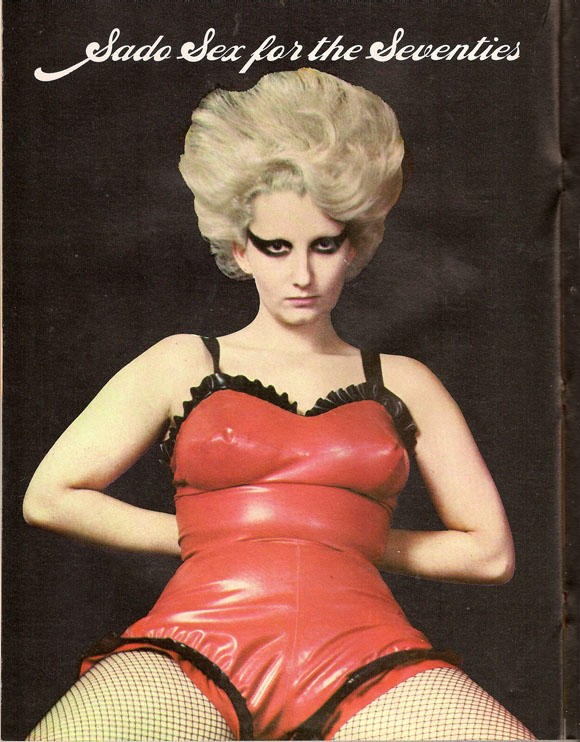
//Sex assistant Jordan, Gallery International, Vol 1, no 4.//
It’s unlikely that cities will shake or nations start to rock under the impact of Malcolm McLaren’s sexual revolution. A few people might die though.
Malcolm McLaren, at 30, is a mixture of entrepreneurial cultist, sexual evangelist, businessman, artist, fetishist and political philosopher; a psychotic visionary in the ephemeral subculture of the fashion world.
David May, Gallery International Vol 1 no 4.
In November 1975 – by which time his charges the Sex Pistols had just embarked on live performances – Malcolm McLaren was interviewed by journalist David May at 430 King’s Road, then in full bloom as radical retail venture SEX.
I am beguiled by this photograph, which is entitled Pierre’s Breakfast and was taken by Willie Christie at David Hockney’s house in Notting Hill on May 18, 1974.
The identities of the two individuals on the left are a mystery*; with Clark (in the white jumpsuit) are make-up artist Pierre Laroche, Marianne Faithfull and Michael Roberts (then writer/photographer at The Sunday Times, now Vanity Fair’s fashion/style director). Behind the group are a selection of artist Mo McDermott’s signature painted wooden tree sculptures.
Laroche, who had worked at Elizabeth Arden for five years before taking up with rock & roll when he was recruited by Brian Duffy for the cover of David Bowie’s 1973 album Aladdin Sane, engaged Willie Christie for the May 74 session for a potential magazine feature.