// In George Cox creepers: Malcolm McLaren, 430 King’s Road, January 1972. Photo: David Parkinson / Slowthai, Northampton, 2018. Photo: Ewen Spencer for Arena Homme + //
“Those blue suede shoes had a magical association that seemed authentic. They represented an age of desperate romantic revolt to change your life.”
Malcolm McLaren, notes on his life in fashion, 1997
I’m celebrating the 70th anniversary of the introduction of George Cox & Co’s first creeper at the Port Eliot Festival next week with Adam Waterfield, the fourth generation owner of the great independent British brand, and his son Alistair, a Central Saint Martins student and model who is very much involved in the family business.
//ECC’s sign on the facade of the Time Out offices at 374 Gray’s Inn Road, King’s Cross, London, autumn 1970. Photos courtesy Electric Colour Company/Andrew Greaves//
Recent encounters with Time Out founder Tony Elliott have brought to mind the audacious sign created by design collective Electric Colour Company to mark the magazine’s move into premises at 374 Gray’s Inn Road.
/Left: Andrew Greaves of Electric Colour Company in the back of Paradise Garage, May 1971. Right: Vivienne Westwood in the back of Let It Rock, January 1972. Photos: David Parkinson//
Preparation for my paper at Ben Kelly’s interior design symposium Dead Or Alive has coincided with the refurbishment of the Worlds End shop at 430 King’s Road in Chelsea.
The address is the subject of my talk; I’ll be detailing the history of 430 and how and why it was an important social and cultural locus over a number of decades.
//Back wall of 430 King’s Road on the opening of Mr Freedom, September 1969. Interior: Electric Colour Company. Photo: David Parkinson//
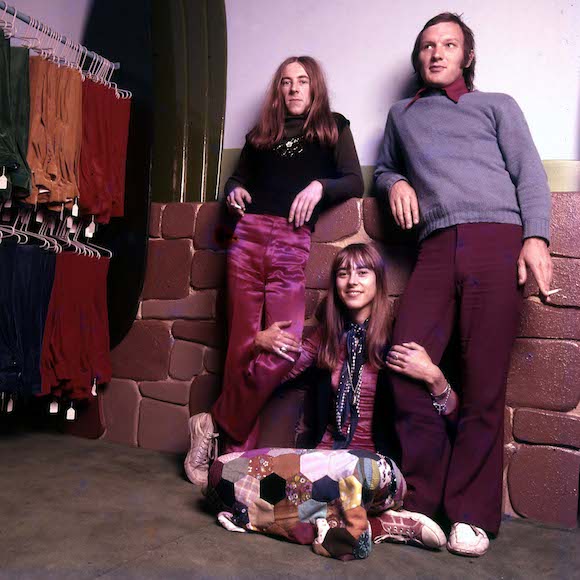
//Electric Colour Company’s Roderic Stokes and David Smith with Carol Davey at Blueberry Hill, 91 King’s Road, London, 1970//
Here are a couple of images relating to late 60s/early 70s British design studio Electric Colour Company; I’m writing a magazine feature about their exceptional body of work which ran from signage, custom-built furniture and shop designs (notably Mr Freedom, Paradise Garage and City Lights Studio) to lighting modules, display objects, interior decoration, murals, custom cars and fashion accessories.
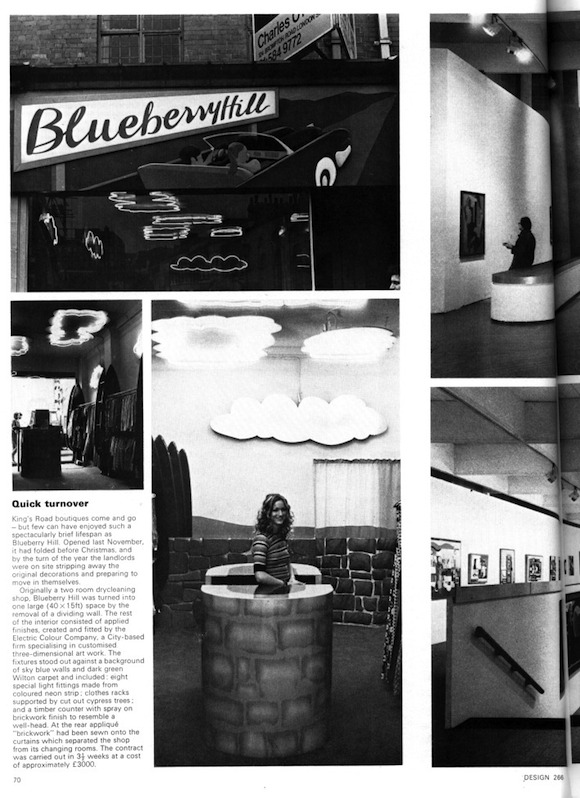
In November 1970 the King’s Road boutique Blueberry Hill was launched with a comprehensive fit-out – reported at a substantial-for-those-days £3,000 – by the ECC team of Andrew Greaves, Jeffrey Pine, David Smith and Roderic Stokes.
//By the time this coverage appeared in the February 1971 issue of Design magazine, Blueberry Hill had been closed for several weeks//
Despite the extraordinary nature of the shop design – which included cloud-form light fittings in neon strip and a timber counter with spray-on brickwork finish resembling a well-head – Blueberry Hill closed after just six weeks when the landlords opted to replace it with a more bankable betting shop.
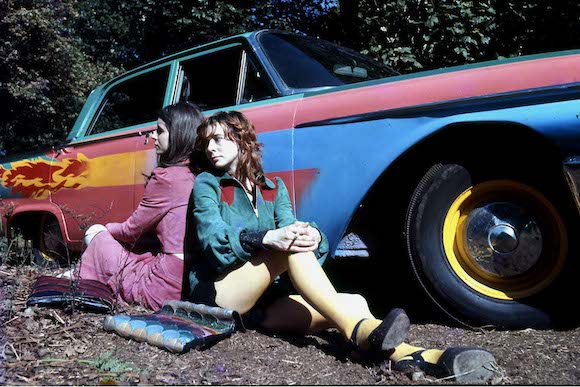
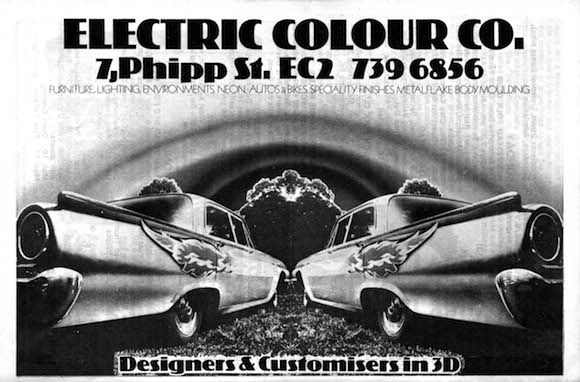
//Irene Smith and Dinah Adams with the ECC-customised Ford Fairlane 500, 1970////Advert, Time Out, 1970//
The other photograph shows ECC fellow travellers Dinah Adams – who designed clothes for Mr Freedom, Paradise Garage and Granny Takes A Trip – and Irene Smith with the customised Ford Fairlane which also appeared in the East End company’s advertising.
I’ll give the nod when my piece on Electric Colour Company is nearing publication.
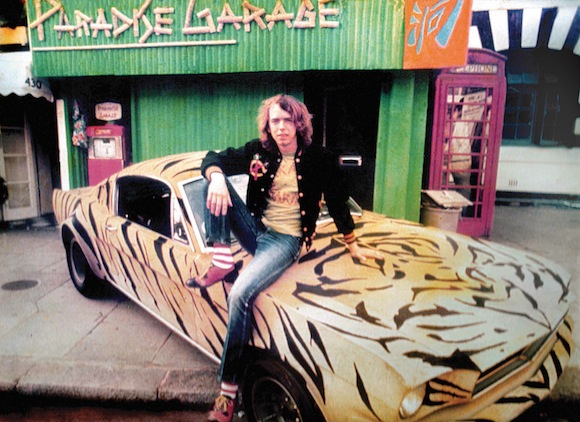
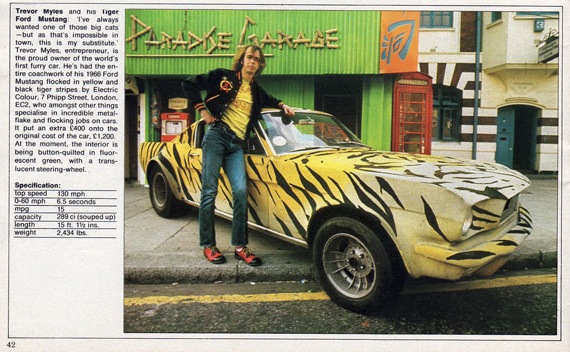
//Trevor Myles, Mustang and 430 King's Road, late summer 1971. Photo: Michael Roberts////From Michael Roberts' article Men & Their Machines, Club, October 1971//
Trevor Myles’ decision to incorporate a flocked and tiger-striped 1966 Ford Mustang as part of his retail space Paradise Garage naturally attracted a lot of attention during the brief existence of this unusual fashion outlet at 430 King’s Road in Chelsea’s World’s End in 1971.
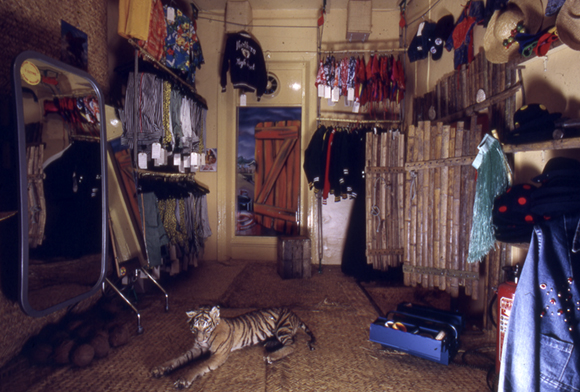
//Interior, 430 King's Road, Chelsea, May 1971. Note coconut matting, shack-style dressing room doors, trompe de l'oeil gate painted on stockroom door... and fake tiger. Photography: David Parkinson.//
I first wrote about Electric Colour Company – the design studio formed in the East End by four fine art students in the late 60s – in The Look and then in more detail here.
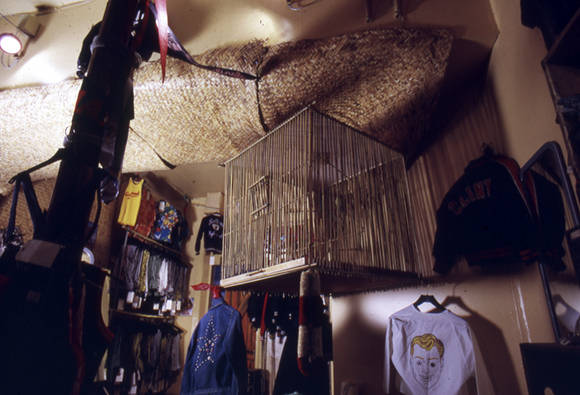
//Amid the singlets, printed sweatshirts and appliqued denim, a bamboo cage housed birds of paradise, suspended from the matting covered ceiling.//
In my view, ECC deserves much greater recognition for executing some very clever work in the field of retail design and interiors in the period 1969-1973.