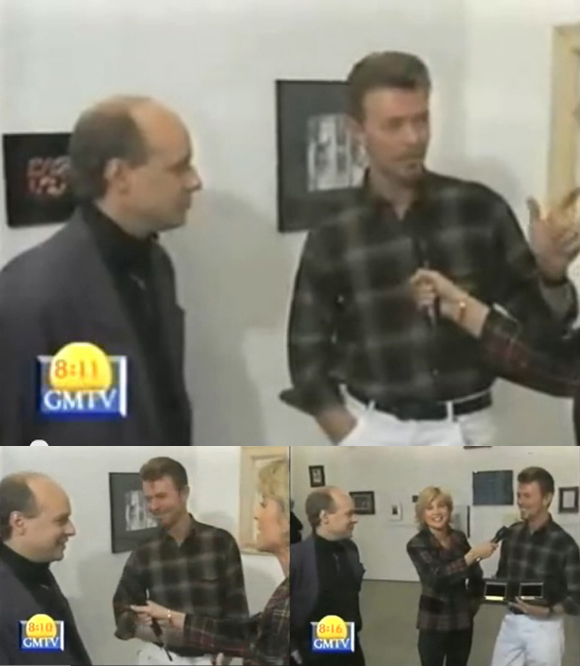
//Brian Eno + David Bowie interviewed by Anthea Turner for British breakfast TV at Flowers, east London, October 1994. This was to publicise the charity art show/auction Little Pieces From Big Stars. By this time the pair were collaborating again, on 1. Outside. For reasons now lost to me, I drove Brian to the gallery early that morning.//
I interviewed David Bowie a couple of the times in the 90s, having met him via fund-raising idea contributions I made to the music industry’s favoured charity, War Child. In the preceding months he had been an enthusiastic contributor to the art events Little Pieces From Big Stars (1994) and Pagan Fun Wear (1995).
This interview took place in the summer of 1995 when Bowie was promoting 1.Outside, notable in that it marked a return to collaboration with Brian Eno (who I also interviewed at the time for his work on that as well as another collaboration, with Jah Wobble on the ambient project Spinner).
Bowie had emerged from the maligned Glass Spider/Tin Machine period a couple of years earlier with more creditable, if not particularly memorable efforts, including The Buddha Of Suburbia soundtrack. He was also actively ploughing a furrow into the visual arts and already mutating as a musician and performer, soon to become a familiar presence on the international festival circuit and engaging in sorties into jungle manifested in the follow-up album Earthling (for which I also interviewed him).
Ideas crackled off Bowie throughout the conversation; Eno once told me that working with him on a song in the studio was like watching a fast-motion film of a flower blossom.
In our chat, Bowie even flew a kite about producing an album based around a fictional character Nathan Adler every year until 2000 culminating in a Robert Wilson-style epic theatrical production at the Brooklyn Academy Of Music. Of course these never came to fruition.
How did you come to hook up with Brian Eno again?
When Brian came to my wedding in 1992, I had instrumental pieces for what would eventually become a third of Black Tie White Noise – music that I composed to be played in the church and at the party afterwards. He explained he was working in a not dissimilar area and I was starting on The Buddha Of Suburbia, where I pretty much started to survey the territory I wanted to be involved in. After a series of conversations, working with Brian really came together in early March 1994. Continue reading Journalism: Interviewing David Bowie on working with Eno + engaging with visual arts, 1995
I interviewed the restaurateur and fine food champion Justin de Blank – who died last month aged 85 – for Reasons To Be Cheerful; de Blank recognised Barney Bubbles’ design talents when the pair met at the Conran Group’s design studio in the 60s.
//Justin de Blank, mid 70s. Courtesy Melanie de Blank.//
This just in from Joe Stevens, following yesterday’s post about his new website: the story behind the photo with Johnny Rotten above, taken in London in 1978.
We were at his Gunter Grove digs in Fulham. Malcolm (McLaren) had left his grotty leathers in my flat in NYC during the Sid and Nancy murder doings. I had them dry cleaned. Never got the $90 for that one.
He had Glitterbest problems in London. So did Rotten. I was over there to do pictures of Public Image Limited.
He made a nice curry. I crashed there with him and Nora (Forster). Ari (Up, Forster’s daughter) would pop by often.
We watched her and The Slits record Heard It Thru The Grapevine and Chrissie (Hynde) rehearsing with her new Pretenders.
Yeah, he’s holding up his trousers with a strand of white cord.
I was later a witness at the High Court trial involving the band versus Glitterbest.
I tried on Malcolm’s leather trousers. Fell in love. It was a first. Went to London in them. Never took them off. Returned two weeks later to NYC wearing them.
Had them cleaned again. This time they didn’t survive. All I got back was swatches of leather in a bag.
Here’s another gem from Herb Schmitz’s photographic goldmine: model Ika Hindley at west London restaurant Julie’s in an early 70s shoot for Dutch agency Kippa.
//Bernard Lansky with Elvis Presley in Lansky Bros, 126 Beale Street, Memphis, 1956.//
I interviewed Bernard Lansky, who has died aged 85, for my first book The Look: Adventures In Rock & Pop Fashion early one morning in March 2000 at his menswear store which was by then located in Memphis tourist attraction, the Peabody Hotel.
His son Hal had forewarned me: “You’d better get there early; once the customers start arriving at 8.00am he won’t have time for you.”
Just as their most celebrated client set fire to popular music as a means of cultural expression, so Lansky and his brother Guy (who was bought out in 1980) formed the template for street fashion by servicing a hitherto ignored subculture – namely the black stylers, hipsters, roustabouts and juke-jointers crowding the city’s segregated area around Beale Street in the post-War period.
Signed copies from a selection of my work are now available from this site – click on the button in the right-hand column or select SHOP from the menu at the top of the page.
At the moment you can buy:
• Mr Freedom – Tommy Roberts: British Design Hero
• Reasons To Be Cheerful: The Life & Work Of Barney Bubbles
• In Their Own Write: Adventures In The Music Press (now out of print)
• The Look Of London (the new map collaboration with Herb Lester Associates)
From time to time I’ll also be making available signed copies of other out of print work, including my book with Goldie, Nine Lives (£9 inc P+P), and the increasingly rare second edition of The Look Adventures In Rock & Pop Fashion (£45 inc P+P).
Inquire here about these titles and for purchases outside the UK.
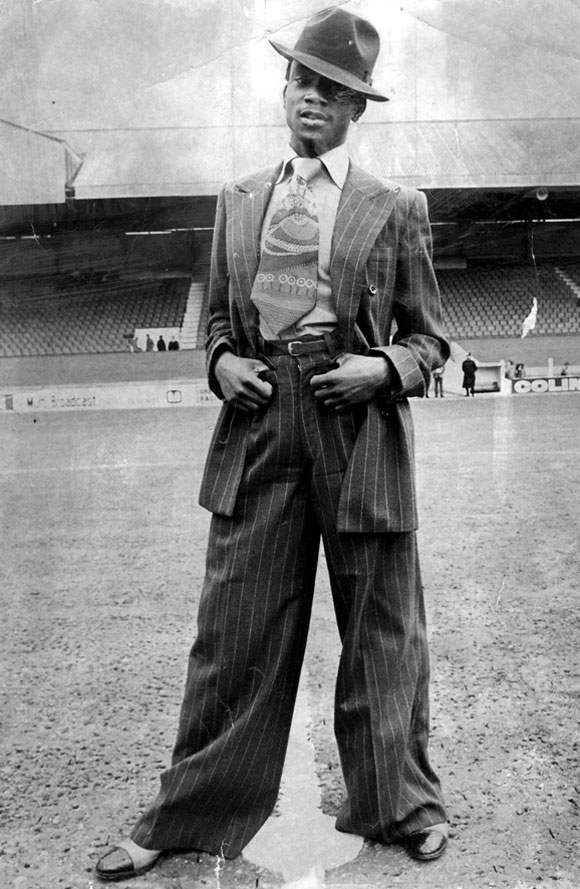
//Laurie Cunningham aged 17, at Brisbane Road, home to Leyton Orient FC, 1973.//
In 1989, footballer Laurie Cunningham’s life was cut short by a car crash on the outskirts of Madrid. He was 33 years old.
By that time Cunningham had notched up a series of sporting firsts which resonated through the wider culture: a teenage signing to east London team Leyton Orient, Cunningham was the first black player to represent England (in 1977 as an under-21, scoring a winning goal against Scotland) and the first Englishman to play for Spanish giants Real Madrid (in 1979).
//William Cowlishaw's memorial in Pozieres cemetry, final resting place of my uncle Desmond. From Silent Cities, RIBA, 1977.//
I have many times asked myself whether there can be more potent advocates of peace upon earth through the years to come than this multitude of silent witnesses to the desolation of war.
George V, 1922.
The result of being the youngest offspring of parents of more advanced years than the norm, I am an anomaly of my generation (as is Mrs G of her’s) in that I have close relations who died in the First World War.
My father’s brothers Charles and Desmond Gorman both perished on the Western Front in 1918, the former aged 17 a bit more than a week before the cessation of hostilities. Desmond was 19 when he was killed outside Jussey in March that year.
 Regulars on both sides of various Soho bars having been mourning the familiar figure the vast majority of us knew simply as Pam.