All my yesterdays: King’s Road pub The Roebuck and key Barney Bubbles designs recreated on our doorstep

//Outside my local “The Roebuck” in London SE1 yesterday//
//Barney Bubbles’ 1966 designs for Woodpecker and Strongbow ciders feature on the bus being used in filming//

This is freaky. Our local has been transformed into the King’s Road pub The Roebuck for the filming of Danny Boyle’s forthcoming FX series Pistol, based on guitarist Steve Jones’s memoir Lonely Boy.

The thing is I knew the Roebuck very well; it is in fact the place where I first met Malcolm McLaren, at the age of 15 in 1975. By happenstance I was drinking in the pub with an older brother the night McLaren recruited John Lydon  to the Sex Pistols.

//The Roebuck in the late 70s. Photo by Barry Beattie/ANL/Shutterstock (5823647a)//

At The Roebuck I came across such individuals as the gangster John Bindon and his well-born paramour Vicki Hodge and the male model David “Piggy” Worth. One night we spotted the infamous art dealer Robert “Groovy Bob” Fraser with some ne’er-do-wells. It was that sort of place.

//The Roebuck was a couple of minutes’ walk east of 430 King’s Road where the Mini driven by Vivienne Westwood, Steve Jones and others could often be seen. This recreation even includes balls of mohair wall in the back//

I returned there over the following years, particularly after I moved to neighbouring Kensington in 1977 – it was a 15-minute walk away. By that time Punk was shifting overground and the upstairs snooker room was the scene of much nefarious activity.

A wild twist is that pioneering 60s designs by the late graphic genius Barney Bubbles have been recreated as period adverts on a bus which is being used for filming.

The conjunction of two of the subjects of my books with a fondly remembered venue 20 yards from where I live is kind of wild.

A life in (mainly second-hand) books: Interviewed as part of Book/Shop’s One Great Reader series

I am the latest subject in the One Great Reader series published by Oakland CA’s Book/Shop.

/Wes Del Val’s introduction//

In the interview by Wes Del Val I talk about the importance of books, particularly second-hand books, in my life.

//I get to nominate the five books I’d keep in stock permanently in my fantasy bookshop//

Above is a selection of reading material mentioned in the chat plucked from the shelves, ranging from Myths & Legends given to me by an older sister when I was eight in the 1960s to Tabitha Lasley’s incredible Sea State published this year.

Read my One Great Reader chat with Wes here.

Exclusive: The very ad which scored the Sex Pistols their place in Tin Pan Alley

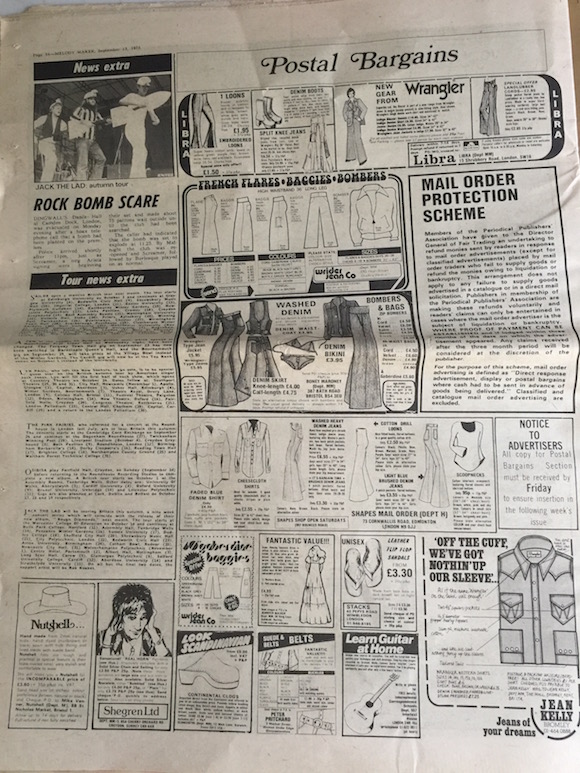
At the bottom of page 66 of Melody Maker, September 13, 1975.

This is, I think, an exclusive. Much mentioned in the story of punk, I’ve not seen this ad published since it appeared 46 years ago.

Tucked away at the bottom of page 66 of the September 13 1975 issue of British music weekly Melody Maker was a relatively nondescript line advertisement offering the lease on premises in London’s Denmark Street, home to the British music publishing industry:

TIN PAN ALLEY.                Must be
useful for some msicians (sic), agent
or such. To take over.       Small lock-
up premises.    Store gear,      group-
meet,    rehearse,     hire-it-out,  etc.
Sacrifice.   –   455 7487.

Complete with that typo, this was the sole entry in the property section of the MM’s classifieds pages, which that week included hundreds of ads for musicians, instruments and equipment over seven pages.

The ad was tucked away at the bottom of the page.

The advert would have cost the leaseholder Bill Collins around £3.50 to post. The father of actor Lewis Collins, the Liverpudlian had made a name for himself in the music business, having been instrumental in the success of 60s powerpop quartet Badfinger, signing them to the Beatles’ Apple label when they were The Iveys. Collins even shared songwriting credits with the group, including those for Without You, which became a massive worldwide hit when covered by Harry Nilsson.

By 1973 Collins had been excluded from Badfinger’s affairs by the powerful US entrepreneur Stan Polley, who was soon accused of depriving the group of millions of dollars. In April 1975, a few months before Collins placed the ad, Badfinger mainman Pete Ham hanged himself at home, blaming Polley in the suicide note for the group’s misfortunes.

Another page of ads towards the back of the issue of MM with a news filler about a bomb scare interrupting a performance by a long-forgotten act called Screamer.

Continue reading Exclusive: The very ad which scored the Sex Pistols their place in Tin Pan Alley

DB Burkeman’s Art Sleeves: Album Covers By Artists avoids the usual suspects and contains many surprises

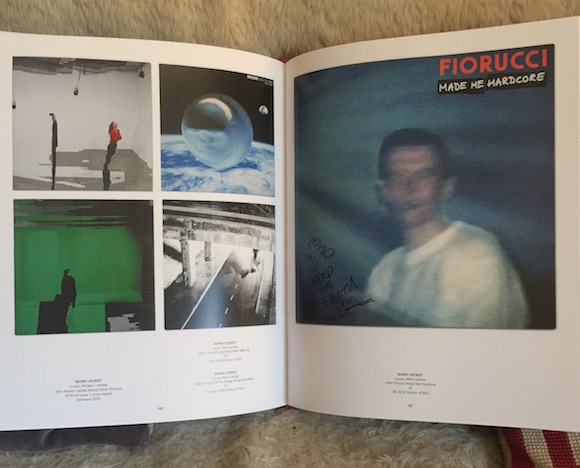
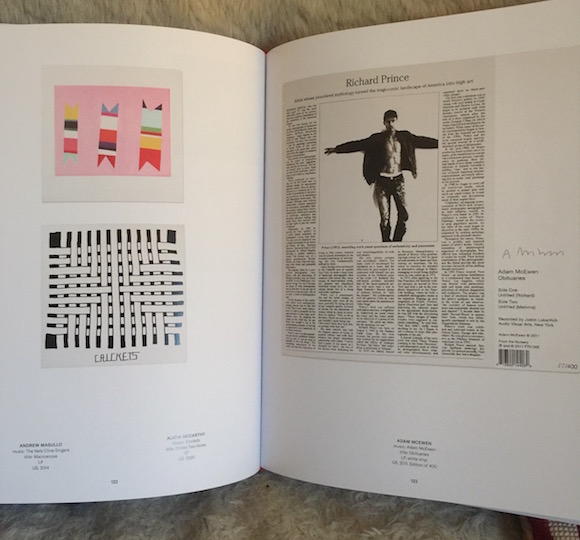
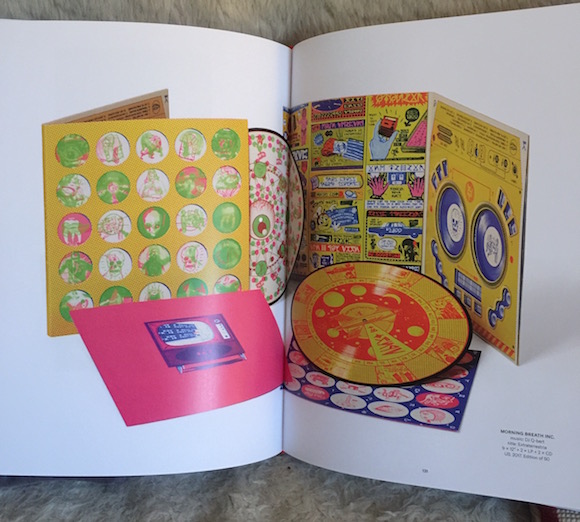
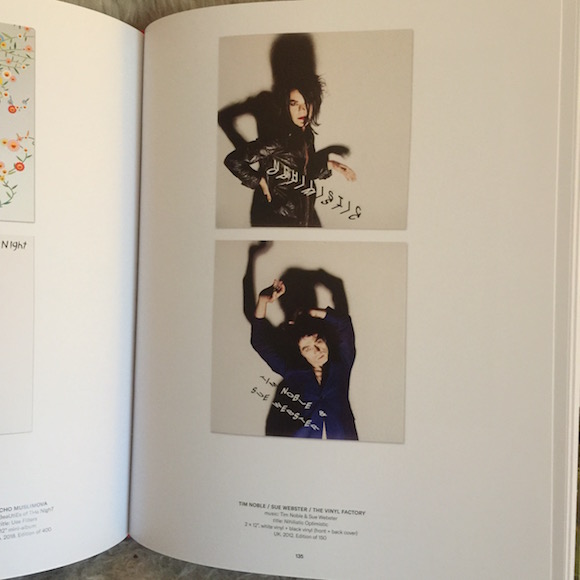
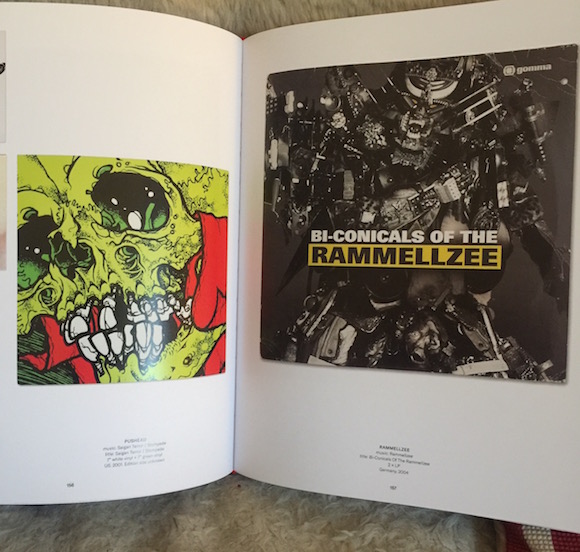
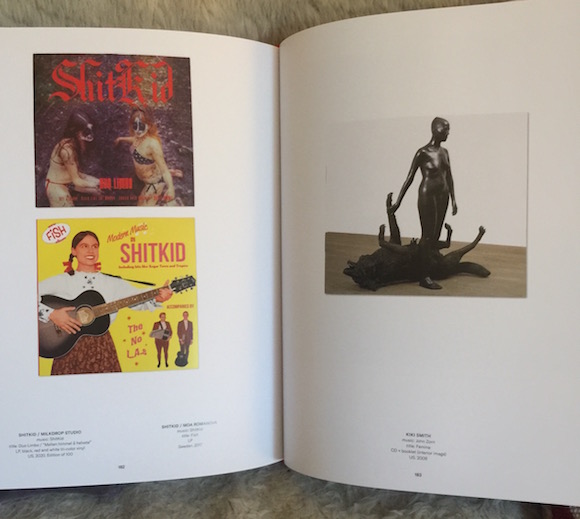
Among the many things the world doesn’t need now is another book of record covers, but DB Burkeman’s Art Sleeves, which is published today by Rizzoli, is something else entirely.

For once the publisher’s blurb is spot-on; this is “a tightly curated exploration” of record covers which challenge the distinctions between art and design, between object and product.

This means that there are many surprises in the book, and a minimum of the usual suspects.

Art Sleeves also contains a bonus in a series of artist spotlights and conversations featuring such exponents as Christian Marclay, INVADER, Ryan McGinley, Genieve Figgis  and Marilyn Minter.

And Barney Bubbles receives a mention as DB’s “personal design hero” in the introduction.

I recommend Art Sleeves highly. Order your copy here and follow Art Sleeves on Instagram here.

Representing the Barney Bubbles Estate

Today I’ve launched a page on this site for the Estate of the late radical graphic artist and designer Barney Bubbles.

//Ridiculous Roadshow mask, 1973. © Barney Bubbles Estate//

I represent the Estate and its hundreds of original artworks. We have some exciting activity coming up, including the loving recreation of one of Bubbles’ most striking designs for a very special reissue on Record Store Day this year.

Then there is a new enhanced edition of my monograph Reasons To Be Cheerful: The Life & Work of Barney Bubbles, to be published by a leading international imprint. We are also planning a companion limited edition box of Bubblesiana, including high quality reproductions of his build-your-own paper and card designs.

In recent years the Estate has collaborated with a number of top-flight partners, including Universal Music, BMG Music, Paul Smith, Fred Perry and NOAH Clothing, and produced limited edition t-shirt, poster and postcard ranges with artist/dancer Stacia Blake and specialist printer Something Else.

//Johnny Moped Lightbulb 1977.© Barney Bubbles Estate//
//John Cooper Clarke, 1979. © Barney Bubbles Estate//

Read Barney Bubbles’ biography on the Estate page here.

//Still from Barney Bubbles-directed video for Ghost Town by The Specials, 1981//
//Letterhead for Teenburger Designs studio, 1969. © Barney Bubbles Estate//
//4D Man, 1982.© Barney Bubbles Estate//
//I Love The Sound Of Breaking Glass, 1978. © Barney Bubbles Estate//
//Hit Me With Your Rhythm Stick, 1978. © Barney Bubbles Estate//
//Cracking Up, 1979. © Barney Bubbles Estate//

For licensing and reproduction inquiries, contact paulgormanis@btinternet.com. PDFs of available artworks on request.

Follow the Estate’s Instagram account: @_barney_bubbles_estate_ 

Shipwreck Of The Fake Fairies: New limited edition bookwork from Paul Kindersley

British artist Paul Kindersley has produced a bewitching small publication which is available now from his Twitter account.

Shipwreck Of The Fake Fairies is 12 pages with 10 b&w illustrations and continues the themes of Kinderley’s recent work, including the performances Fake Fairy Fantasies and Ship Of Fools and his film The Burning Baby.

Limited to 100 in A5 format on 300gsm paper, each is signed and hand numbered.

Copies of Shipwreck Of The Fake Fairies are £10 each inc p&p.

For yours DM Kindersley at twitter.com/PaulKindersley.

Farfouiller dans Les Archives: Robert Rubbish’s Nouvelle Vague show on Instagram

London  antique dealer James Jackson is currently presenting an Instagram exhibition of a folio of new works by the British artist Robert Rubbish.

Farfouiller dans Les Archives (Rummaging in the archives) consists of 10 original A3 artworks; James is posting one work daily on his IG account.

//The artist at bay//

“In the summer of 2019, I started making a collection of works inspired by stills from the French New Wave films I was watching,” explains Rubbish. “They are mostly of couples in cafes; I liked the idea of juxtaposing words onto them like subtitles, using 1980s pop song lyrics.

//”I was working as a waitress in a cocktail bar when I met you”. Robert Rubbish, 2021//

“The text was translated from English to French using Googletranslate. The results became profound, existential (or profoundly existential?) and sometimes absurd.”

Jackson has exhibited Rubbish’s work previously at his premises in Fulham, west London. “Robert will return with an old school gallery type exhibition of new and inspired works  at James Jackson in Lillie Rd as and when circumstances allow,” adds Jackson.

Enjoy the show here.

Special limited edition postcard: Rare 1972 portrait of Malcolm McLaren inside Let It Rock

//The postcard, which measures 230 x 150mm (6 x 9in), is printed in a numbered limited edition of 150//

“Fashion seemed to be the place where music and art came together. Creating my own clothes was like jumping into the musical end of painting. The shop became a natural extension of my studio.”
Malcolm McLaren. The Look, 2001.

Featuring a rare portrait of Malcolm McLaren displaying his wares inside the recently opened Let It Rock in January 1972, this limited edition large-size postcard is a companion to my biography of the man published earlier this year.

The photograph on the front of the card was taken by the late David Parkinson, who documented the refurb of  the premises at 430 King’s Road carried out by McLaren and his art school friend Patrick Casey; the address had previously housed Trevor Myles’ Americana boutique Paradise Garage.

//The postcard arrives clad in black, McLaren’s favourite anti-colour. “Black expressed the denunciation of the frill,” he wrote in the introduction to my book The Look//

The card shows McLaren revealing the detail on a flamboyant drape jacket made to his design by the East End tailor Sid Green, while he is surrounded by the accessories and ephemera which constituted Let It Rock’s environmental installation. Against the black walls, Day-glo socks from Whitechapel wholesaler Kornbluth vie with Frederick Starke red rockabilly shirts, Sun Records 45s, French rocksploitation movie posters and deadstock clothing.

It makes for a beguiling image: the 25-year-old – then still legally Malcolm Edwards – is caught making the leap from art school to fashion retailing by, as he later described it, “jumping into the musical end of painting”.

Limited edition numbered postcard hand-numbered and printed 4/1 col. offset on 350gsm single sided board stock, trimmed to size.

Printing: Something Else.

Price: £12.50 each or £20 for 2. P+P: £5 UK, £10 rest of the world. All postage with tracking and/or signature.

Payment via PayPal to this address.

I’m happy to sign cards on request.

Malcolm McLaren, Double Dutch skippers, NYPD’s Dave Walker and the Duck Rocker on The Midsummer Night’s Tube 1983

Excerpts from the annual summer music jamboree broadcast as part of UK TV station Channel 4 youth programme The Tube have been posted this week on Youtube.

//Jools Holland interviews McLaren about his “Duck Rocker”, one a number of customised boomboxes McLaren commissioned for promotional appearances//

One clip from the so-called Midsummer Night’s Tube of 1983 features an interview with Malcolm  McLaren about his recently released album Duck Rock and single Double Dutch.

Continue reading Malcolm McLaren, Double Dutch skippers, NYPD’s Dave Walker and the Duck Rocker on The Midsummer Night’s Tube 1983

Read my essay From The Streets To The Stadium in the new Stone Island monograph Storia

I have an essay in the Stone Island monograph Storia which is published today by Rizzoli Books.

Edited by Eugene Rabkin of StyleZeitgeist and art-directed by the supreme Simon Foxton, Storia is an extremely handsome volume featuring texts by Angelo Flaccavento and Jian Deleon, as well as my piece, From The Streets To The Stadium, which traces the Italian label’s place in popular culture.

Storia is available from all good booksellers – a special edition has been published in a slipcase with a poster.

This is available from Stone Island stores around the world, but hurry; within a few hours of publication I’ve been hearing tales that it has sold out in certain territories.

Photos of book by Sabrina Tanzi.