//Polaroids taken on the journey by Bayley courtesy of the NYU Richard Hell Archive////Opening spread of my feature in GQ UK March 2015//
“I’m forever grateful for Jake for giving us the opportunity. It was magical that he wanted to encourage Roberta and me to use our abilities in a new way. Just another example of his beautiful style.”
Richard Hell
The new issue of GQ UK contains my piece about the quixotic 1980 US road trip undertaken by Roberta Bayley and Richard Hell in a Cadillac Eldorado belonging to Jake Riviera (who conceived and sponsored the journey).
These jaunty photographs were taken by Barry Plummer in the spring of 1979 for a Melody Maker interview with Malcolm McLaren about the just-released soundtrack for the Sex Pistols’ biopic The Great Rock N Roll Swindle (beset by financial and creative difficulties, the film wasn’t released for another year).
McLaren was accompanied by Vivienne Westwood; they made a striking pair in mixed and matched one-off and traditional pieces with a selection of clothing from their King’s Road shop Seditionaries. By now the transition away from punk – left behind when the Sex Pistols split a year earlier – was becoming evident.
John “Hoppy” Hopkins – who died yesterday aged 77 – was the photographer and activist best known for his associations with London’s counterculture of the 1960s and 70s, having been a founder of the radical London Free School which in turn led to the Notting Hill Carnival, a contributor to the pacifist paper Peace News, and a pivotal figure in the establishment of both the underground paper International Times and the psychedelic club UFO.
Hopkins was also a leading light of the squatting movement and a brave proselytiser for cannabis usage; electing for trial by jury for possession he was labelled “a pest to society” by the judge and sentenced to nine months in jail.
According to his friend Jeff Dexter, Hopkins’ favourites among his own photographs were of London rockers, those Ton-Up habitues of the North Circular’s Ace Cafe and Paddington’s 59 Club whose outsider cool and tribal clanship he documented with acuity.
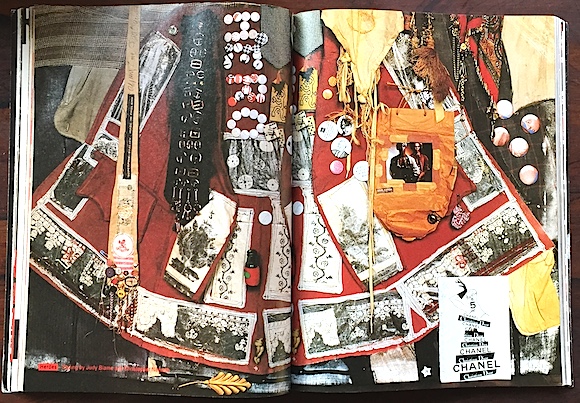
//Heroes by Mark Lebon for i-D Bible 1988. Styling by Judy Blame and Christopher Nemeth//
I’m looking forward to participating in ShowStudio’s live broadcast discussion of today’s Louis Vuitton A/W 15 menswear show in Paris.
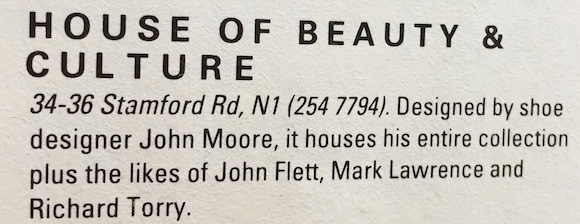
Vuitton artistic director Kim Jones has been trailing the show on his Instagram feed with tantalising hints as to the direction and content. Jones’ A/W 15 collaborators include Judy Blame, Nellee Hooper and Mark Lebon – all names associated with the late shoemaker John Moore’s magical 80s north-east London art/fashion space The House Of Beauty & Culture.
//Malcolm McLaren, 1973. Photo: David Parkinson. Bryan Ferry, 1976. Photo Richard Wallis//
A couple of years back I showed examples of photography by the late David Parkinson to car-nut graphic design maestro Jules Balme; I knew he would be interested in the incorporation of a 1959 Cadillac Eldorado in a 1973 Let It Rock fashion shoot.
What drew Balme’s eagle eye was not the car fin detail, but the fact that Malcolm McLaren in the shot below sported a tie of the same distinctive Atomic-style 50s pattern as worn by Bryan Ferry in the video clip for his 1976 solo hit Let’s Stick Together (and subsequently on the sleeve of the compilation of the same name rushed out to capitalise on the single’s success that year).
//McLaren and models in Let It Rock attire – right are examples of the so-called “Alan Ladd” and “Jazz” suits – photographed in Acre Lane, Brixton for Club International by David Parkinson, summer 1973//
//Photo: Alun Anderson////Stacia Blake relaxes amind Hawkwind’s equipment. Photo: Alun Anderson//
“When these photographs were taken, everything about them was everyday and unexceptional. These were the clothes we wore, the Hawkwind festivals that filled our summers, the drugs we took, the love we had, the way we moved. Only looked at from a distance does something extraordinary seem to emerge. Whether it is possible to live in the present with this view of what is around you, I don’t know.”
Alun Anderson, 2015
//George Grosz’s book jacket for of Die Kunst is in Gefahr, published by Malik Verlag, Berlin, 1925//
“Today’s artist, if he does not want to run down and become an antiquated dud, has the choice between technology and class warfare propaganda. In both cases he must give up ‘pure art’. Either he enrolls as an architect, engineer or advertising artist in the army (unfortunately very feudalistically organized) which develops industrial powers and exploits the world; or as a reporter and critic reflecting the face of our times.” From Last Round, the conclusion to Art Is In Danger
Today I’m returning to Blessed & Blasted – my occasional series about art manifestos – with Art Is In Danger, issued as a small book in 1925 by George Grosz and John Heartfield’s brother Wieland Hertzfelde.
This choice has been triggered by a charity shop acquisition of the catalogue for the 1979 London exhibition Neue Schachlichkeit And German Realism Of The Twenties, an examination of the so-called “New Objectivity” which arose as a reaction to the establishment of Weimar Germany.
//Copy of PIL’s Metal Box complete with tape printed with Dennis Morris’ logo for the band; DB reckons this may have come from the group’s guitarist Keith Levene//
During a recent visit to his mother’s north London home, NY-based expat DJ, art/publishing player and blogger DB Burkeman took the opportunity to recover some of the ephemera of his youth, including the items you see here.
//Flyer for evening at the London outpost of Peter Gatien’s 80s club brand featuring Barnsley (now Barnzley), Tim Simenon (of Bomb The Bass) and the Wild Bunch’s Nellee Hooper////Photo of Allen Jones artwork obtained from Burkeman’s first employer//
One of my favourite Instagram feeds is The Family Acid, run by Kate Steffens, daughter of reggae archivist, actor, anthologist, psychedelic pioneer and photographer Roger Steffens.
//Vivienne Westwood and Malcolm McLaren, Paris, November 1973. (c) Alain Dister//
A photograph of Vivienne Westwood – credited to the fashion designer’s archive in the new Westwood book with Ian Kelly – put me in mind of an image I have in one of my many books in storage.
At first I couldn’t put my finger on the particular tome. Then bingo! Bought eight years ago on publication, the France-only publication Punk Rockers! is a compendium of the photography of the late Alain Dister from the early 70s to the mid-00s.
//Johnny Thunders, David JoHansen, Sylvain Sylvain, Paris, November 1973. (c) Alain Dister////Left: Westwood and McLaren. Right: Seditionaries frontage 1978. (c) Alain Dister////Book jacket photo of unidentified female punk rocker taken in Seattle, 1996. (c) Alain Dister//
Among the photographs Dister discusses in the brief foreword is one of Westwood with Malcolm McLaren when they journeyed to Paris to witness a gig by the New York Dolls at the Olympia Theatre in November 1973. This is clearly one of a sequence taken by Dister and featured in Westwood’s book.
As Dister writes, McLaren was “habillé en Teddy Boy années 50”. In photographs taken at the French capital’s Belle Epoque brasserie La Coupole – where we were happily ensconced with the Dolls’ confrère Marc Zermati only last year – the American proto-punk group is shown in all their glory, with guitarist Sylvain Sylvain resplendent in a zippered wool/mohair Let It Rock creation.
//London 1978. (c) Alain Dister////Fans at Sex Pistols reunion concert, Finsbury Park, north London, 1996. (c) Alain Dister////Left: Berlin 1998. Right: Seattle, 1996////Left: Yoyogi Park, Tokyo, 2002. Right: Sheena, Tokyo 2002//
Punk Rockers! is a valuable document; Dister cast his unstinting eye as punk mutated from London and New York in the 70s to blossom in such cities as Berlin in the 80s, Seattle in the 90s and Tokyo in the 00s.
Former Melody Maker journalist Chris Charlesworth provides a fascinating snapshot of the Dolls at their debauched peak in Paris here.