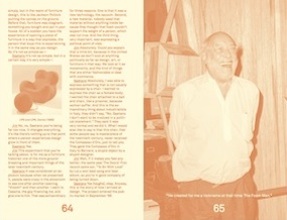
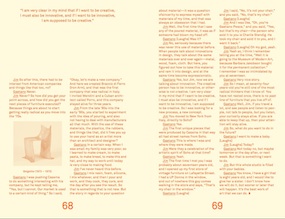
//Polaroids taken on the journey by Bayley courtesy of the NYU Richard Hell Archive////Opening spread of my feature in GQ UK March 2015//
“I’m forever grateful for Jake for giving us the opportunity. It was magical that he wanted to encourage Roberta and me to use our abilities in a new way. Just another example of his beautiful style.”
Richard Hell
The new issue of GQ UK contains my piece about the quixotic 1980 US road trip undertaken by Roberta Bayley and Richard Hell in a Cadillac Eldorado belonging to Jake Riviera (who conceived and sponsored the journey).
//”This photograph was taken by Chris Morris in my bedroom at Commonwood Cottage in Downley village near High Wycombe in 1965 (when I swapped my mod life for university). I’m wearing an almost unwearably itchy John Stephen herringbone wool shirt. Apart from the Ricky Tick poster, I’d permanently pasted up two vintage London Transport posters I found in the attic. My old man wasn’t too pleased about that”. From http://johnpidgeon.com////Front cover of Pidgeon’s 1974 book//
I highly recommend John Pidgeon’s blog; Pidgeon is another of those unpindownable figures in the cultural landscape. His considerable talents have been expressed from music journalism and magazine publishing through roadie-ing for The Faces and composing songs with their recently departed and already much missed keyboard maestro Ian McLagan to commissioning stunning design work from Barney Bubbles and producing BBC documentaries and radio comedy (and in the process promoting the talents behind hit series such as Dead Ringers, Little Britain and The Mighty Boosh). Continue reading Highly recommended: The unpindownable John Pidgeon’s blog
//Heroes by Mark Lebon for i-D Bible 1988. Styling by Judy Blame and Christopher Nemeth//
I’m looking forward to participating in ShowStudio’s live broadcast discussion of today’s Louis Vuitton A/W 15 menswear show in Paris.
Vuitton artistic director Kim Jones has been trailing the show on his Instagram feed with tantalising hints as to the direction and content. Jones’ A/W 15 collaborators include Judy Blame, Nellee Hooper and Mark Lebon – all names associated with the late shoemaker John Moore’s magical 80s north-east London art/fashion space The House Of Beauty & Culture.
//Malcolm McLaren in a previously unpublished shot wearing original 50s George Cox Bingley D-ring brothel creepers to match his detail-perfect Teddy Boy garb. Photo taken inside Let It Rock, 430 King’s Road, January 1972. (c) David Parkinson//
//Left, Saint Laurent point-toed patent brothel creepers, A/W 2014. Right: George Cox Buckle Diano made to the 1950s last//
Last season’s foregrounding by Saint Laurent of the pointed brothel creeper is just one of a run of examples of fashion brands plugging into the purity of this quintessentially British rock & roll style minted in 1949 by the UK independent footwear company George Cox.
Among the first stylistic innovators to take the design out of Teddy Boy revivalism and apply it to contemporary fashion was Malcolm McLaren, who had been selling creepers for a couple of years at Let It Rock, the boutique he operated with Vivienne Westwood, by the time he visited the Cox factory in Northampton in November 1973. Here he ordered samples for six styles, some of which went into production for sale at 430 King’s Road.
//Malcolm McLaren, 1973. Photo: David Parkinson. Bryan Ferry, 1976. Photo Richard Wallis//
A couple of years back I showed examples of photography by the late David Parkinson to car-nut graphic design maestro Jules Balme; I knew he would be interested in the incorporation of a 1959 Cadillac Eldorado in a 1973 Let It Rock fashion shoot.
What drew Balme’s eagle eye was not the car fin detail, but the fact that Malcolm McLaren in the shot below sported a tie of the same distinctive Atomic-style 50s pattern as worn by Bryan Ferry in the video clip for his 1976 solo hit Let’s Stick Together (and subsequently on the sleeve of the compilation of the same name rushed out to capitalise on the single’s success that year).
//McLaren and models in Let It Rock attire – right are examples of the so-called “Alan Ladd” and “Jazz” suits – photographed in Acre Lane, Brixton for Club International by David Parkinson, summer 1973//
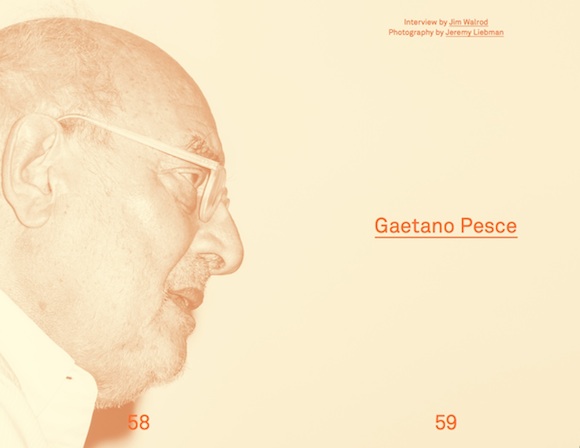
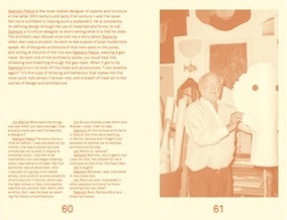
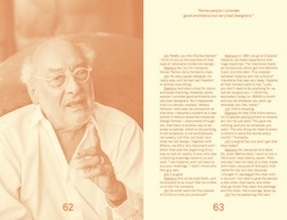
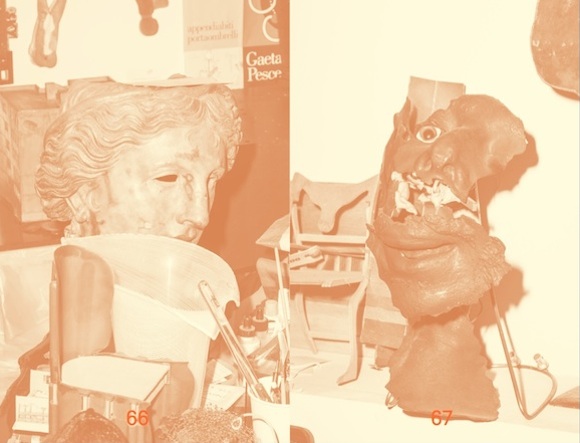
The current issue of arts and culture magazine Bad Day is enlivened by an engaging interview with the eminent designer and architect Gaetano Pesce by one of his most vocal champions, design authority Jim Walrod.
Augmented by Jeremy Liebman’s photographs, the feature makes a strong case for Pesce’s significance. “He’s the most punk rock person I’ve ever met,” writes Walrod of the 74-year-old.
Issue 18 of Bad Day has sold out but visit the magazine’s excellent website for further elucidation.
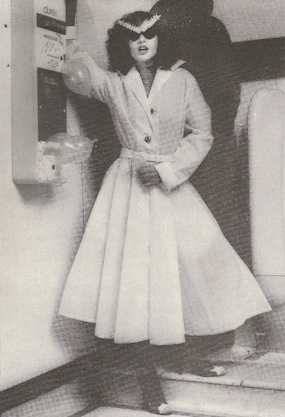
//Photography: Bob Carlos Clarke 1976 (left) and David Parkinson 1975//
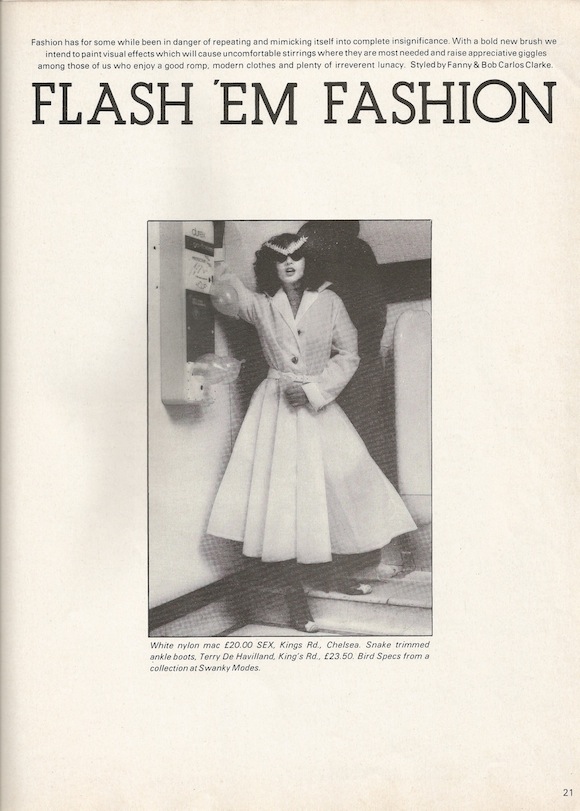
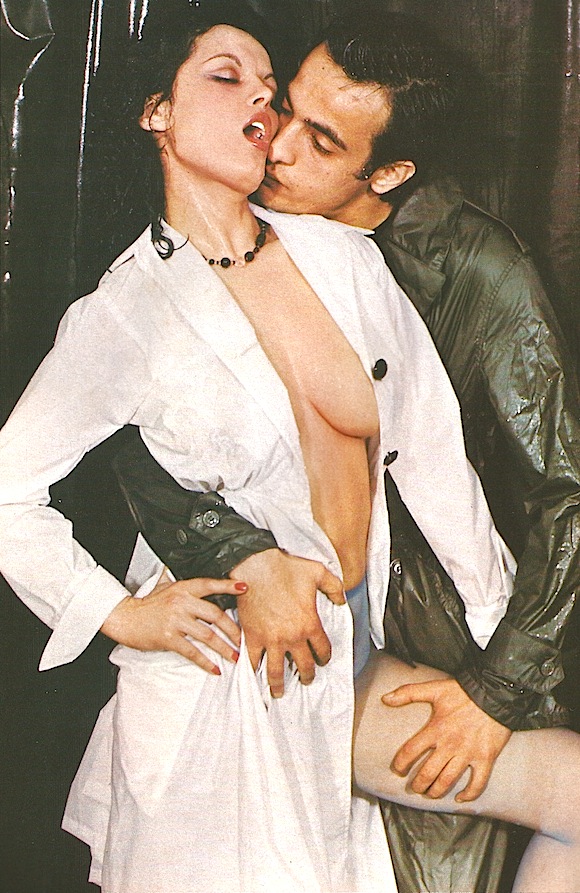
Malcolm designed a very nice women’s mac. A real 50s style, it was made of very thin ciré and looked almost like a dress, with its circular skirt and stand-up collar. It was like something that the B52s might have worn – half a dozen years later.
Glen Matlock on his time as a shop assistant at Sex in his memoir I Was A Teenage Sex Pistol (first published 1990, Omnibus Press)
As well as unique examples of Malcolm McLaren’s fashion designs with Vivienne Westwood, along with exclusive photographic prints of work by such luminaries as Robyn Beeche, Bob Gruen, Sheila Rock and Joe Stevens, the exhibition Let It Rock: The Look Of Music The Sound Of Fashion will present a panoply of ephemera, including many never previously catalogued publications which featured some of the extraordinary clothing emanating from 430 King’s Road in the 70s and 80s.
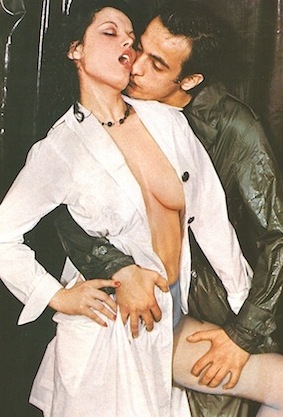
//From Vamp, 1976. Paul Burgess Collection////Female model in the Sex mac/dress, male in a raincoat from Kenny MacDonald’s Marx, The Common Market, King’s Road. David Parkinson for Club International, 1975//
Among them is the ultra rare 1976 issue of photographer Bob Carlos Clarke’s magazine Vamp, loaned by collector/expert Paul Burgess. Among the garments from Sex in the Flash ‘Em Fashion spread is the delightful rainwear dress designed by McLaren, which was also photographed by David Parkinson for Club International.
In his memoir I Was A Teenage Sex Pistol, Glen Matlcok recounted how this particular design was plundered by the mainstream fashion business: “This woman’s firm totally ripped it off for one of the mid-market youth fashion houses. And made a mint out of it. Without paying a penny to Malcolm and Vivienne – whose idea it was. Well, sort of. They probably ripped it off themselves from a Hollywood still. But that’s not the point really. Their’s was a fully-developed idea and garment.”
Let It Rock: The Look Of Music The Sound Of Fashion runs from August 3-6 at the Crystal Hall in Copenhagen’s Bella Center as part of Coepnhagen Fashion Week.
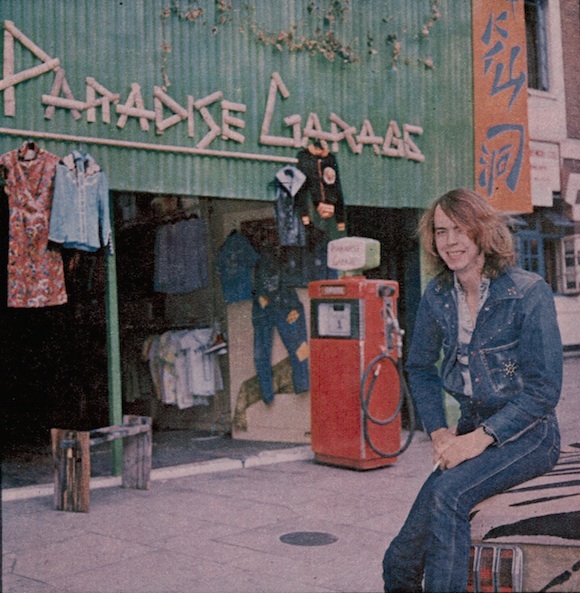
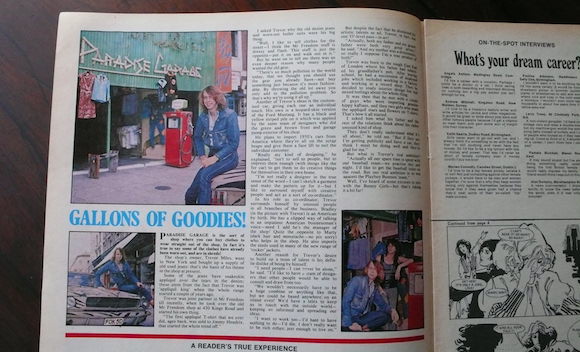
//Trevor Myles in front of his store at 430 King’s Road, autumn 1971. Photographer: Not credited////pp6-7, Jackie, December 4, 1971//
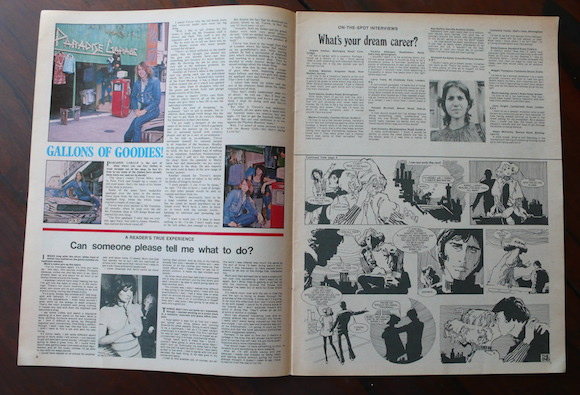
Well done to vintage collector/dealer Sharon of Sweet Jane’s Pop Boutique blog for spotting this wowser on a Facebook group: a 1971 article in teen fashion and music magazine Jackie about the game-changing fashion outlet Paradise Garage run by Trevor Myles at 430 King’s Road.
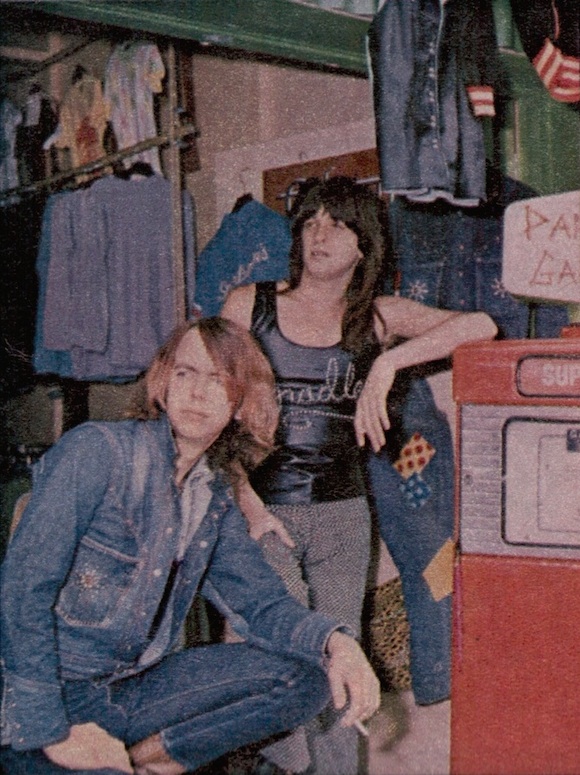
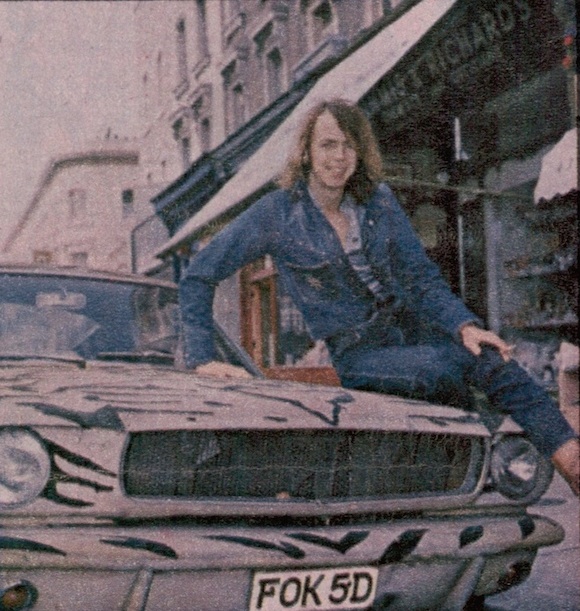
//Myles with Bradley Mendelson (in ‘Bradley’ studded top) outside Paradise Garage. Photographer uncredited////Myles on his tiger-strip flocked 1966 Ford Mustang Pony car. Photographer uncredited/
Paradise Garage is important because it was the first shop in Britain to import and sell used denim in a meaningful way. Using the astounding environment created by Electric Colour Company, faded and worn denim, sometimes appliqued or patched, was stocked alongside an acutely compiled selection of soon-to-be-familiar dead-stock: Hawaiian shirts, baseball and souvenir jackets, Osh Kosh B’Gosh dungarees, bumper boots, cheongsams and so on.
Myles opened Paradise Garage in May 1971 as a reaction to the Pop Art flash he had engineered at Mr Freedom with his ex-partner Tommy Roberts. In the Jackie article he makes a point about fashion and environmental sustainability of pertinence today:
“There’s so much pollution in the world that we thought you should use the gear you already have – not buy something just because it’s fashionable. By throwing the old lot away you only add to the pollution problem. So that’s why we’re using it all up.”
Also interviewed and photographed is shop manager Bradley Mendelson, the New Yorker whose November 1971 encounter with Malcolm McLaren while Myles was absent overseas resulted in the establishment of Let It Rock at the same address.
The publication date of the issue of Jackie – December 4, 1971 – is poignant; by the time the feature appeared Paradise Garage was gone and McLaren and others, including his art-school student friend Patrick Casey and Vivienne Westwood, had taken over the outlet and were refurbishing it to match Mclaren’s radical British take on 50s retromania.
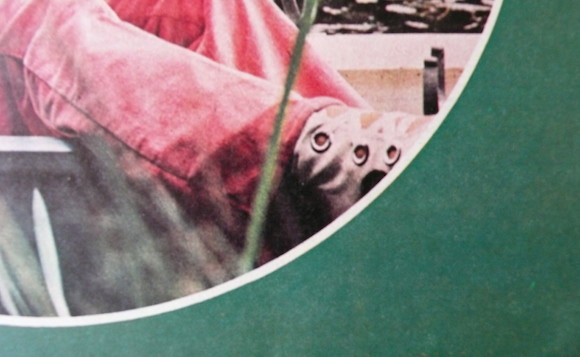
//Mr Freedom designs produced under Myles’ former partner Tommy Roberts appeared elsewhere in the same issue. Here customer Elton John sports an appliqued top////The female cover model wore a pair of green and white winged boots from Mr Freedom (detail cropped out)//
//From the catalogue for Christie’s Pop Culture auction, June 20,2014//
Six years ago on The Look blog I posted images and memories supplied by Terry Slobodzian, who ran boutiques Explosion and Lacy Lady in the upstate New York town of North Tonawanda in the late 60s and early 70s.
Such shops as Slobodzian’s and The People’s Space (run by Tommy Hilfiger in the neighbouring Emira) were part of a regional US trend for wild and usually wildly-named clothing stores sparked by eccentric retail ventures such as Granny Takes A Trip in England.
As I discovered through contact with vintage dealer/expert Ben Cooney, these are the places who showed at the National Boutique Show in NYC and broadcast their wares from the back pages of Baron Wolman’s fashion/music mag Rags: A Long Time Comin’ in San Anselmo, The Bead Experience in Baltimore, The Great Linoleum Clothing Experiment in LA, Bouncing Bertha’s Banana Blanket and Jenny Waterbags in New York, Mom’s Apple Grave in San Francisco…you get the picture.
//From The Look blog, December 2008//
Granny’s occupied a totemic status for the people who operated these outlets; Slobodzian visited London on a buying spree in 1970 and naturally dropped in at 488 King’s Road. “What a trip it was,” he told me in 2008.“Every piece fit like a glove right off the rack. The craftmanship and choice of fabric was amazing.”
Now Slobodzian’s Granny’s suits as featured on The Look blog are in this Friday’s Pop Culture sale at Christie’s along with two shirts from Bouncing Bertha’s Banana Blanket.
Here’s Rod Stewart in the same paneled velvet suit design as Lot 55 in the sale:
//Jacket photograph Terry Richardson with shots from Walrod’s Instagram feed//
Design authority Jim Walrod wears a deep and wide-ranging understanding of his subject – specifically that pertaining to modernism in furniture, interiors, product design and architecture – lightly.
This is refreshing in a field populated by bloodless experts and humourless know-alls. The founder of important 90s/00s store Form & Function, Walrod – described as “the ultimate design raconteur” by André Balazs and “the furniture pimp” by the Beastie Boys – is above all an enthusiast.