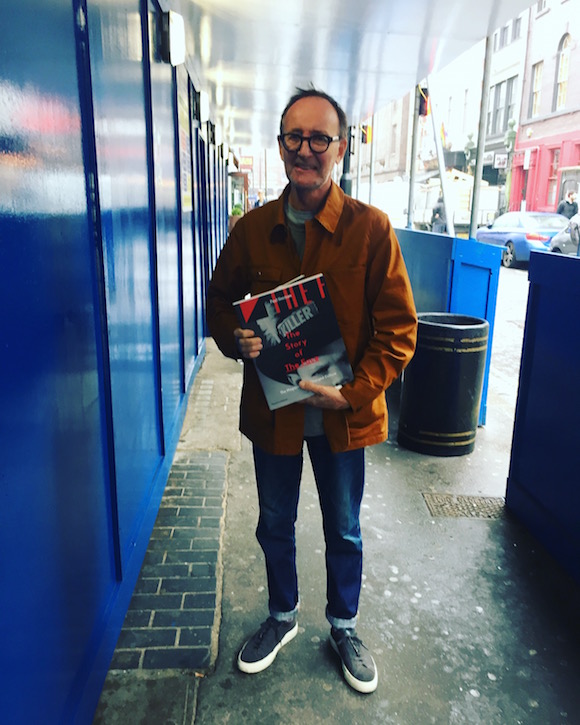
The booklet we have produced to accompany new Somerset House exhibition PRINT! Tearing It Up is in keeping with the show’s fluoro punk aesthetic and DIY theme.
The new issue of international interiors magazine apartamento includes my feature about British artist Duggie Fields and his extraordinary mansion flat in inner west London neighbourhood Earl’s Court.
//ECC’s sign on the facade of the Time Out offices at 374 Gray’s Inn Road, King’s Cross, London, autumn 1970. Photos courtesy Electric Colour Company/Andrew Greaves//
Recent encounters with Time Out founder Tony Elliott have brought to mind the audacious sign created by design collective Electric Colour Company to mark the magazine’s move into premises at 374 Gray’s Inn Road.
//A Prayer For Madonna, The Face, September 1983. Photography: Kate Simon, text: James Truman. This was the superstar’s first substantial UK press appearance, five months ahead of her British live debut//
Of the many talented photographers who provided The Face with its visual verve, Kate Simon was uniquely positioned to chronicle the cutting edge cultural developments in New York in the 1980s.
Simon had spent much of the previous decade in London, photographing musicians and performers from Bob Marley and David Bowie to the Sex Pistols and The Clash (whose debut album features her striking portrait of Strummer, Jones and Simonon). Crucially, Simon’s work also appeared in the New Musical Express during The Face founder Nick Logan’s editorship of the music paper.
//The cover of the February 1982 issue of The Face featuring Sheila Rock’s striking image of Siouxsie Sioux at the Sonos store in Earlham Street. Photo: Lawrence Ajayi////Photo: Lawrence Ajayi////Photo: Lawrence Ajayi//
The Face magazine was firmly rooted in central London and like its host city it was inclusive, outward-looking, multi-cultural and diverse. While it expressed all the best aspects of creative London it was never parochial but simultaneously intent on making the connections to cities and sub cultures around the country and around the world.
Based throughout the 1980s and 90s in the enclaves around Carnaby Street, Mortimer Street, Marylebone and Clerkenwell, the magazine and its writers, designers, photographers and stylists became fundamental to the scenes they documented.
From Soho’s “The Cult With No Name” through rare groove, rave and British soul to Britpop, Brit Art and beyond, The Face was at the epicentre of the capital’s youth, music, fashion, art, design and club cultures.
At a time when the area’s venues and nightlife are being challenged by regulation, regeneration and urban development, this exhibition and companion events aim not only to shine a light on central London’s cultural significance but also highlight a time when a magazine could change the world.
Perhaps the greatest exemplars of The Face’s disruptive London attitude were cover stars such as John Lydon, Malcolm McLaren, George Michael and Suede as well as Kate from Croydon and Naomi from Streatham, who toppled the glamazons ruling fashion and endure as emblems of London street style and suss.
The Face: It was a London thing.
My exhibition about The Face magazine’s roots in, and relationship to, London is currently being staged at home leisure specialist Sonos’ newest store, in Earlham Street, Seven Dials.
//Left: detail, outer gatefold illustration by Holly Hollington, Greasy Truckers At Dingwalls Dancehall, Greasy Truckers Records, 1973; right: Uschi Obermaier and Michael J. Pollard, Oui, October 1973. Photo: Chris von Wangenheim//
//Left: Detail, uncredited cover photo, Oui, Oct 1973. Art director: Don Menell; right: detail; Greasy Truckers sleeve//
Recently I obtained a pristine copy of the October 1973 issue of American men’s magazine Oui, which contains a Chris von Wangenheim fashion shoot featuring actors Michael J. Pollard and Uschi Obermaier .
For the ‘My London’ slot on his BBC Radio London programme, British broadcaster Gary Crowley has conducted an illuminating interview (with musical choices) with Nick Logan, editor, publisher and hands-down the greatest British magazine innovator of our time.
//Athenaeum has done the book proud with this splendid window display. Photo: Athenaeum//
The Story Of The Face is coming to Amsterdam on Friday (December 15).
In an event at the city’s NewWerktheater organised by leading Netherlands bookshop Athenaeum Nieuwscentrum, I’ll be making a visual presentation about the magazine that changed culture.
Afterwards I’ll talk about the enduring influence of The Face and my new book The Story Of The Face with Gert Jonkers, founder of Butt and Fantastic Man and publisher of The Gentlewoman and COS Magazine.
To mark the publication of my new book about The Face, I will be in conversation at London’s Central Saint Martins on November 16 with Magculture’s Jeremy Leslie and the magazine’s founder/editor/publisher Nick Logan.
//Logan in Soho last week. In this area he ran The Face as a one-man band from offices in Carnaby Street (1980-81) and Broadwick Street (1981-82)//
This event represents a chance not just to hear from Leslie, whose shop is the country’s leading independent magazine hub, but also a rare opportunity to witness Logan – in my book (literally) the most important figure in post war British magazine publishing – talk about the magazine that changed culture.