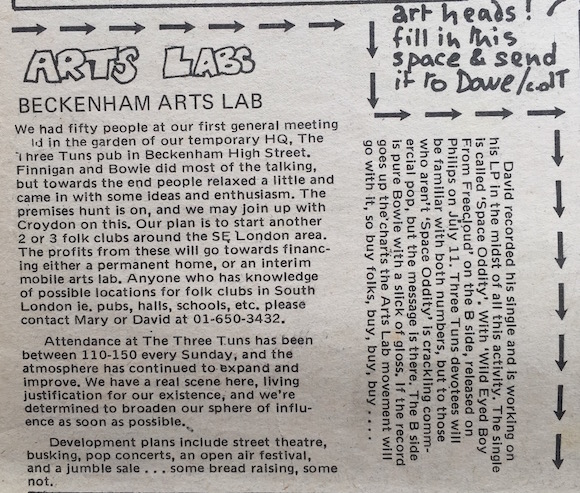
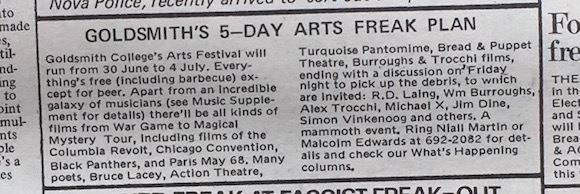
//Box advert for the Beckenham Arts Lab run by David Bowie and Mary Finnigan in IT #59, July 1969////News story about the Goldsmiths Arts Festival organised by Malcolm Edwards and his fellow student Niall Martin in IT #59//
Researching my archive during lockdown for a project has given me the opportunity to thoroughly assess individual publications, none more so than the 59th issue of underground paper IT, which hit the streets in early July 1969.
This particular edition features a couple of small items which provide clues as to the countercultural activities at the time of two Londoners who would go on to define pop culture in the 1970s: David Bowie and Malcolm McLaren.
//Members of the audience from Edinburgh who preferred Australian support act Icehouse to Bowie//
Fittingly Britain’s most surprising rock star has found his way to Britain’s newest and most surprising city, where high tech meets ecologic, where concrete meets conservation, where the silicon chip meets the fibreglass rod…
Steve Taylor, South Of Watford, Summer 1983, London Weekend Television
While putting the finishing touches to my forthcoming book about The Face magazine, I followed a line of research which lead me to an excellent documentary about the late David Bowie which I hadn’t seen since it was screened in 1983.
Shown as part of London’s regional broadcaster LWT’s South Of Watford strand, the film focused on Bowie’s immersion in the mainstream with the Let’s Dance LP and companion Serious Moonlight tour (sponsored by Levi’s in a groundbreaking marketing deal, this inaugurated the era of corporate and branded live music events).
The doc’s point of entry was Bowie’s weekend of sold-out gigs that summer at Milton Keynes Bowl, the open-air arena in Britain’s newest city north of London in the Buckinghamshire countryside.
//Watched by the crowd, writers/poets/frontmen Robert Calvert and Michael Moorcock (left), drummer Simon King and bassist Lemmy prepare for lift off, August 25, 1973. Photo: Dave Walkling////Detail of pic above showing Bubbles’ drumheads and speaker designs//
Following my post of photos from the free music festival at Windsor Great Park to the west of London in 1973, attendee Dave Walkling has sent a couple of sharp images which capture the anticipation in the crowd just before Hawkwind’s set.
//Drumhead painted by Barney Bubbles in 1972. Photo: (c)////From left: Nik Turner, Stacia Blake, Simon King and Lemmy during Hawkwind’s set at the Windsor Free Festival on August 25, 1973. Note the drumhead on the left. Photographer: Unknown//
A rare design by the late graphics master Barney Bubbles has come to light after four decades; the psychedelic sci-fi drumhead was painted for Hawkwind when the space rocking Sonic Assassins undertook tours around the world following their success with the Silver Machine single in 1972.
//Photo: Alun Anderson////Stacia Blake relaxes amind Hawkwind’s equipment. Photo: Alun Anderson//
“When these photographs were taken, everything about them was everyday and unexceptional. These were the clothes we wore, the Hawkwind festivals that filled our summers, the drugs we took, the love we had, the way we moved. Only looked at from a distance does something extraordinary seem to emerge. Whether it is possible to live in the present with this view of what is around you, I don’t know.”
Alun Anderson, 2015
I’m intrigued by the photography of Sunny Suits, the American who, like so many illustrious others, flourishes in Paris, so am delighted to present this selection of recent work complete with her descriptions and background text.
Joujouka
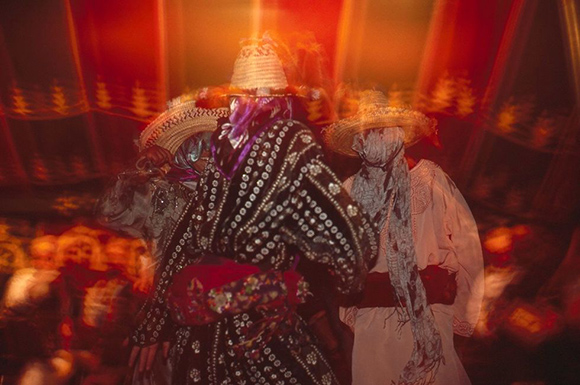
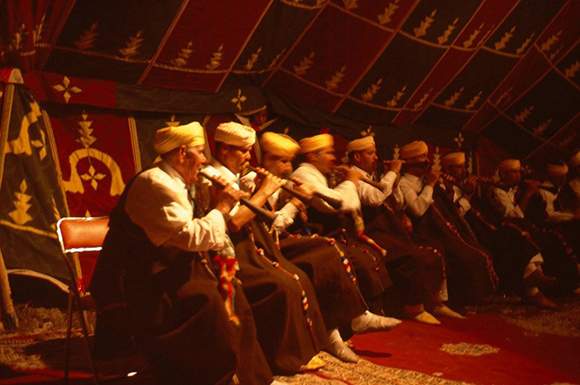
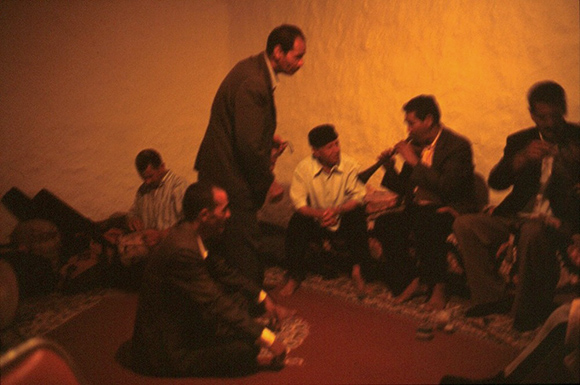
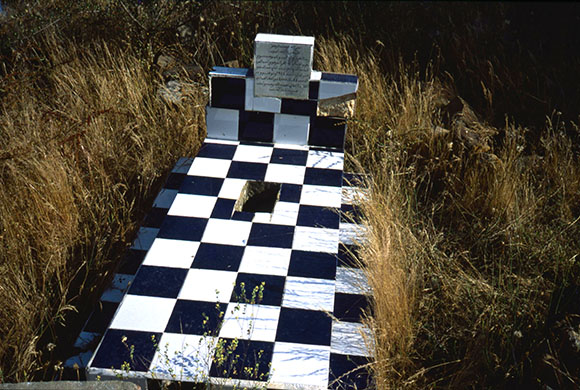
//Village boys dressed as Aisha Kandisha, Joujouka, 2013. Sunny Suits////Master Musician pipers playing under the tent, Joujouka, 2013. Sunny Suits////Master Musicians in the Madras before playing, Joujouka, 2013. Sunny Suits////Mohamed Hamri’s grave, Joujouka, 2013. Sunny Suits////Cafe Boujeloud, Joujouka, 2013. Sunny Suits//
The Joujouka festival happens once a year in Morocco, a few hours from Tangier. It’s an incredible experience, to live on the farm with the villagers, to share their lives for a few days. Each night around midnight the musicians play and are excellent!
The folklore of the village is something special and I feel really lucky to have experienced it. Brian Jones and the Beats are to be thanked for sharing the discovery with us I’d say but it’s the music and also the painter Mohamed Hamri that I connect with most.
Champagne Bars and Sex Shops
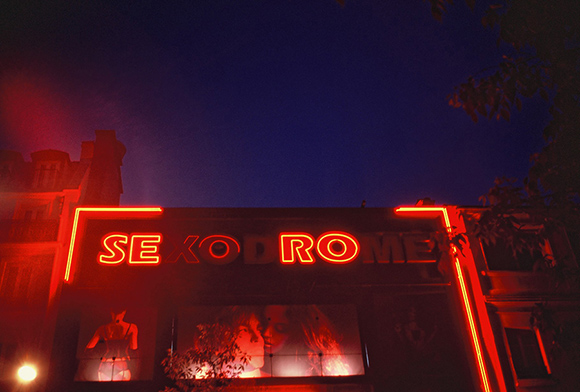
//SERO, sex shop sign, Paris 2014. Sunny Suits//
My first memories of Paris include Pigalle. I used to live in the area and I have wanted to document the champagne bars and the women who work in them for years but before, my French wasn’t good enough and now the bars have almost disappeared. It’s also not exactly my world so I don’t think I have the right to intrude even though it’s only with respect that I see them.
Some of them have become sheesha bars, which I don’t mind because it’s part of the quartier, but red light districts are dying worlds. I see it as them as endangered species, something exotic and necessary. It’s a shame to see them disappear. There should be a smut preservation society.
The photograph ‘Sero’ is of the largest sex shop in Pigalle called Sexodrome. The lights had burned out leaving the sign to read Sero. Ironic for a sex shop sign.
Vince Aletti
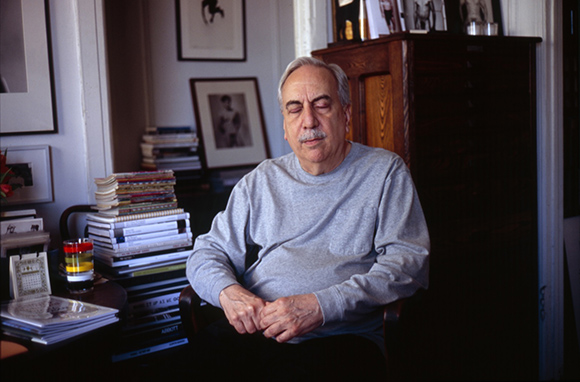
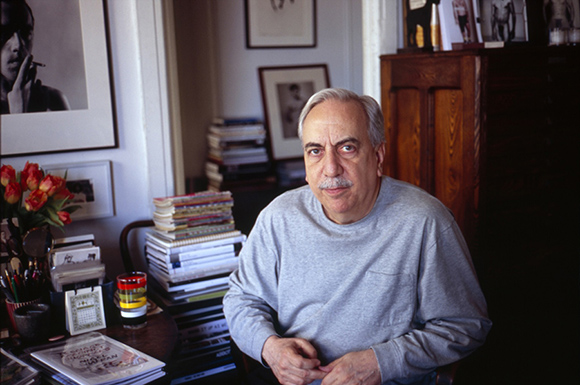
Vince is a journalist and photo critic who was close to Peter Hujar. He knew David Wojnarowicz and many, if not all of the great artists from the Lower East Side that I admire so much. His voice is one of experience as that was his peer group. My friend the artist Paul P and Vince are friends and Paul took me to meet him one day at his place, which is like a shrine! He’s smart and generous and it was a lovely afternoon.
Ariel Kenig
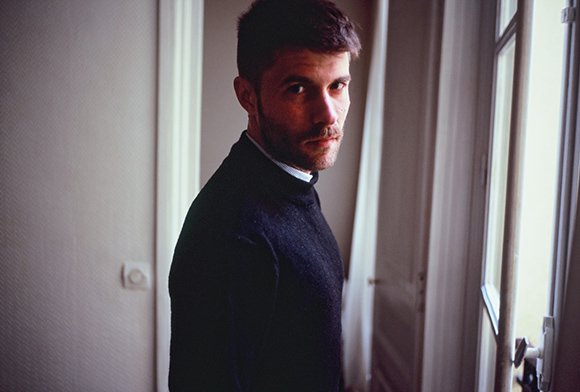
My friend Ariel is a writer here in France, novels and plays. He’s young and accomplished. He’s singing now and I think he’ll be just as successful. His groupies are already in line. He’s got something no doubt. His style is sort of what I call ‘Nu-Française’. He respects the lineage, of literature and now singing, and is a contemporary of it.
Lamine Badian Kouyaté
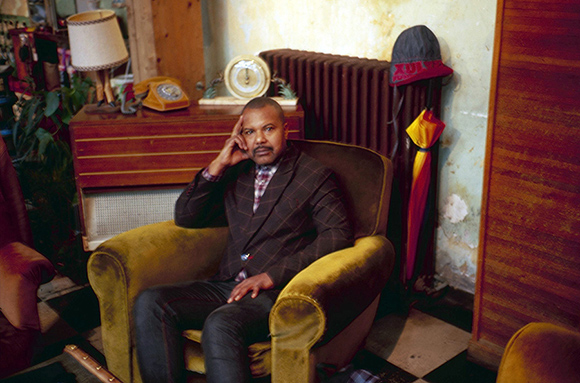
//Lamine Badian Kouyaté (Xuly Bët), Le Comptoir General, Paris, 2014. Sunny Suits//
Lamine is the designer of the French brand Xuly Bët. He’s half Malian half Senegalese and for me totally Parisien. Xuly Bët has its well earned place in fashion history. I don’t think of fashion without thinking of Xuly Bët. His proposition is a mix of street, couture and Africa and I love it. It’s the 25th anniversary of Xuly Bët this year and I’m really honoured to have been able to take his picture. You can see a great Xuly Bët show in the Robert Altman film Prêt-à-Porter.
Read more about the Master Musicians Of Joujouka here and the story of Aïsha Kandisha here.
For French-speakers there is an interview with Ariel Kenig about his book Le Miracle here.
DJHistory has a great interview with Vince Aletti here.
//David Holah in Solitude, directed by John Maybury. 11mins, 1981//
One of the choice selections to be screened as part of this month’s post-punk film season This Is Now is Solitude, the 1981 John Maybury short featuring David Holah, then a fashion student, soon to launch the era-defining label Bodymap with Stevie Stewart.
Put together by British Film Institute curator William Fowler, This Is Now is on at London’s South Bank and explores the early 80s explosion in DIY creativity in this field among UK art students, clubbers, New Romantics and members of the post-punk scene, all of whom embraced inexpensive domestic technology such as VHS and Super 8 to make often bold and uncompromising statements.
//From Vacant by Nils Stevenson, photo: Ray Stevenson//
If you are of a London gig-goer of a certain (getting on to be advanced) age you will remember “Jesus”, an enthusiastic audience member at many musical events in the capital from the 60s to the late 70s.
//Detail: Hynde, Rotten, Matlock and Jesus. Photo: Ray Stevenson//
Jesus was notable because a) he was personable and b) would often discard his clothes as he energetically idiot-danced stage-front. Jesus liked to frolic with abandon, more often than not exposing much, or even all of his rail-thin body.
This year’s presentation of the Malcolm McLaren Award at the finale of performance arts biennale Performa will celebrate the 30th anniversary of the iconoclast’s game-changing LP Duck Rock.
Hosted by eminent writer Glenn O’Brien and McLaren’s widow Young Kim, the event on Sunday will culminate in the presentation of the award by sound artist Christian Marclay to the artist under 40 who has demonstrated “the most innovative and thought-provoking performance” during Performa’s three-week run.
Designed by Marc Newson, the Malcolm McLaren Award was inaugurated at the last Performa in 2011, where it was presented by the late Lou Reed.