This portrait of Malcolm McLaren was captured among the columns outside the entrance to London’s august British Museum by Andy Rosen in 1983.
In the photograph taken during promotion of the Duck Rock album, which was released at the start of 1983, McLaren sported a rare trenchcoat design from the Witches collection he and Vivienne Westwood debuted on the catwalk that spring.
//16 Situations in vitrine at Land Marks. Photo: Jasper Weinstein Sheffield//
I’m pretty late with this but there are still three or so weeks to go, so, if you have the opportunity, I recommend a visit to Hauser + Wirth Somerset, home until June 21 of the contemplative and poised exhibition Land Marks: Structures For A Poetic Universe.
Curated by historians Nicholas Olsberg and Markus Lähteenmäki, Land Marks presents 100 architectural studies and works constituting an investigation into the boundaries between sculpture and architecture and landscapes and cities.
The spell-binding space at Durslade Farm outside the village of Bruton provides the perfect setting; I am thrilled that the curators included Derek Boshier’s quizzical 1971 work 16 Situations.
McLaren opened up the frontiers between artistic and wider cultural attitudes by taking fashion and music out of their respective contexts and translating them into new formats that captured the wider popular zeitgeist. A closer look at his seemingly disarticulated, exuberant and streetwise oeuvre shows it to be consistent and, in its own way, profound.
David Thorp
On Wednesday (June 3) I’m introducing a screening of Malcolm McLaren’s Paris: Capital Of The XXIst Century at The Performance Studio in Peckham, south London.
This is a the first-ever opportunity in this country to see the final work, which McLaren completed a matter of weeks before his death in April 2010. A working version was shown here just once, at Newcastle’s Baltic in November 2009.
//Astral Weeks – Van Morrison, Peter Wilkins, 2015////Hammersmith Apollo, Peter Wilkins, 2015//
In the 21st century, when digital downloads displaced compact discs as the format of consumer choice, music went naked into the world, unadorned by design or packaging. Yet this in turn gave rise to vigorous rear-guard action in the growing appreciation of what was fast disappearing. As if from the dead, vinyl made a comeback and the fan in Wilkins places him in a key position to cogitate this phenomenon. From my text for the Lost In Music catalogue
//Clockwise from top left: A UFO by Ettore Sotsass, Italy 1957. Manufacturer Arredoluce; Passiflora by Superstudio, Italy 1966. Manufacturer: Design Centre; Belt Lamp by Gaetano Pesce, USA 1995. Manufacturer: Fish Design; C2 by Studio Rossi-Molinari, Italy 1969. Manufacturer: Totem//
“These lamps were in no way meant to be utilitarian. They were mass produced as expressions of art by the most innovative designers working at the time and are beautiful objects. Just don’t try to read a book by them!”
The pick of design authority and interiors practitioner Jim Walrod’s extraordinary lighting collection is on display at New York’s Patrick Parrish Gallery until Sunday (April 19).
Over time our assumptions of Pop have become more narrow. That word needs to be shook open a little bit. That history needs to be displaced a little bit. To allow for the diversity you have to go back to a more open idea of what Pop could be.
Darsie Alexander and Ryan Bartholomew, curators, International Pop
Today’s New York Times features Derek Boshier’s 1961 painting Special K as part of the newspaper’s coverage of International Pop, the new exhibition which addresses the fallacy that the movement was the preserve of the US and Britain.
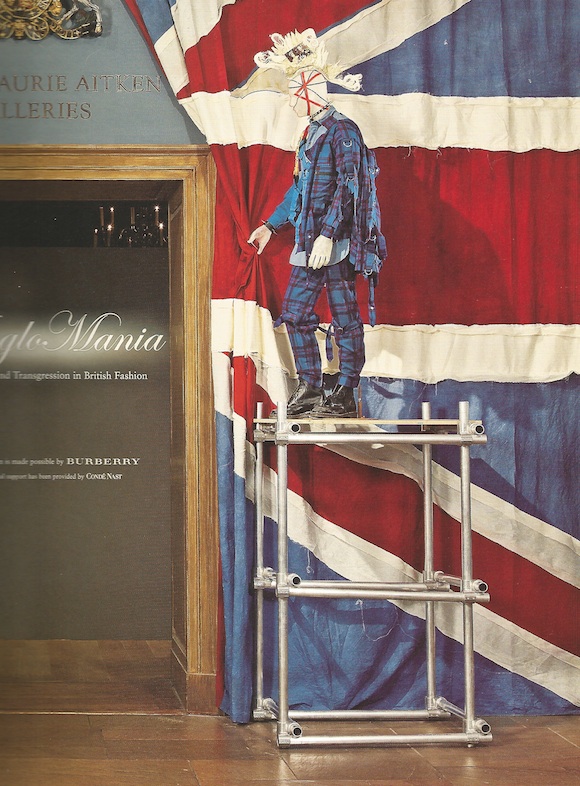
//One of the two bondage suits which have been removed from the Met collection. They were previously granted prominence in the museum’s 2006 exhibition Anglomania. This image is from the frontispiece of the show’s lavish catalogue//
Years after concerns were raised about the authenticity of around half of the punk fashion pieces in the Metropolitan Museum Of Art Costume Institute collection, cleaning house has finally begun at the New York institution with the expulsion of two bondage suits purporting to have been original 70s designs by Malcolm McLaren and Vivienne Westwood.
A museum spokesperson has confirmed that the suits have been “formally de-accessioned”. A relatively rare process in international-standard curatorial circles, de-accessioning occurs when information undermining the provenance and authenticity of a museum object comes to light.
//Detail from 1965 showcard: Derek Boshier and 1965 works. Photo: Annette Green////Card for Boshier’s show at the Fraser Gallery, March 30 – May 1, 1965. Design: David Cripps. Courtesy: Pace London//
Thanks to Pace London for providing scans of the showcard for Derek Boshier’s spring 1965 exhibition at Robert Fraser Gallery in Mayfair’s Duke Street.
//Sam Spade, Derek Boshier, 1966, on the back wall of this recreation of the office at Robert Fraser Gallery, Duke Street, London W1//
Derek Boshier’s 1966 work Sam Spade is given prominence in A Strong Sweet Smell Of Incense, the exhibition dedicated to the connoisseurship of the late art dealer Robert Fraser.
Boshier was a client until he foreswore painting for a decade or more in 1968. This was a particularly difficult period for Fraser, who was jailed over the infamous Redlands drug bust at Rolling Stone Keith Richards’ house the previous year.
//From Pace’s exhibition guide. The work in the background looks to be another of Boshier’s from the Sam Spade period//
Boshier has recounted how he became so frustrated over Fraser’s unwillingness to pass on payments in the 60s that he and his friend, the poet Christopher Logue, once broke into the Duke Street gallery and retrieved works Fraser had refused to release in lieu.