This is designer Ben Kelly at his 1974 degree show at London’s Royal College Of Art.
Kelly adopted the alter-ego The Photo Kid, who is portrayed in the work by which he is standing. The Photo Kid wore clothes – in particular brothel creepers – from Malcolm McLaren and Vivienne Westwood’s shop Let It Rock, as did Kelly; the shoes, pink socks and belt in this photograph all came from there, while the Hopalong Cassidy & Topper top (see Ian Harris’s comment below) was picked up at a Paris flea market.
//Photographer Kate Simon and performer Chrissie Hynde (lifting the front of her mohair jumper from Sex), London, 1976. (c) Joe Stevens//
This photograph – taken by Joe Stevens in early 1976 in Fulham, west London – is featured in the exhibition Just Chaos!, which opens tomorrow (May 7) at Marc Jacobs’ Bleecker Street NYC bookstore BookMarc.
The T-shirts worn by Simon and Hynde were among the first variants of a limited edition designed by Malcolm McLaren to promote the newly formed Sex Pistols. A few were also sold in Sex, the environmental installation/shop operated by McLaren with Vivienne Westwood at 430 King’s Road in World’s End, Chelsea.
“Malcolm dropped the shirts off at my Finborough Road studio; they were freshly silk-screened from a limited edition,” says Stevens, then working for the NME and living with Simon (who was employed by rival music paper Sounds). “Chrissie was living in a squat and cleaning offices for a living. She’d drop by the pad to take showers. I’d hear her singing in there and realised she had a wonderful voice.”
McLaren produced the designs with the express aim of promoting the new group. “This was my first attempt at making a Sex Pistols T-shirt,” he told me in 2006. “I wanted to create something of a stir.”
//Keith Lucas and Ian Dury onstage at the Kings Road Theatre, November 1974. Photo: Simon Haynes Collection//
As these rarely seen photographs show, when the subject of my last book the late Tommy Roberts took over management of Kilburn & The High Roads he sought to elevate them from the pub-rock scene by upping the visual ante on every front.
//From left: Lucas, Dury, David Rohoman, Charlie Sinclair and Davey Payne//
From the archive of the late Tommy Roberts, this image from British teen fashion magazine Mirabelle shows a particularly outré commission from fashion’s master of flamboyant retailing: a 7ft high rendition of a King Kong-style gorilla in blue fun fur created by the design team Sue and Simon Haynes.
//Robert Watts in front of Products by Implosions Inc. Photographer: unknown//
Malcolm McLaren’s adaptation of the infamous Tits t-shirt is one of punk’s most familiar designs, as applied by he and Vivienne Westwood to shirts sold in SEX and Seditionaries, worn by members of the Sex Pistols and replicated hundreds of thousands of times since.
Such is its distorting androgynous power that a version was chosen along with another McLaren/Westwood design – the Cowboys shirt – to represent the core aesthetic of the movement when the forthcoming Costume Institute exhibition Punk: Chaos To Couture was announced earlier this month.
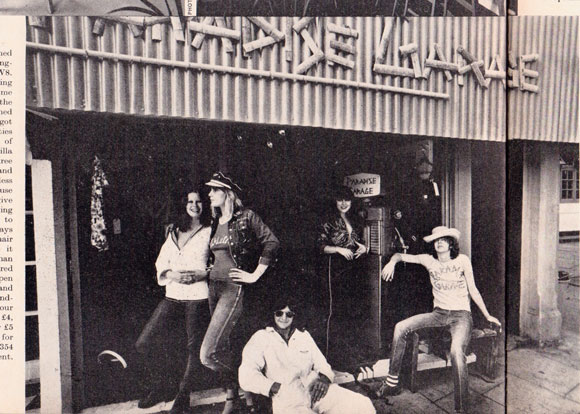
Harpers & Queen ran this photograph of the short-lived but significant World’s End boutique Paradise Garage in the Shopping Bazaar section of the September 1971 issue.
//Photo detail (from left): SEX customers Danielle, Alan Jones + Chrissie Hynde; Vivienne Westwood; assistant Jordan.//
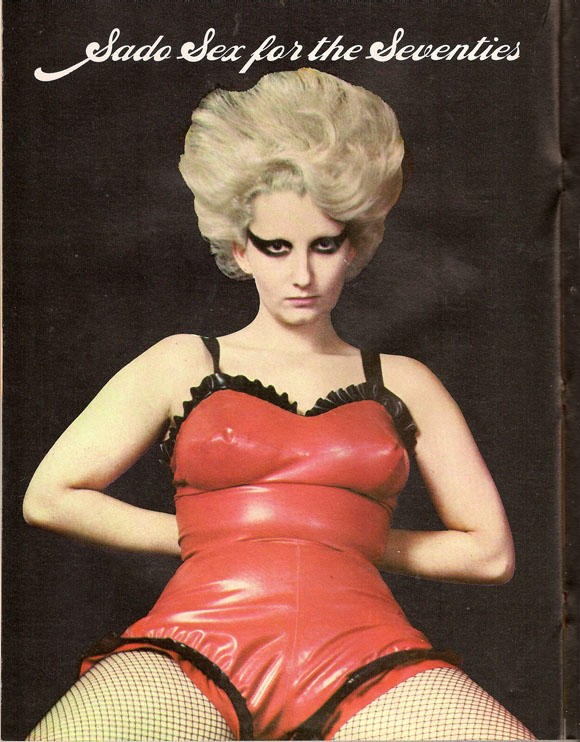
As a follow-up to my recent post about the rarely seen 1975 interview with Malcolm McLaren in soft porn mag Gallery International, here is another exclusive: for the first time since publication in June 1976, the full article featuring McLaren and Vivienne Westwood’s shop SEX in British sex guide Forum.
Tomorrow (October 11) is the publication date of The Look Of London, my map collaboration with the pre-eminent modern guide-makers Herb Lester Associates.
“This map is a reminder that London, with all its individuality and character, is still very exciting,” writes Paul Smith in the foreword; he opened at 44 Floral Street WC2 in 1979.
//Sex assistant Jordan, Gallery International, Vol 1, no 4.//
It’s unlikely that cities will shake or nations start to rock under the impact of Malcolm McLaren’s sexual revolution. A few people might die though.
Malcolm McLaren, at 30, is a mixture of entrepreneurial cultist, sexual evangelist, businessman, artist, fetishist and political philosopher; a psychotic visionary in the ephemeral subculture of the fashion world.
David May, Gallery International Vol 1 no 4.
In November 1975 – by which time his charges the Sex Pistols had just embarked on live performances – Malcolm McLaren was interviewed by journalist David May at 430 King’s Road, then in full bloom as radical retail venture SEX.
Tucked away at the back of an issue of British soft-porn magazine Club International was a fashion shoot featuring clothing elements which denoted the crystallisation of the new art-directed glam aesthetic inaugurated by the release of Roxy Music’s first album a couple of months previously.
The photographer was Karl Stoecker, the New Yorker who had been resident in the UK since the mid-60s and was coming into his own with important contributions to Roxy’s visual identity across that LP and its successors For Your Pleasure and Stranded.