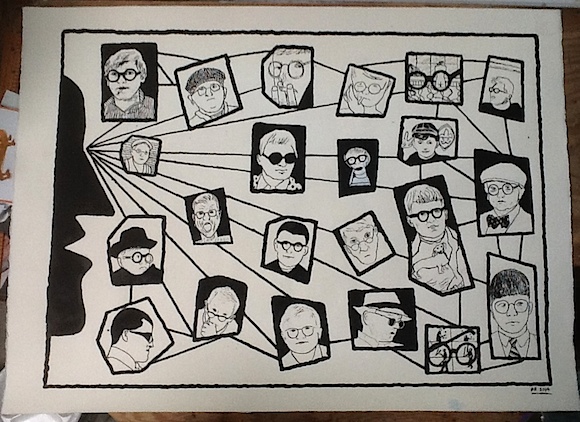
//David Hockney 22 Times, Derek Boshier, 2014. 31 x 42 inches. Ink on Archer’s paper//
I’m delighted to announce that David Hockney has written the preface to Rethink/Re-Entry, the Derek Boshier monograph I am editing.
In the piece, Hockney points out that they have known each other since 1957, and that Boshier “like me, is an artist, and one who has never lost his wonder at the world”.
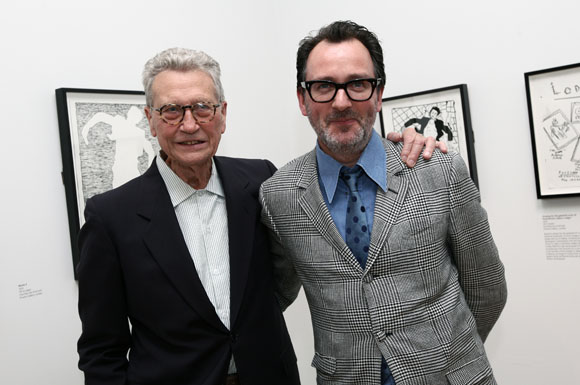
//Derek Boshier and I at the opening of his 2012 exhibition David Bowie + The Clash at Pallant House Gallery, Chichester, Sussex//
//Berries – 8 Yellowy Green Female Forms, Malcolm McLaren, 1969. Mixed media, 5 x 4’. Photo (c) Barry Martin/Malcolm McLaren Estate//
“I started out in art school as a painter. I studied there for eight years and most of my education was based around the visual arts. I learnt all my politics and understanding of the world through the history of art.”
Malcolm McLaren speaking on British arts documentary series the South Bank Show, 1983
//I Will Be So Bad, Malcolm McLaren, 1969. Oil on canvas, 15 x 12”. Photo (c) Barry Martin/Malcolm McLaren Estate//
Among the exhibits at Let It Rock, the Malcolm McLaren room at this autumn’s group exhibition Art In Pop at Magasin in Grenoble, are never-previously exhibited photographs of the late cultural iconoclast’s paintings taken by his teacher Barry Martin during McLaren’s student days in the 60s.
These are discussed in this extract from the exhibition introduction:
In the summer of 1969, at the end of his first year of the fine art course at London’s Goldsmith’s School Of Art, the 23-year-old student Malcolm Edwards showed 10 or so gestural paintings, mainly oils on canvas with some integrating text statements and others used as the basis for mixed media experimentation incorporating chicken wire, hammered wood planks and, in one case, an inverted paper envelope against depictions of leaf forms.
//Map Of British Isles With Yellow Star And Hole, Malcolm McLaren, 1969. Oil on canvas, 7 x 4’. Photo (c) Barry Martin/Malcolm McLaren Estate//
During a 90-minute critical review by his teacher Barry Martin, Edwards (soon to revert to his birth-name of McLaren) declared his rejection of the limitations imposed by traditional art forms, in particular painting.
McLaren subsequently destroyed all but one of the works. In a symbolic statement the exception, the largest canvas – the 7ft tall Map Of British Isles With Yellow Star And Hole, into which he had already kicked a sizeable hole – was left to rot in the summer rain in the yard at the back of the college. Eventually it was torn apart and taken away by the dustbin-men.
//The Intangible Manipulation Of Minds, Malcolm McLaren, 1969. Mixed media, 4’6″ x 4’6”. Photo (c) Barry Martin/Malcolm McLaren Estate//
McLaren dedicated his remaining two years at Goldsmith’s to organization of events and film-making, one about his hero, the early British rock’n’roller Billy Fury merged into an unfinished commentary on consumerism centred on the history of London’s main commercial thoroughfare, Oxford Street.
In doing so McLaren was inserting himself into the lineage back to Duchamp which included such figures as the Dutch Situationist Asgar Jorn, who had proclaimed “Painting is dead” in 1958, and in particular Andy Warhol, who explained his sponsorship of The Velvet Underground in 1967 by saying: “Since I don’t really believe in painting anymore we have a chance to combine music and art.”
//Leaves, Nature And Cuts, Malcolm McLaren, 1969. Mixed media, 4 x 3’. Photo (c) Barry Martin/Malcolm McLaren Estate//
McLaren later described his decision to open the boutique Let It Rock in London’s King’s Road on exiting the art school system in 1971 as “jumping into the musical end of painting”; here McLaren blazed the trail dictated by his formidable art education by creating new artworks as fashion pieces out of the juxtaposition of found objects.
//Words Trapped In Brick Compartments With Prostrate Figures, Malcolm McLaren 1969. Oil on canvas, 5 x 4’. Photo (c) Barry Martin/Malcolm McLaren Estate////14 Pink Figures On Moving Sea Of Green, Malcolm McLaren, 1969. Oil on canvas, 12 x 15”. Photo (c) Barry Martin/Malcolm McLaren Estate//
Thanks to Barry Martin for his insights and assistance in putting together the Malcolm McLaren segment of Art In Pop. Martin continues to practice as an artist and sculptor; this is his website.
Art In Pop, which opens on Saturday, is curated by Magasin’s Yves Aupetitallot with John Armleder, Young Kim of the Malcolm McLaren Estate, John Miller and I. The exhibition runs until January 4, 2015 at Le Magasin, Site Bouchayer-Viallet, 8 Esplanade Andry Farcy, 38028 Grenoble.
//Positioning the 430 shop logos in the Malcolm McLaren room at Art In Pop. Photo: Magasin head of production Eric Pourcel//
‘Black is the most exciting colour’ (Goya). Black when used in different ways appears the most infinite and mysterious, the most spatial and loose. Malcolm McLaren, essay for course at Croydon Art School, 1967
It’s exciting. Work is underway on building the Art In Pop group exhibition which opens next month at Le Magasin, France’s National Centre for Contemporary Art in Grenoble.
//McLaren’s first logo at 430 King’s Road was featured on the side of a 12m installation at Let It Rock at CIFF this summer. Foreground image of McLaren in Central Park, spring 1975, by Bob Gruen. Photo: Jean Francois Carly/Malcolm McLaren Estate////The Too Fast To Live shop frontage in this 60 x 40″ blow-up at CIFF//
Featuring artworks by musicians such as Don Van Vliet and Daniel Johnstone as well as musical ventures by artists including John Armleder and John Miller, Art In Pop incorporates the sizeable space dedicated to Let It Rock, the show exploring the work of the late Malcolm McLaren.
This will focus on McLaren’s investigations into the visual arts from the 60s to his death in 2010 along with the engagements with commercial media such as fashion, film and music for which he is best known.
In line with Let It Rock’s manifestation at the Copenhagen International Fashion Fair this summer, the pink-on-black Let It Rock sign will be recreated, this time at the entrance to the Malcolm McLaren room.
For Art In Pop the sign is being matched by a giant reproduction of the shop logo which followed Let It Rock at 430 King’s Road: Too Fast To Live Too Young To Die.
The dominant use of black behind these logos riffs on McLaren’s repeated use of the colour in his work and should make for an impactful introduction to the show, which will feature hundreds of exhibits from throughout the cultural iconoclast’s artistic life.
//Founded in 1986, Le Magasin – Centre National d’Art Contemporain is housed in an industrial hall built for the 1900 Paris World’s Fair by the workshops of Gustave Eiffel//
Art In Pop – which is curated by Magasin’s Yves Aupetitallot with John Armleder, Young Kim of the Malcolm McLaren Estate, John Miller and I – runs from Oct 11 to January 4, 2015 at Le Magasin, 8 esplanade Andry Farcy, 38028 Grenoble.
//Malcolm McLaren outside 430 King’s Road, March 1972. Photo: Mirrorpix//
In the shop’s various incarnations I made clothes that looked like ruins. I created something new by destroying the old. This wasn’t fashion as a commodity; this was fashion as an idea.
From his foreword to The Look: Adventures In Rock & Pop Fashion, Malcolm McLaren, 2001
The first exhibition to examine the late cultural iconoclast Malcolm McLaren’s engagement with fashion in the 70s and early 80s is to be held next month in Copenhagen.
Let It Rock: The Look Of Music The Sound Of Fashion – curated by Young Kim of the Malcolm McLaren Estate and me – is being staged from August 3-6 as part of the Copenhagen International Fashion Fair; creative directors Pierre Tzenkoff and Arnaud Vanraet have commissioned the show in conjunction with an exhibition entitled Industrial by Nature by streetwear guru Virgil Abloh.
Let It Rock will investigate McLaren’s deep roots in fashion (his mother + stepfather operated the womenswear brand Eve Edwards in the 50s and 60s and his grandfather was a master tailor’s cutter) and will also demonstrate how he drew on his art-school investigations into environments to become the progenitor of the pop up shop concept.
Let It Rock revolves around an installation dedicated to the shop from which it takes its title, complete with a recreation of the frontage in black corrugated iron and pink rock&roll signage McLaren designed when he opened the premises with Vivienne Westwood in 1971.
The exhibition is divided into six sections each dedicated to the manifestations at 430 King’s Road as well as Nostalgia Of Mud, the outlet operated by McLaren and Westwood at 5 St Christopher’s Place in London’s West End from 1982 to 1984.
These sections will all feature rarely-seen and never previously publicly-exhibited clothing designs, photography, sketches, notes, magazine spreads and even pages from McLaren’s notebooks.
Among the exhibits is McLaren’s own ‘I Groaned…” t-shirt from Sex, the Chico hat and grey Crombie coat he wore in the famous portrait for the Witches collection taken by Steven Meisel for Vogue in 1983, the short sheepskin jacket worn through the Buffalo Girls and Duck Rock period and a Let It Rock drape suit fitted personally by McLaren for guitarist songwriter Marco Pirroni.
//McLaren modelling Witches in the Chico hat and Crombie coat with Talisa Soto and Vivienne Westwood by Steven Miesel, US Vogue, June 1983////Button, pocket and cuff detail of Marco Pirroni’s drape jacket fitted by McLaren and made by Sid Green, 1974////Leather t-shirt with Let It Rock label from 430 King’s Road in summer 1974 during the transition from Too Fast To Live Too Young To Die to Sex//
Ben Kelly – who realised the design for the exterior of Seditionaries in 1976 and is now professor of interiors & spatial design at University Of The Arts London – is contributing photographs taken of his work at the time for his portfolio and there is a very special leather t-shirt bearing a Let It Rock label during the transition in 1974 to the incarnation as Sex.
Contributors also include photographers Robyn Beeche, Bob Gruen, the David Parkinson Estate and Sheila Rock as well as others close to McLaren during his game-changing adventures in the fashion world.
Find out more about the show on the CIFF site here.
John Beck and Matthew Cornford’s intelligent and measured book The Art School And The Culture Shed may be a slim volume but it packs a hell of a punch in locating the ravages wreaked on our cultural life over the past 20 years by privatisation, the failings of local councils and town planners and the depredations of property developers.
//Left: Moseley School Of Art, closed 1975. Right: The site of Sidcup School Of Art, occupied since 2010 by a Morrisons and a car park//
//Robyn Denny, early 60s. Photo: Bernard Jacobson Gallery//
Artist/illustrator Peter Knock pays tribute to the British ‘Situation’ painter Robyn Denny, who has died:
Sad to learn of the death of abstract painter Robyn Denny last Tuesday (May 20). It surprised me that he was, in fact, 83; my image of him is locked into the 60s when he was one of the hip and talented artists to have emerged from the Royal College of Art (where he studied in the 50s).
Great Big Biggest Wide London, Denny’s mural for Austin Reed’s Regent Street store, conveyed classic 1960s new age optimism, and received the ultimate seal of approval as a piece defining of its era when The Beatles asked to be photographed standing in front of it in 1963.
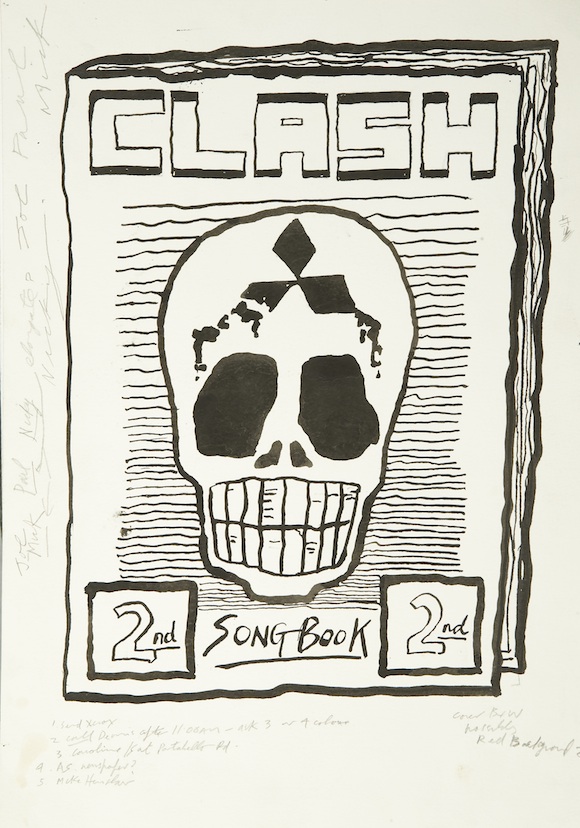
//Sketch for songbook cover, 13 x 9″. Derek Boshier 1979 courtesy Flowers Gallery//
While interrogating materials for Rethink/Re-Entry – the monograph of artist Derek Boshier I am editing – I’ve come across many delights, including these sketches in the Flowers Gallery archive for one of the most visually striking documents of the post-punk era, CLASH 2nd Songbook.
“There is a moment when ‘good taste’ becomes dead; what has been considered ‘bad’ is suddenly found to be invigorating. Fashion today has little to do with la mode and the tacky is often accepted as an essential part of the necessary ‘total’ look. It can be fun.”
Cecil Beaton, introduction to the catalogue for the 1971 V&A exhibition Fashion: An Anthology
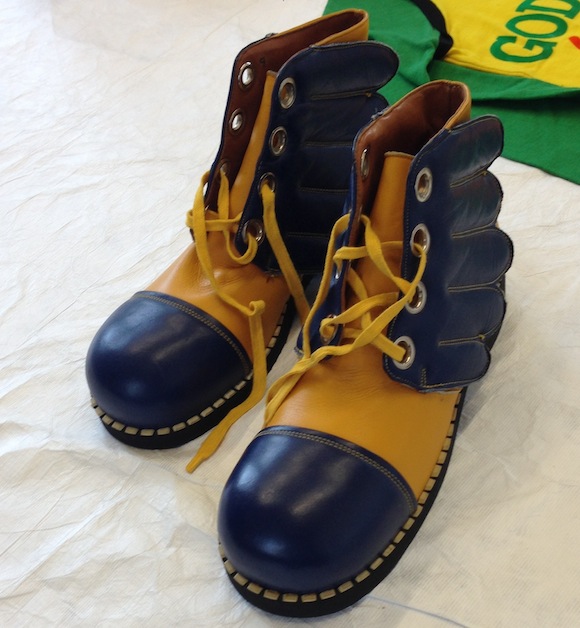
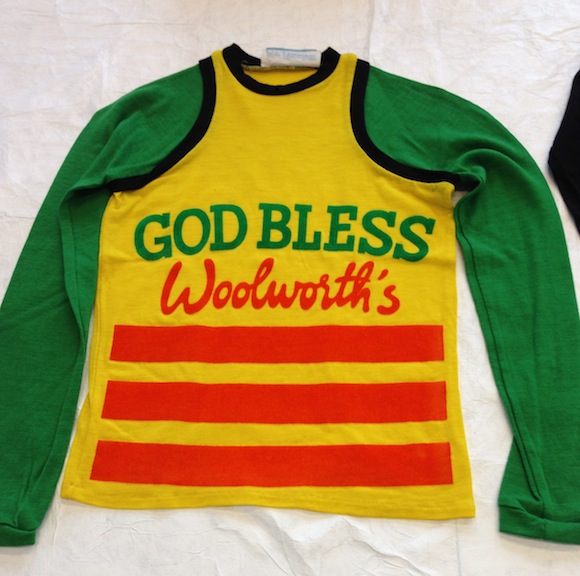
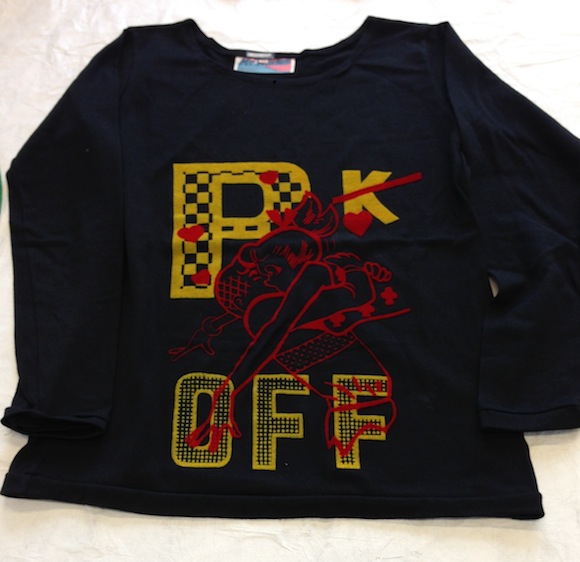
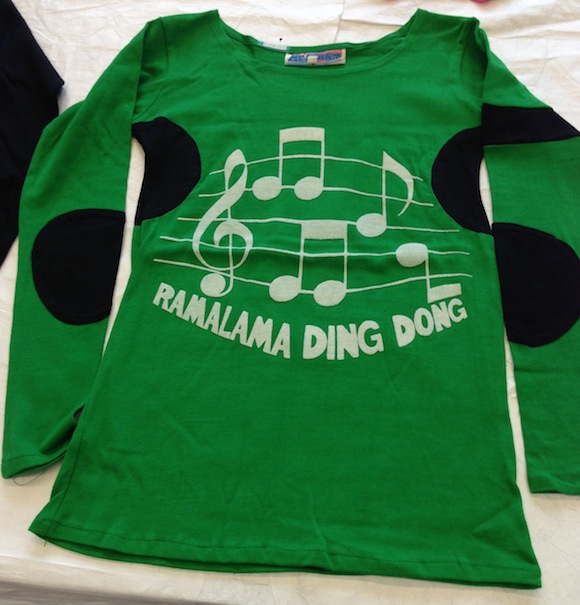
Recent visits to the V&A’s Archive of Art & Design have proved fruitful, particularly a viewing earlier this week of the collection of Pop Art clothing sold through London boutique Mr Freedom in the late 60s and early 70s.
//Design: Diana Crawshaw, 1971////Kiss Off t-shirt, Jim O’Connor, 1971////Design Christopher Snow/Trevor Myles, body design: Diana Crawshaw, 1971////Design: Pamla Motown, 1971//
//Richard Wernham, Nick Garvey, Robert Gotobed, Rob Smith on the front cover of Teenage Head/Lights Out by The Snakes, Dynamo Records, 1976//
I went to a good school (it was approved, as my first editor would have it in the late 70s. You had to be there).
I was taken on as a scholarship boy, one who showed enough promise for the fees to be paid by the council.
But I was lazy, not as bright as I made out, unhappy, an under-achiever. Aside from winning the cross-country race when I was 14, my life there was almost entirely undistinguished, so preoccupied was I with music, clothes and girls. I had pretensions to vast knowledge in all three areas undercut by lack of experience in the latter regard.
//Booklet with Quadrophenia, an album about "a cat with four personalities" according to me, 1973////School report 1975: "If Paul is as familiar with DG Mackean's Introduction To Biology as he is with the NME, he will pass his O-Level. As it is, he isn't, so I fear he won't." And I didn't//
Today the National Portrait Gallery unveiled Imaginary Portraits, a selection of works by artist Derek Boshier, who is the subject of a monograph I am editing.
Prominent are two studies of David Bowie; an oil-on-canvas painting executed in New York in 1980 while Bowie was rehearsing for his role in Bernard Pomerance’s play The Elephant Man at the city’s Booth Theatre and a 1981 ink-on-paper drawing which resulted from Boshier’s design for the sleeve for the album Lodger a couple of years earlier.
//Outer gatefold sleeve, Lodger, David Bowie, RCA, 1979. Design Derek Boshier, photography Brian Duffy//