Ola Hudson in the 1970s. Photo: Ola Hudson Archive, courtesy Ash Hudson. No reproduction without permission.Fashion sketch and negatives. Ola Hudson Archive, courtesy Ash Hudson. No reproduction without permission.Bowie in Ola Hudson suit on the set of The Man Who Fell To Earth, New Mexico. Photo: StudioCanal.
I’m extremely grateful to artist/designer/photographer Ash Hudson for sending precious photographs and design sketches from the archive of his late mother Ola Hudson, the super-talented fashion designer and costumier best known for providing David Bowie with the formal yet other-worldly collection of garments he wore in Nicolas Roeg’s 1976 film The Man Who Fell To Earth and as The Thin White Duke on the subsequent Isolar world tour.
//The Michael Joseph image which was to be central to the 1971 Fernet-Branca campaign was featured in Dave Saunders’ survey Sex In Advertising, published by Batsford Books in 1996//
//Front, Funk Spectrum, BBE Records, 1999. Photo: Michael Joseph//
//Back, Funk Spectrum, BBE, 1999. Photo: Michael Joseph//
In 1971 the great advertising director and photographer Michael Joseph was commissioned to shoot a billboard campaign for the Italian digestif Fernet-Branca.
//Jordan Mooney and David “Piggy” Worth. From photo by Patrick Lichfield, 1976//
//As they appeared in the Parlophone full-page advert for The Beatles compilation Rock “n”Roll Muisc, New Musical Express, June 26, 1976//
“He was a man full of wit and charm who always had an eye for new and exciting things. His special characteristics were kindness and forethought”
Jordan Mooney, 2016
Following my recent blogs on the life of the late fashion model David “Piggy” Worth, here is a gem: Sex and Seditionaries superstar Jordan Mooney recalls her friend and in particular the time Worth urged her to join him in a 50s photoshoot by royal photographer Patrick Lichfield.
This was used for an advert and poster promoting Rock ‘N’ Roll Music, a compilation of previously released cover versions recorded by The Beatles between 1962 and 1970.
It is a great honour to feature this guest post by the artist and thinker Judy Nylon about her friend David “Piggy” Worth and their life and milieu in London at the turn of the 70s (brought up in Boston, Nylon had arrived in the UK capital at the start of the decade). The photographs, like those posted here at the weekend, were taken by Tony Hall as he set out on his career in photography, and have not been previously published…
THERE was a time when I smoked and owned skirts.
I lived at 14 Edith Grove, just south of Fulham Road, in a house owned by Donald and David Cammell just after they’d done Performance.
Piggy lived further down Edith Grove below the King’s Road, in a basement flat that was like stepping into his imagination. He had collections of clothes, props and small objects.
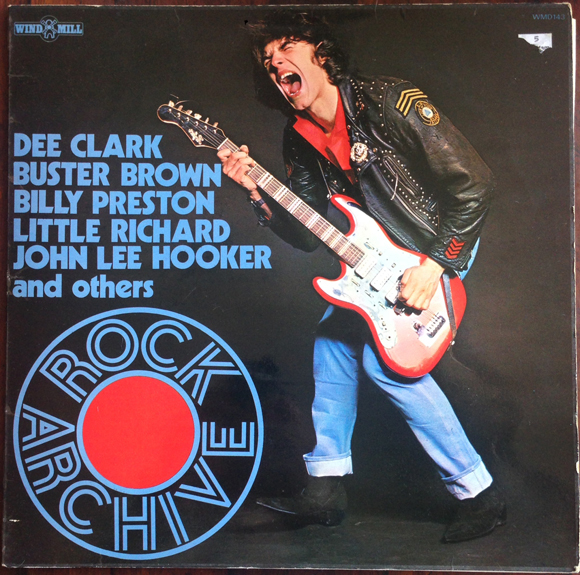
//Front cover, Rock Archive, Various Artists, Windmill Records, 1972//
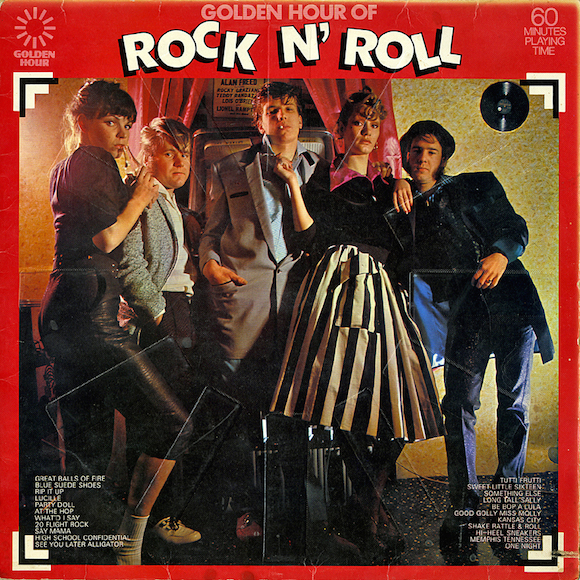
It is relatively common knowledge among those interested in the careers of Malcolm McLaren and Vivienne Westwood and their series of extraordinary shops that they supplied clothes to the 1973 album Golden Hour Of Rock & Roll; Let It Rock at 430 King’s Road was clearly credited on the back of the record sleeve.
//Front cover, The Golden Hour Of Rock N Roll, Various Artists, Pye/Golden Hour, 1973//
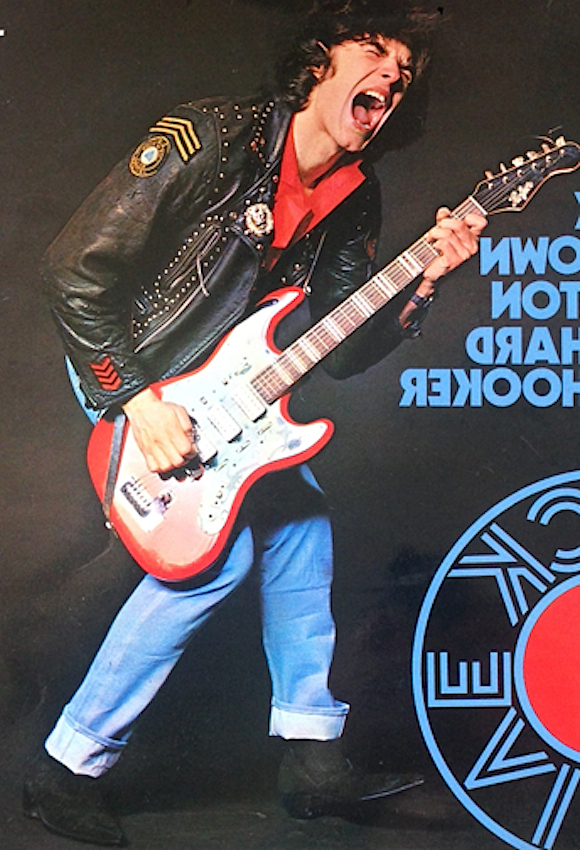
//The photograph on the Rock Archive cover was flipped to better accommodate the text. Here it is as originally shot//
But I have fresh information which helps towards a greater understanding of McLaren’s project to investigate the detritus of popular culture’s recent past. During a bout of research recently I came across this earlier and hitherto undocumented use of Let It Rock clothing in a music context: the front cover of Rock Archive, a budget LP compilation released by the specialist British independent label Windmill in 1972.
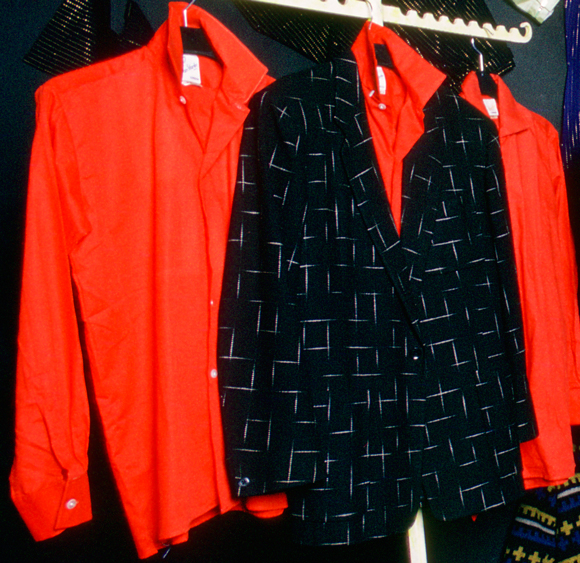
And I am detailing the clothes on the cover with images taken inside Let It Rock which have never been previously published.
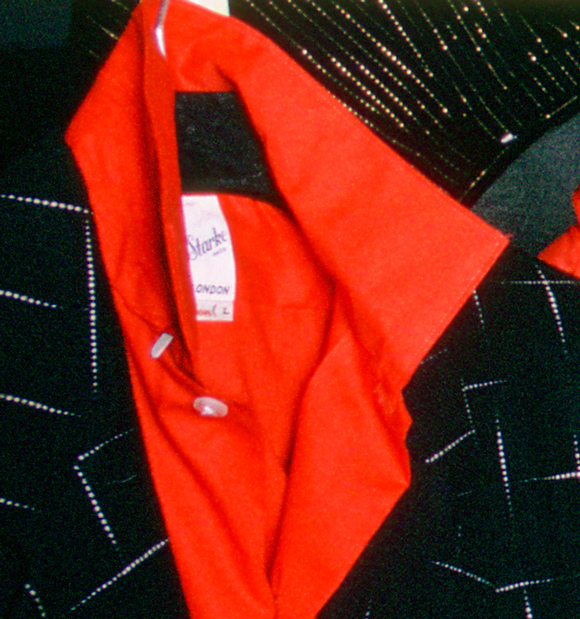
//Starke shirts with 50s sports jacket on Let It Rock wall, January 1972. Photograph: David Parkinson//
//Starke label detail//
Each garment worn by the model – whose attempts at rocking out resulted in his giving every appearance of suffering considerable pain – comes from the deadstock of British brands assiduously assembled by Malcolm McLaren and his art-school friend Patrick Casey for the opening of the world’s first avowedly post-modern retail outlet in November 1971.
From the ground up, the Rock Archive cover star wore black suede Denson’s Fine Poynts, ice-blue Lybro jeans with 5in cuffs, a Frederick Starke flyaway collar shirt and a studded and decorated Lewis Leathers early 60s Lightning jacket (which featured a highly collectable 6-5 Special patch).
The fabulous Peggy Noland has selected four online clips loosely linked by the theme of transformation for LA’s Museum Of Contemporary Art channel MOCAtv:
• A “haul video” from Mall Of America made by dedicated shopper PiinkSparkles
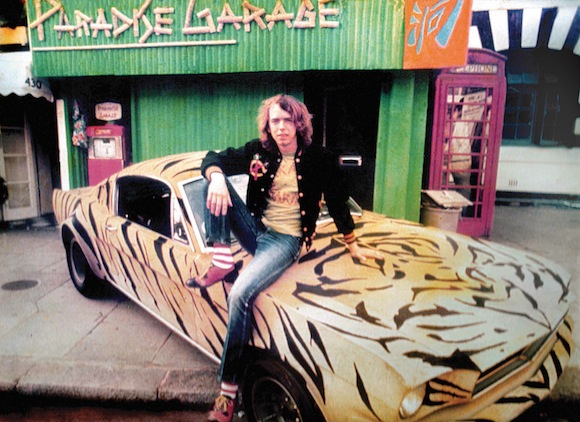
//Trevor Myles, Mustang and 430 King's Road, late summer 1971. Photo: Michael Roberts//
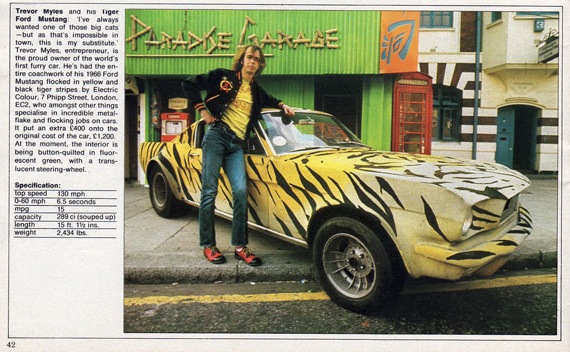
//From Michael Roberts' article Men & Their Machines, Club, October 1971//
Trevor Myles’ decision to incorporate a flocked and tiger-striped 1966 Ford Mustang as part of his retail space Paradise Garage naturally attracted a lot of attention during the brief existence of this unusual fashion outlet at 430 King’s Road in Chelsea’s World’s End in 1971.
Paris, Capital of the XXIst Century is a personal and subjective journey that began firstly by ambling through a century’s archive of thousands of cinema commercials about the city (its inhabitants, what it sells, how it looks…), secondly by gathering impressions (choosing what to exploit, covet and keep), jotting them down only when I returned to my studio. Then, using these specific scenes as a palette and my voice as a brush, twenty-one portraits emerged of a Paris I had never witnessed before.
Malcolm McLaren November 2009
Tomorrow (June 10), Art Basel will host a screening of Malcolm McLaren’s final artwork, Paris, Capital of the XXIst Century.