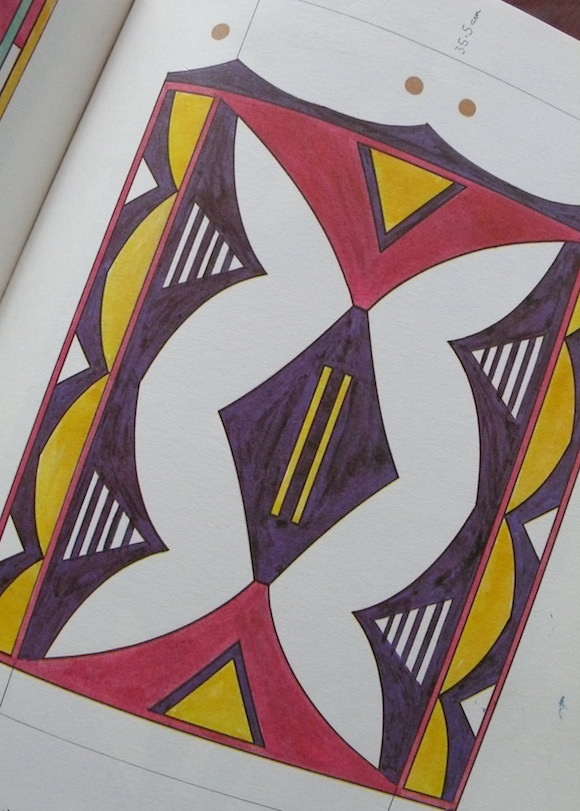
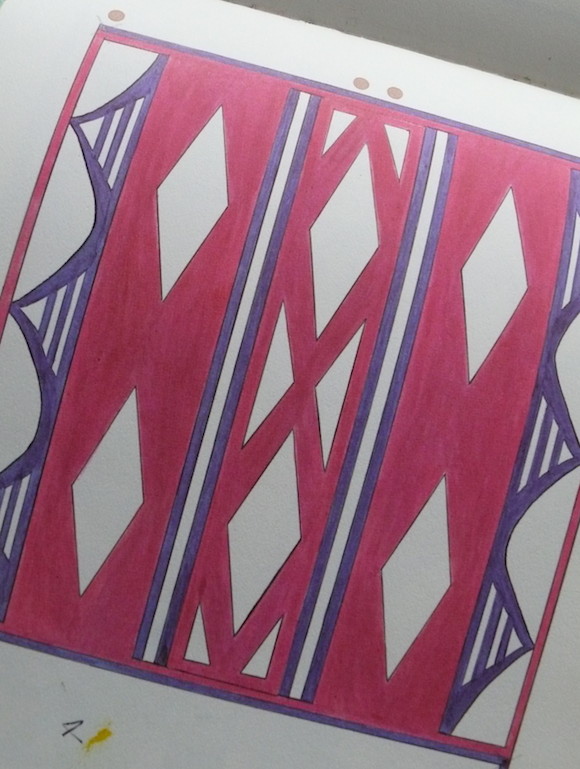
//Malcolm McLaren’s copy of Mable Morrow’s Indian Rawhide: An American Folk Art, published by Oklahoma University Press as part of the Civilization Of American Indian series in 1975////Annotated page showing design for a parfleche (painted hide) of the Dakota////Savages dress in thick marl and cotton with overprinted lettering. Design: Malcolm McLaren and Vivienne Westwood for Worlds End, 1981. Private collection//
Among the most revealing exhibits at the Malcolm McLaren show Let It Rock is the cultural iconoclast’s copy of a folk art book which proved a rich source of reference when he came to design the Savage collection with Vivienne Westwood in 1981.
McLaren’s consistent approach to creative activity always began with deep research (from the first publicly recognised manifestation, the Teddy Boy outlet Let It Rock, to his final film artworks Shallow 1-21 and Paris: City Of The XXIst Century).
And in the early 80s, McLaren’s copy of Mable Morrow’s Indian Rawhide, published by Oklahoma University Press in 1975, proved inspirational for this lifelong fan of Native American Indian culture.
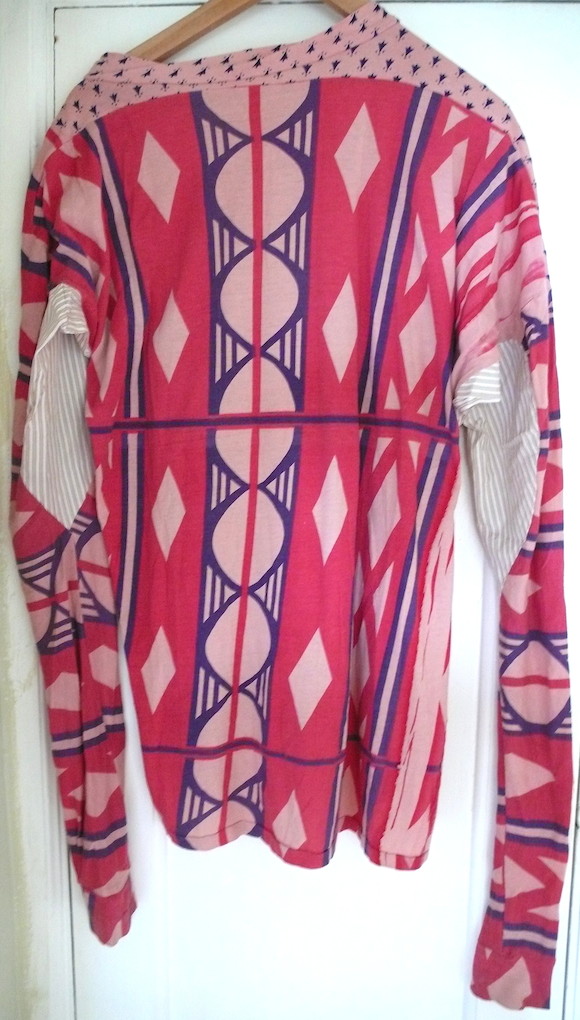
//Assiniboin parfleche design collected on the Fort Belknap Reservation, Montana////Savages soft jersey top with contrasting armpit inserts and neck yolk. Designed by Malcolm McLaren and Vivienne Westwood for Worlds End, 1981. Private collection.//
McLaren’s recasting of this folk art in the sphere of fashion aligns his work in the 70s and 80s with the post-modern practice of appropriation which infused all spheres of artistic endeavour at the time, from literature to film and fine art. It is arguable that he and Westwood were the first and the greatest to incorporate the approach in clothing design.
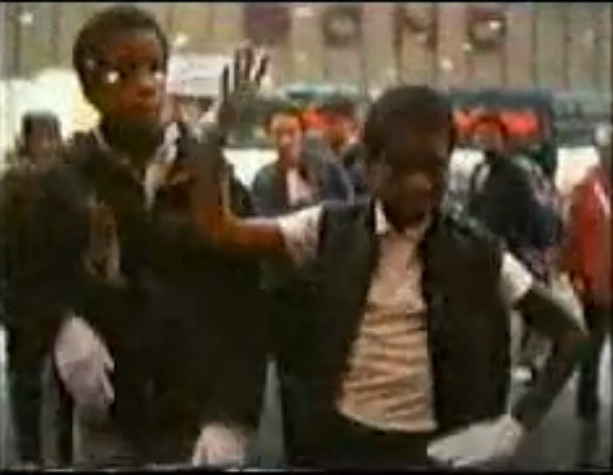
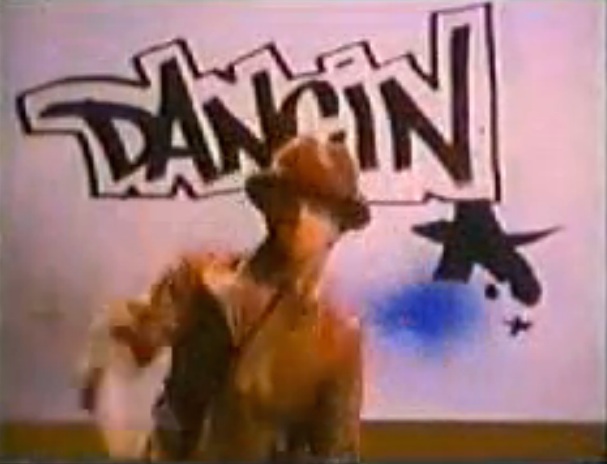
When Savage debuted in October 1981 at Olympia’s Pillar Hall in west London, the repurposing of Native American tribal prints across a range of fabrics and garments – some overprinted with block capital slogans such as “Breaker” and “Girly” – and meshing with contemporary urban black culture and streetwear proved groundbreaking in fashion terms, as can be seen in this film commissioned for the event by McLaren:
Indian Rawhide and the clothing featured in this post are among the many rare and unique exhibits in Let It Rock: The Look Of Music The Sound Of Fashion, which is at the Crystal Hall in Copenhagen’s Bella Center from August 3-6.
//Front cover, Dances Of The World’s Peoples, Vol 3, Folkways Records, 1958. Design: W. Johnson, printed on paper glued to cardboard sleeve.////Front of four-page song and information sheet utilising W.Johnson’s design, paper, 1958////Invitation card to Paris show of McLaren and Westwood’s Nostalgia Of Mud collection, March 1982. Design: Nick Egan. Courtesy Malcolm McLaren Estate//
The idea is to show in clothes and music that, in the post-industrial age, the roots of our culture lie in primitive societies. Malcolm McLaren on Nostalgia Of Mud and Duck Rock, 1983
Thanks to Hiroshi Fujiwara for tipping the wink over one of the sources of visual inspiration fed by Malcolm McLaren into the concepts unified by his solo album Duck Rock, the central London clothing store Nostalgia Of Mud and the fashion collections he designed with Vivienne Westwood in 1982-3.
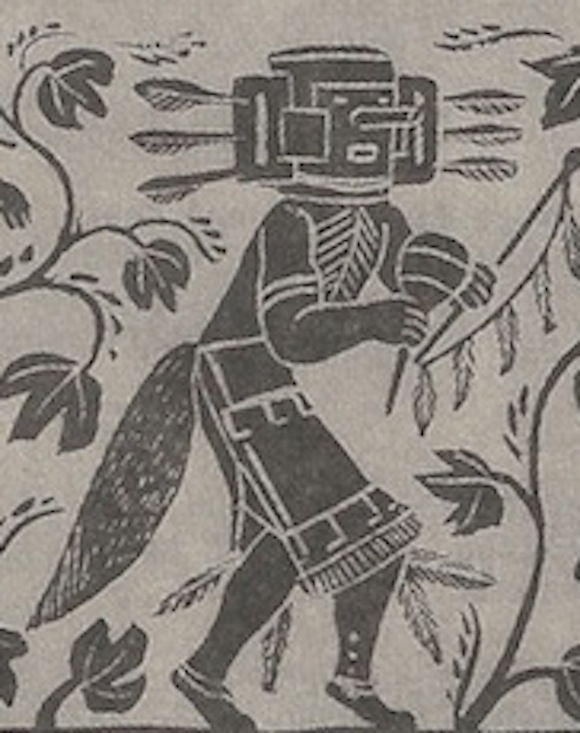
//Witchdoctor figure from W. Johnson’s design////Figure recast by McLaren and Westwood with Keith Haring adornments on cotton top from Witches collection, 1983. From private collection//
One of the cues for Duck Rock’s investigations into music from all over the world was the series of recordings by enthnological music archivists Ronnie and Stu Lipner released on Folkways Records in the late 50s under the banner Dances Of The World’s Peoples. And McLaren’s appropriation of the naive cover art by W. Johnson – in particular the striking witchdoctor figure – found new form in design collaborations with Westwood, graphics supremo Nick Egan and artist Keith Haring.
//Nostalgia Of Mud pattern show card, 1982. Courtesy Malcolm McLaren Estate//
McLaren’s brilliance at fusing disparate elements into culture-defining and dazzling artworks is being celebrated next week with the exhibition Let It Rock: The Look Of Music The Sound Of Fashion at the Crystal Hall in Copenhagen’s Bella Center.
The show – which runs from August 3-6 during Copenhagen Fashion Week – will incorporate hundreds of exhibits, many rare and never previously shown to the public, including clothing and objects featured here such as the Witches top, the show cards and original copies of the Dances Of The World’s Peoples LP and catalogue.
The exhibition Disobedient Objects opens at the V&A tonight; here curator Catherine Flood – who originated the concept for the show – talks me through five exhibits which embody the spirit of contemporary protest.
TEAR GAS MASKS MADE FROM WATER BOTTLES
//How To guide: Makeshift Tear-Gas Mask. Illustrated by Marwan Kaabour at Barnbrook//
Disobedient objects are often those which are simply to hand and waiting to be re-purposed. These masks made from water bottles were used during last year’s Gezi Park protests in Istanbul as a response to the unprecedented amounts of teargas used against protestors in Taksim Square, and became symbolic – they were featured in street art and graffiti and there are photographs of whirling dervishes wearing them.
One of the key points of the exhibition is to demonstrate that excellent design can emerge from people with limited resources and not much time but brilliant ideas. These also show that design doesn’t have to be about professional practice or commercial purpose but can still make a wide impact; people also tweeted images from local chemists of the products which could be bought to make up a survival kit when gassed. As an accessible form of design we chose it for one of our “how to” guides because it is a great example of “swarm” design, documented by one group so that others can use them in different contexts.
PLACARDS IN THE DIGITAL AGE
//A message to you Vladimir. Gay rights activist protests at Putin’s re-election in 2012: “We won’t give it to Putin a third time.”////Protestor – who has subsequently had to leave Russia – with his placard, which was collected by Flood herself. She was in Moscow taking an exhibition down when the protests were on//
This placard was made for demonstrations against Putin’s re-election in 2012 and marked a different style of protest in Russia: rather than a crowd united under by one slogan, hand-painted placards were produced with personal, sometimes witty messages. There’s nothing especially innovative about hand-rendered placards but this time they were used in conjunction with social media so were a bit like tweets, conveying pithy messages which were photographed and put on Twitter.
This was created by a gay rights activist and says: “We won’t give it to Putin a third time,” apparently quite a crude reference in Russia and playing on his homophobia. The protestor told us that this was the first time the LGBT Rainbow colours were used in public. He has subsequently had to leave the country.
INFLATABLES
//Testing an inflatable hammer made by Eclectic Electric Collective at the Berlin Mauer Park, 2010. Photo: Jakub Simcik//
The Berlin-based Eclectic Electric Collective (now called Tools For Action) produce inflatables of protest objects such as cobblestones and hammers. When they’re thrown at police lines they change the dynamic of demonstrations; the police either become distracted by the big shiny thing or they throw it back and the exchange turns into a game, like a surreal version of volleyball.
It’s a really interesting way of occupying public space. This element of unruliness upsets the authorities because the protestors are not abiding by protocol and the accepted rules of engagement. The clever use of props – giant puppets have been used elsewhere – allows the protestors to wrest control.
In the same section of the show we have “bloc books”, painted shields in the form of giant works of literature and philosophy made by students protesting at education cuts. When they demonstrated, the students were effectively being defended by culture, and by striking the shields, the police not only invoked the destruction of books but were also forced into a performance without realising it.
This started off in Italy and was taken up in Britain and America by students who had seen them on social media.
The Eclectic Electric Collective made us a cobblestone for the exhibition. This is an issue with this material, because quite often it is destroyed in the process of protest.
EMBROIDERY
//Dónde están nuestros hijos (“Where are our children?”). Chilean Arpilleras wall hanging, Roberta Bacic collection. Photo: Martin Melaugh//
We start in the 70s and the rise of neo-liberalism; among the earliest objects in the show are Chilean appliqued textiles produced by women in workshops during the Pinochet regime. These documented the social realities of the disappearances, the tortures, the economic hardships. These worked on a number of levels.
Made from scraps of material, these were sold, so provided economic support, and in the act of gathering to make them, the women found solidarity and collective strength.
There are accounts of women saying that it was only when they had their eyes down on their sewing that they felt safety in confronting what was going on and were able to document what they were otherwise proscribed against speaking about.
These textiles often left the country, and were seen as innocent by the authorities because of their resemblance to folk art, but carried letters and communicated with the outside world. This technique spread, and we have examples from Colombia in 2010. It was also used in Ireland by women protesting against the use of Shannon Airport in extraordinary rendition.
THE TIKI LOVE TRUCK
//The Tiki Love Truck, Art Car Parade, Manchester, 2007. Photo: Paul Herrmann//
This is one of the biggest objects in the exhibition. Made by British ceramic and mosaic artist Carrie Reichardt, The Tiki Love Truck protests against the US death penalty. It’s an incredibly powerful piece, not least because it features the death mask of John Joe “Ash” Amador, who had corresponded with her and asked Carrie to be a witness at his execution.
Her friend Nick Reynolds went with her and cast the mask, which was woven into the truck and driven in the Art Car Parade in Manchester 10 days after the execution.
Disobedient Objects runs until February 1, 2015. More info here.
//Malcolm McLaren outside 430 King’s Road, March 1972. Photo: Mirrorpix//
In the shop’s various incarnations I made clothes that looked like ruins. I created something new by destroying the old. This wasn’t fashion as a commodity; this was fashion as an idea.
From his foreword to The Look: Adventures In Rock & Pop Fashion, Malcolm McLaren, 2001
The first exhibition to examine the late cultural iconoclast Malcolm McLaren’s engagement with fashion in the 70s and early 80s is to be held next month in Copenhagen.
Let It Rock: The Look Of Music The Sound Of Fashion – curated by Young Kim of the Malcolm McLaren Estate and me – is being staged from August 3-6 as part of the Copenhagen International Fashion Fair; creative directors Pierre Tzenkoff and Arnaud Vanraet have commissioned the show in conjunction with an exhibition entitled Industrial by Nature by streetwear guru Virgil Abloh.
Let It Rock will investigate McLaren’s deep roots in fashion (his mother + stepfather operated the womenswear brand Eve Edwards in the 50s and 60s and his grandfather was a master tailor’s cutter) and will also demonstrate how he drew on his art-school investigations into environments to become the progenitor of the pop up shop concept.
Let It Rock revolves around an installation dedicated to the shop from which it takes its title, complete with a recreation of the frontage in black corrugated iron and pink rock&roll signage McLaren designed when he opened the premises with Vivienne Westwood in 1971.
The exhibition is divided into six sections each dedicated to the manifestations at 430 King’s Road as well as Nostalgia Of Mud, the outlet operated by McLaren and Westwood at 5 St Christopher’s Place in London’s West End from 1982 to 1984.
These sections will all feature rarely-seen and never previously publicly-exhibited clothing designs, photography, sketches, notes, magazine spreads and even pages from McLaren’s notebooks.
Among the exhibits is McLaren’s own ‘I Groaned…” t-shirt from Sex, the Chico hat and grey Crombie coat he wore in the famous portrait for the Witches collection taken by Steven Meisel for Vogue in 1983, the short sheepskin jacket worn through the Buffalo Girls and Duck Rock period and a Let It Rock drape suit fitted personally by McLaren for guitarist songwriter Marco Pirroni.
//McLaren modelling Witches in the Chico hat and Crombie coat with Talisa Soto and Vivienne Westwood by Steven Miesel, US Vogue, June 1983////Button, pocket and cuff detail of Marco Pirroni’s drape jacket fitted by McLaren and made by Sid Green, 1974////Leather t-shirt with Let It Rock label from 430 King’s Road in summer 1974 during the transition from Too Fast To Live Too Young To Die to Sex//
Ben Kelly – who realised the design for the exterior of Seditionaries in 1976 and is now professor of interiors & spatial design at University Of The Arts London – is contributing photographs taken of his work at the time for his portfolio and there is a very special leather t-shirt bearing a Let It Rock label during the transition in 1974 to the incarnation as Sex.
Contributors also include photographers Robyn Beeche, Bob Gruen, the David Parkinson Estate and Sheila Rock as well as others close to McLaren during his game-changing adventures in the fashion world.
Find out more about the show on the CIFF site here.
John Beck and Matthew Cornford’s intelligent and measured book The Art School And The Culture Shed may be a slim volume but it packs a hell of a punch in locating the ravages wreaked on our cultural life over the past 20 years by privatisation, the failings of local councils and town planners and the depredations of property developers.
//Left: Moseley School Of Art, closed 1975. Right: The site of Sidcup School Of Art, occupied since 2010 by a Morrisons and a car park//
//Jacket photograph Terry Richardson with shots from Walrod’s Instagram feed//
Design authority Jim Walrod wears a deep and wide-ranging understanding of his subject – specifically that pertaining to modernism in furniture, interiors, product design and architecture – lightly.
This is refreshing in a field populated by bloodless experts and humourless know-alls. The founder of important 90s/00s store Form & Function, Walrod – described as “the ultimate design raconteur” by André Balazs and “the furniture pimp” by the Beastie Boys – is above all an enthusiast.
Beat This: A Hip Hop History is an hour-long documentary broadcast by BBC in its Arena strand in 1984 and directed by Dick Fontaine (who I interviewed for my Goldie book back in the early 00s).
In one section Malcolm McLaren talks about his August 1981 introduction to Afrika Bambaataa’s Zulu Nation in the south Bronx.
This was effected by artist/filmmaker/writer Michael Holman; his often overlooked achievements include actually naming the genre “hip hop” in his East Village Eye column, founding the noise group Gray with Jean-Michel Basquiat (Holman also wrote the 1996 Julian Schnabel-directed biopic), running the world’s first hip-hop club (Negril, on 11th Street), creating the New York City Breakers and making the films and TV shows Catch A Beat, Beat Street and Graffiti Rock.
//Jack Henry Moore (right) outside the Melkweg, Amsterdam with fellow film-makers Kit Galloway and Dave Jones, early 70s. Photo: The Generalist/The Videoheads//
Jack Henry Moore – who has died aged 73 – was one of the unpindownables of the counterculture in the 60s and 70s.
Known principally as a pioneering video film-maker and sound recordist (the archive he leaves behind is estimated to contain more than 70,000 hours of tape compiled over five decades), Moore was central to the establishment of many of the foundation stones of the underground in London and other European cities.
//With Lennon and Ono 1968. Photo: The Generalist/The Videoheads//
Moore joined fellow ex-pat American Jim Haynes in his theatrical experiments in Edinburgh in the mid-60s, where they staged productions by the likes of Lindsay Kemp. As in his native Oklahoma, Moore’s openness about his homosexuality necessitated a geographical shift, this time south to London.
//David Holah in Solitude, directed by John Maybury. 11mins, 1981//
One of the choice selections to be screened as part of this month’s post-punk film season This Is Now is Solitude, the 1981 John Maybury short featuring David Holah, then a fashion student, soon to launch the era-defining label Bodymap with Stevie Stewart.
Put together by British Film Institute curator William Fowler, This Is Now is on at London’s South Bank and explores the early 80s explosion in DIY creativity in this field among UK art students, clubbers, New Romantics and members of the post-punk scene, all of whom embraced inexpensive domestic technology such as VHS and Super 8 to make often bold and uncompromising statements.
I’m agnostic about Steve Nicks (though I have been to The Night Of 1,0000 Stevies), but this is mesmerising.
Mrs G turned me onto this. It seems Nicks was listening to a backing track of then-new composition Wild Heart as she was being made-up for a Rolling Stone photoshoot.
The title song of her first solo album, it was hit in 1983. Don’t bother with that version – it’s buffed and polished into formulaic AoR.
This is something else; Nicks and a backing singer/friend launch into the chorus again and again like there’s no tomorrow. The make-up artist eventually gives up her job and looks on in awe. As do we decades later.