
Here’s another treasure from the trove of Design magazines given to me by the designer Paul Walters; the invitation for the opening of Paul Reeves’ west London boutique Universal Witness in November 1970.
Here’s another treasure from the trove of Design magazines given to me by the designer Paul Walters; the invitation for the opening of Paul Reeves’ west London boutique Universal Witness in November 1970.
** This post is dedicated to the New York design thinker and doer Jim Walrod, who has passed away. Just a couple of weeks ago I mentioned my intention to post about On 1st to Jim over dinner. Of course, he knew about the store but was excited to see what fresh info I might have turned up. I’ll write about Jim when I have collected my thoughts; wherever he is, I am sure Jim will join us all in the necessary proclamation: Fuck Trump**


In conversation this summer, British artist Duggie Fields revealed to me that, during a sojourn in the US in 1968, he had been in line to work at photographer Bert Stern’s “architecturally mind-blowing” art store/publishing house On 1st in Manhattan’s east side.


Among my current projects is an article for Apartamento about the great British artist Duggie Fields and his flat in London’s Earl’s Court.

Graphic artist, musician, fashion and interiors designer and all-round all-rounder Ian Harris has granted me access to more items from his amazing archive; this is in the intriguing category – a flyer for a most unusual art project he visited in the early 1970s.
Warhol Waking was staged over one day in the foyer of Kensington Town Hall in west London in the spring of 1971. This tumultuous period of creative experimentation in public and private spaces was later described as representing either “the immense variety and talent of the London arts scene or its condition of cultural confusion” by artist and art historian John A. Walker.
The installation/intervention proved challenging for visitors: it comprised a typical domestic bed with sheets and blanket drawn back to reveal excrement juxtaposed with a towering orchid which drooped as the day passed and flies gathered.
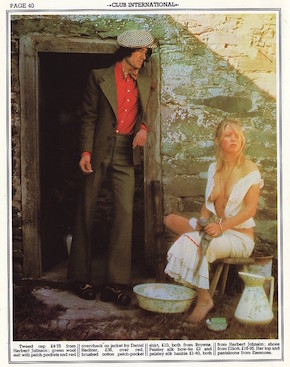
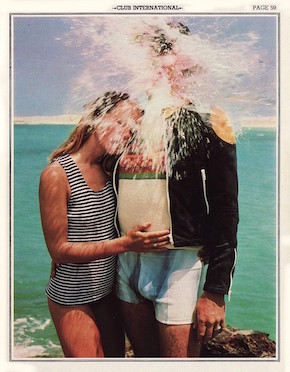
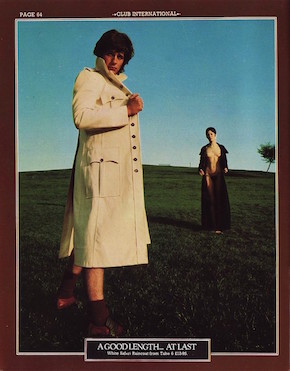
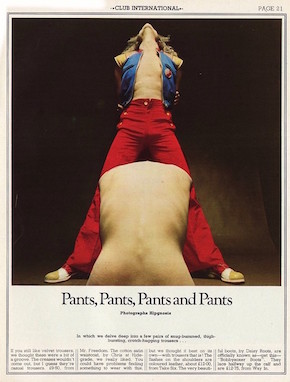
When innovatory British men’s magazine Club International was launched in 1972, editor Tony Power and art director Steve Ridgeway assembled a diverse pool of contributors, including jazzer, art critic and cultural commentator George Melly, the Stately Homo Quentin Crisp, Rocky Horror Show founder Richard O’Brien, former White Panther Mick Farren, photographers David Parkinson, Mick Rock and Karl Stoecker, illustrators Bush Hollyhead and Brian Grimwood and the design studio Hipgnosis.


Continue reading Audacious early 70s Hipgnosis fashion shoots for Club International


In 1971 the great advertising director and photographer Michael Joseph was commissioned to shoot a billboard campaign for the Italian digestif Fernet-Branca.


Taking its title from a song on hippie outfit Quintessence’s debut album, Jo Gannon’s documentary Getting It Straight In Notting Hill Gate – as featured on the BFI’s website – captures the social churn in the west London neighbourhood at the start of the 70s.

Jack Henry Moore – who has died aged 73 – was one of the unpindownables of the counterculture in the 60s and 70s.
Known principally as a pioneering video film-maker and sound recordist (the archive he leaves behind is estimated to contain more than 70,000 hours of tape compiled over five decades), Moore was central to the establishment of many of the foundation stones of the underground in London and other European cities.

Moore joined fellow ex-pat American Jim Haynes in his theatrical experiments in Edinburgh in the mid-60s, where they staged productions by the likes of Lindsay Kemp. As in his native Oklahoma, Moore’s openness about his homosexuality necessitated a geographical shift, this time south to London.
Continue reading One of the unpindownables of the counter culture: Jack Henry Moore 1940-2014


