Tomorrow I’m a guest of historian Amber Butchart at London’s National Film Theatre for a conversation and q&a about Punk fashion with her special invitee Jordan Mooney, SEX and Seditionaries superstar and inner member of the Sex Pistols circle.
I’ve put together a presentation from my archive to run during our chat, including images of Jordan’s striking series of visual personae and slides showing how the designs by Malcolm McLaren and Vivienne Westwood at 430 King’s Road were regularly featured in the fashion and national press from the early 70s to the time of Punk later in the decade.
//Selection of Let It Rock designs showcased in a May 1972 issue of The Sunday Times Magazine. Photos: Hans Feurer. Paul Gorman Archive//
//Magazines from my archive (clockwise from top left): Creem, August 1974; Grand Royal #3, 1995; Club International, August 1973; Harpers & Queen, October 1976//
//After Dark, September 1974; Ben Is Dead #26, 1996//
I’m one of the contributors to Print, writer Lou Stoppard’s forthcoming celebration of the great fashion and music magazines of the past and present.
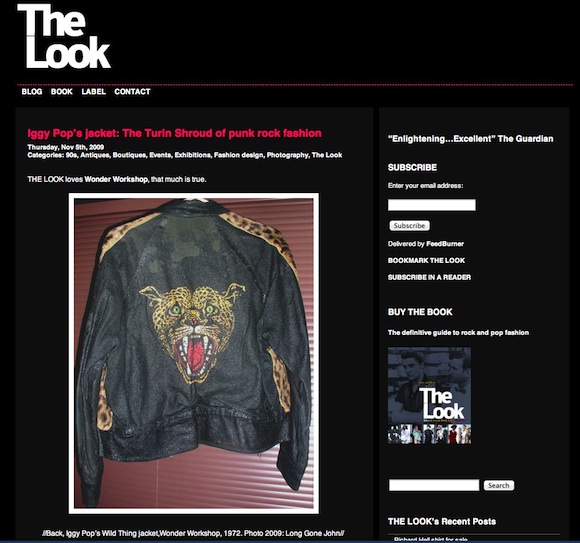
A few years back I wrote a series of blogs about the so-called “Wild Thing” jacket worn by Iggy Pop on the cover of his and The Stooges’ album Raw Power; in 2008 I had brokered a deal for the jacket designers John and Molly Dove to reissue a t-shirt range – including a version bearing the Wild Thing’s panther head – via Topman.
Around that time I also hooked them up with the current owner of the jacket, US maverick pop culture entrepreneur and collector “Long Gone” John Mermis (who I’d met as far back as the mid-90s at his extraordinary Long Beach mansion).
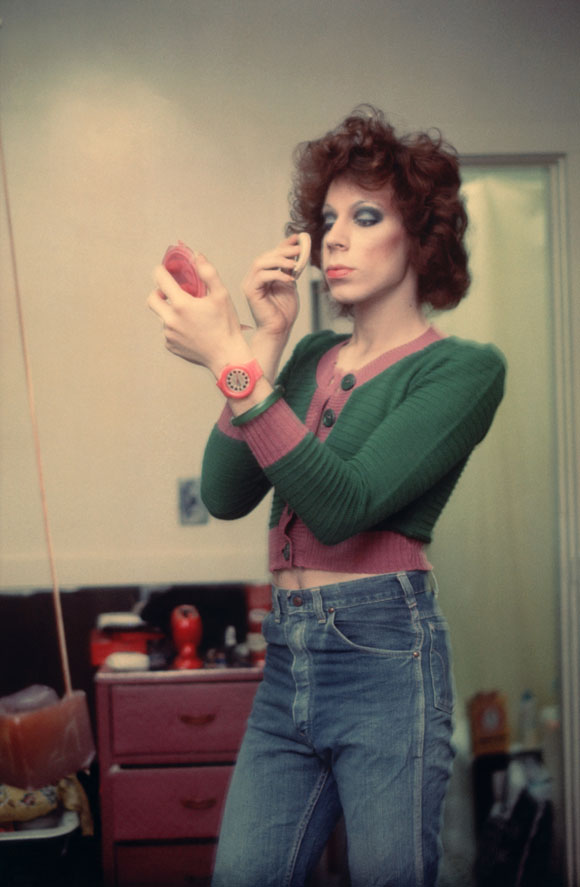
//Kenny putting on make up, Nan Goldin, Boston, 1973 //
Perhaps it is a matter of displacement – that slippery moment when art becomes commerce, shifting back again into the cultural arena as another kind of commodity. The fact is, even today, few among us are willing to acknowledge that certain mass culture forms and practices may comprise the most significant ‘culture’ of our time, precisely because of their ‘popular’ characteristics.
Marcia Tucker and William Olander, New Museum Of Contemporary Art, 1988.
In the 25 years since Tucker and Olander made this statement, the displacement they sought to define has become, if anything, more slippery.
For this reason alone, Liverpool Tate curator Darren Pih must be applauded for negotiating such tricky waters with Glam! The Performance Of Style, the exhibition he has curated in an attempt to locate the early 70s glam-rock phenomenon in the context not just of a certain area of artistic practice of the period but also more broadly the interplay between “high” and mass culture.
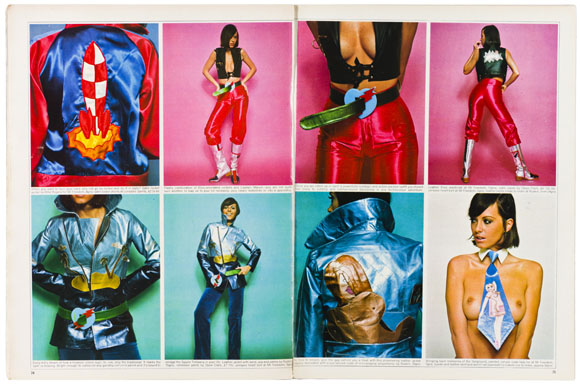
//Fashion spread featuring Mr Freedom and Ossie Clark designs, Nova, May 1970 //
Thanks to photographer David Reed for this portrait of Tommy Roberts and John Paul in much satin finery in the office hallway above their Mr Freedom boutique at 20 Kensington Church Street in 1971.