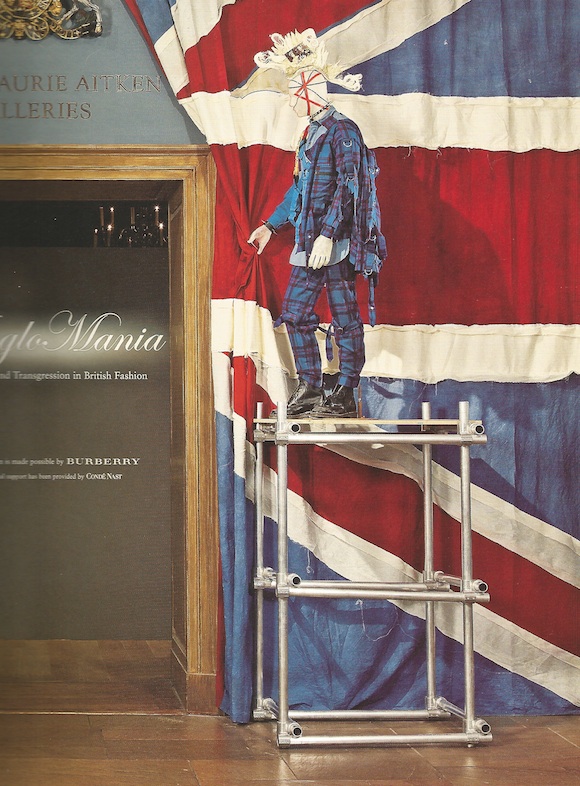
//One of the two bondage suits which have been removed from the Met collection. They were previously granted prominence in the museum’s 2006 exhibition Anglomania. This image is from the frontispiece of the show’s lavish catalogue//
Years after concerns were raised about the authenticity of around half of the punk fashion pieces in the Metropolitan Museum Of Art Costume Institute collection, cleaning house has finally begun at the New York institution with the expulsion of two bondage suits purporting to have been original 70s designs by Malcolm McLaren and Vivienne Westwood.
A museum spokesperson has confirmed that the suits have been “formally de-accessioned”. A relatively rare process in international-standard curatorial circles, de-accessioning occurs when information undermining the provenance and authenticity of a museum object comes to light.
In the period 1972-78 when the body of the partnership’s punk fashions were created, Malcolm McLaren’s art education and development as a largely conceptual visual artist was applied with Vivienne Westwood’s intuitive and sophisticated technical skills.
The resultant potency of the work was achieved by such factors as: balance in the proportions; deft use of juxtaposition; confidence in realisation; jarring harmony in the use of colour; wit in the application of motifs; and astute sense of framing, particularly of text and visual imagery.
Excerpt from introduction to my review of the McLaren/Westwood designs in the Costume Institute collection of the Metropolitan Museum of Art, summer 2013.
Precision, deftness, balance, harmony, these are terms unjustly omitted from the standard critical lexicon applied to punk’s central design aesthetics as conceived and realised by Malcolm McLaren and Vivienne Westwood and their coterie.
Which is why Punk @ ShowStudio, the elegant exhibition which is now moving into its final week at photographer Nick Knight’s Belgravia gallery, is to be applauded, since it avoids the run-of-the-mill in favour of recognition of the importance of these qualities.
“I was very impressed. It was inspiring to see what I like to call ‘the origins of Punk’ as opposed to the usual well documented ‘greatest hits of Punk’,” the collector/archivist/author Paul Burgess wrote to me recently.
//Part of Judy Blame's contribution to the exhibition//
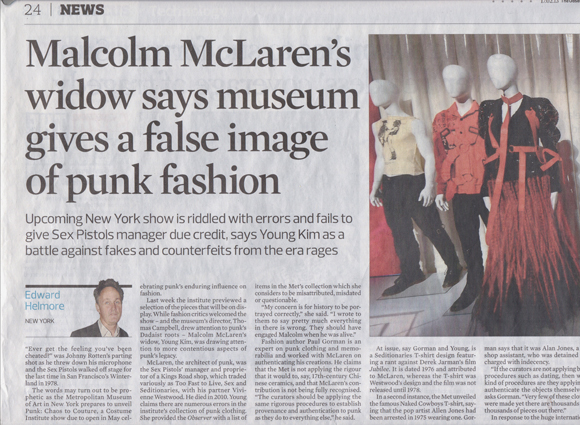
I’m quoted in today’s article in UK Sunday newspaper The Observer about the factual failings surrounding the punk clothing collection of the New York Metropolitan Museum Of Art’s Costume Institute.