The third edition of Scott King and Matt Worley’s CRASH! has arrived. Entitled Nostalgia For The Jet Age, it is an “exhibition in a box” which coincides with an actual exhibition of the same name currently being held at Scotland’s Timespan.
Next week I will be taking part in a panel discussion on the fashion legacy of the late cultural iconoclast Malcolm McLaren at London’s Institute of Contemporary Arts.
The other participants in the chat – chaired by Young Kim of the Malcolm McLaren Estate – are Louis Vuitton menswear artistic director and McLaren/Westwood collector and expert Kim Jones and Ben Reardon, editor of Man About Town; the new issue of his magazine contains a huge section dedicated to McLaren’s stylistic forays with and without Vivienne Westwood, including a fashion story photographed by Alasdair McLellan and styled by Olivier Rizzo and my essay Been There Done That Going Back.
The panel will be followed by the launch of Man About Town S/S 16 in the ICA Bar in partnership with specialist dealer Idea Books.
Watch out for Duke Brooks’ film documenting artist/designer Claire Barrow’s painting of two 15-metre canvases from which she cut couture garments for her AW16 collection.
/Left: Andrew Greaves of Electric Colour Company in the back of Paradise Garage, May 1971. Right: Vivienne Westwood in the back of Let It Rock, January 1972. Photos: David Parkinson//
Preparation for my paper at Ben Kelly’s interior design symposium Dead Or Alive has coincided with the refurbishment of the Worlds End shop at 430 King’s Road in Chelsea.
The address is the subject of my talk; I’ll be detailing the history of 430 and how and why it was an important social and cultural locus over a number of decades.
//Back wall of 430 King’s Road on the opening of Mr Freedom, September 1969. Interior: Electric Colour Company. Photo: David Parkinson//
//Portfolio shot of the newly completed Seditionaries, 430 King’s Road, London SW10, December 1976. (c) Ben Kelly//
Interior Design: Dead Or Alive is the title of the symposium being organised by the prominent British designer Ben Kelly at London’s Institute Of Contemporary Arts on March 14.
I am a contributing speaker alongside writer/curator Michael Bracewell, designers Fred Deakin, Ed Barber & Jay Osgerby and Peter Saville, artists Lucy McKenzie and Bridget Smith and David Toop of the London College Of Communications and Tate Britain’s Andrew Wilson.
“We’re going to be taking stock of the ways in which iconic interiors affect and influence the direction of popular culture and the wider world,” says Kelly, who is putting the event together in his capacity as professor of interior design and spatial studies at the University of the Arts London.
//Portfolio shot of the freshly installed Seditionaries name plaque, December 1976. (c) Ben Kelly//
Among Kelly’s designs was the November 1976 transformation of Malcolm McLaren and Vivienne Westwood’s shop Sex at 430 King’s Road into Seditionaries. Knowing that I have researched and produced a substantial document on the history of 430 King’s Road, Kelly has asked me to address this little space with a big impact in terms of its importance as a cultural hub and incubator of often radical ideas.
Here’s a cure for year-end cookie-cutter rock-doc fatigue.
Basically Johnny Moped, Fred Burns’ exemplary documentary about Paul Halford (aka punk rocker Johnny Moped), has been selected for a week of screenings at London’s ICA.
The mini-season kicks off next Tuesday night with a post-film chat and q&a with Moped conducted by Burns.
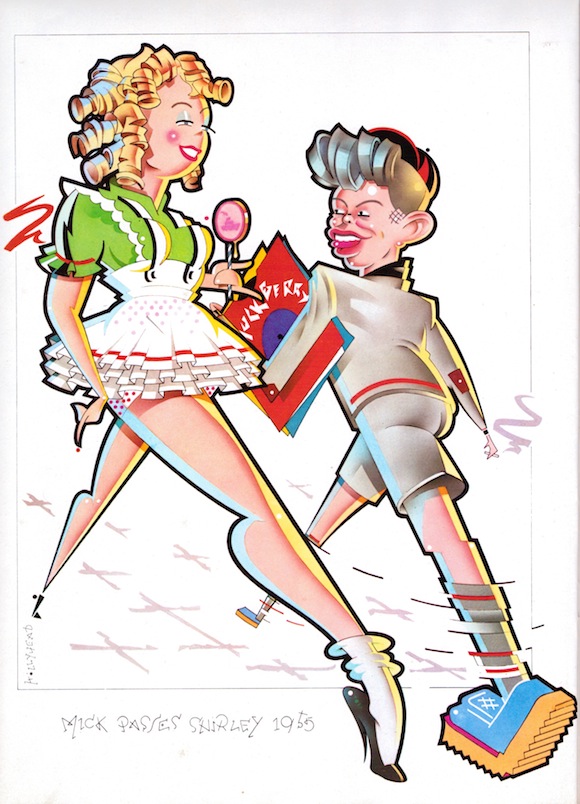
//’Mick Passes Shirley, 1955′ Illustration for a feature about growing up in the 50s by Mick Farren, Club International 1975 by Hollyhead/NTA from an idea of George Hardie’s//
“It isn’t so much what’s on the table that matters, as what’s on the chairs”
Jonathan Swift, from a letter to his friend Esther Johnson, 1711
//Simon Haynes in his ICA sitting room, 1970. Source publication: Unknown//
Ten Sitting Rooms was the title of a group exhibition curated by Jasia Reichardt at London’s Institute of Contemporary Arts in 1970. She organised a budget of £100 for each artist and gave them the brief of making a sitting room in spaces of either 15 x 18 feet or 12 x 24 feet.
I was alerted to the show’s existence by participant Simon Haynes, whose work I have been featuring here. Haynes’ Pop environment, which was produced in collaboration with his wife Sue, developed the themes and materials they used in the boardroom interior and furniture created earlier that year for Trevor Myles’ and Tommy Roberts’ boutique Mr Freedom at 430 King’s Road.
//Nick Abrahams (second left) with actor Aidan Gillen (left) and crew, fox and animal trainer shooting Ekki múkk in woods near Amersham, Bucks, last year. Photo: Eva Vermandel.//
Film-maker – and Bloke Of Britain – Nick Abrahams is the much-deserved subject of a retrospective at the ICA over the next two nights.
Tomorrow (January 24) there will be an evening of films and promos by Abrahams, who was recently nominated for the British Council best short for his magical Ekki múkk (which has already won best short film at the London Short Film Festival 2013). Made for Sigur Rós, this starred a snail (voiced by folk singer Shirley Collins), a fox and The Wire’s Aidan Gillen.