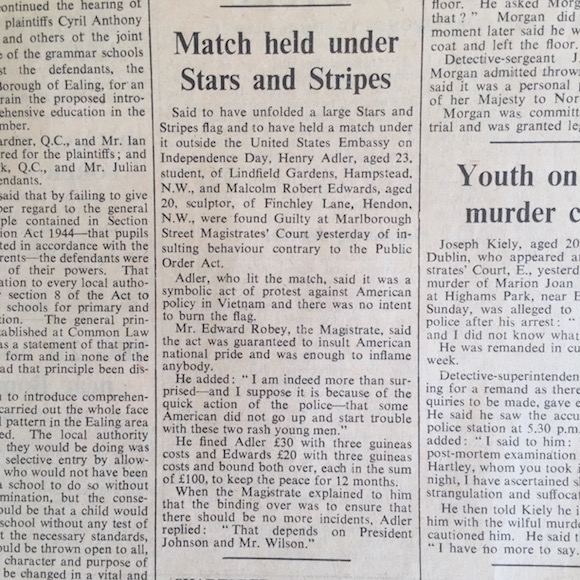
Match held under Stars and Stripes: When Malcolm McLaren was arrested for burning the US flag in Grosvenor Square in 1966

//From The Times, July 29, 1966. Paul Gorman Archive. No reproduction without permission//

The late Malcolm McLaren made his first national media appearance in a 250-word item on the Law Report page of The Times in the summer of 1966.

This is an extract from my biography The Life & Times of Malcolm McLaren:

In 1966 while he was attending a painting course at Chelsea College of Art, Malcolm McLaren – who had been forced to take his step-father’s surname Edwards a few years earlier – came under the influence of Stan, a fellow student whose last name is lost to memory.

“Stan was a Trotskyist who played a mean jazz saxophone and politicised Malcolm,” says Fred Vermorel, a friend of McLaren’s who had been at Harrow art school with him a couple of years previously.

For McLaren, radical politics opened up a world of possibilities when entwined with his investigations into art. Encouraged and initially accompanied by Stan, McLaren began attending rallies and demonstrations protesting on behalf of the causes célèbres of the day: against the war in Vietnam and South Africa’s apartheid regime.

Long gone were the polite CND parades peopled by earnest chaplains and fresh-faced Home Counties youth in duffel coats chanting Kumbaya. Taking their cue from the US uprisings such as that among the African American community on Chicago’s West Side, the British protestors of 1966 brought activism to new heights in direct confrontation with the authorities. A turning point was the July central London rally calling for the British government to disassociate itself from US military policy in south-east Asia.

Continue reading Match held under Stars and Stripes: When Malcolm McLaren was arrested for burning the US flag in Grosvenor Square in 1966

McLaren – A New Type Of Artist: Subject of my talk last night to CSM fine art students

12237143_1640419466210257_1217131514_n

Last night I gave a talk to fine art students at Central Saint Martins as part of the London art and design college’s Monday Guest Lecture series.

The title – Malcolm McLaren: A New Type Of Artist – stemmed from the catalogue  introduction by the late Paul Taylor to Impresario, the 1988 New York New Museum show he curated about McLaren’s activities.

csmlecture1

Taylor wrote:

Clearly, Malcolm McLaren is a “bad guy” of contemporary pop culture, a reputation that in these times makes him all the more appealing. To many in the worlds of art and social criticism, however, McLaren is like a new type of artist. A “producer” in more than one sense of the word, he has literally orchestrated new musical events and created provocative “cultural texts” within the mass-media. He has also shown that art in the post-avant-garde era is a matter of synthesis, of combining elements from radically different sources. . . . McLaren is a populariser, which is to say that he is a pioneer.

Continue reading McLaren – A New Type Of Artist: Subject of my talk last night to CSM fine art students

‘Blowing up bridges so there is no way back’: Malcolm McLaren, Situationists + Sex Pistols remembered by Fred Vermorel in new exhibition catalogue

12224609_442896145919320_1965879805_n
//Front and back cover designs//
IMG_9679
//Pages on McLaren including image of the 1977 God Save The Queen muslin top designed with Vivienne Westwood and featuring Jamie Reid’s graphic and lyrics for the Sex Pistols track//
IMG_9671
//Vermorel’s memoir includes images of McLaren’s student work such as this mixed media piece produced while on a fine art course at Goldsmith’s College in 1969//

Considered as an artwork, a two-and-a-half year project, and in its own terms, McLaren’s Sex Pistols’ was as seminal and resonant as Picasso’s Guernica.

Only this was a masterpiece made not of paint and canvas but of headlines and scandal, scams and factoids, rumour and fashion, slogans, fantasies and images and (I almost forgot) songs, all in a headlong scramble to auto-destruction.

For it was equally a Situationist treatise-by-example, the unremitting and obdurate core being McLaren’s grasp of the theory of situations as proposed by the SI.

Indeed, the story of the Pistols is a Situationist textbook of how to create situations from which there is no return. You refuse to negotiate, to compromise, to be co-opted, you exacerbate every crisis and recklessly play loser wins and then you blow up all the bridges so then there is no way back.

We are then forced to invent another future. Or maybe simply relish the mess, “the ecstasy of making things worse”.
From Fred Vermorel’s memoir which appears exclusively in the new exhibition catalogue.

The catalogue for the exhibition Eyes For Blowing Up Bridges is now available.

The lavishly illustrated 100-page book includes a foreword by John Hansard Gallery’s Ros Carter and Stephen Foster, my introduction, an essay by co-curator David Thorp and a specially commissioned memoir of Malcolm McLaren and his connections to post-war radicals by his art-school friend and collaborator Fred Vermorel.

Continue reading ‘Blowing up bridges so there is no way back’: Malcolm McLaren, Situationists + Sex Pistols remembered by Fred Vermorel in new exhibition catalogue