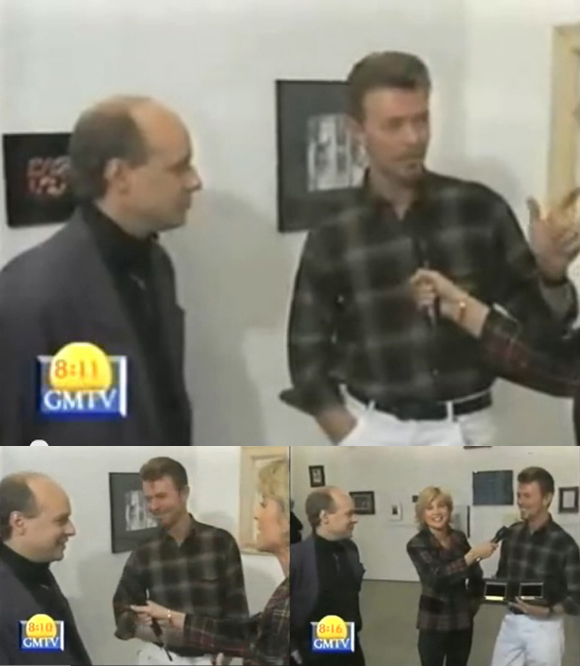
Journalism: Interviewing David Bowie on working with Eno + engaging with visual arts, 1995

//Brian Eno + David Bowie interviewed by Anthea Turner for British breakfast TV at Flowers, east London, October 1994. This was to publicise the charity art show/auction Little Pieces From Big Stars. By this time the pair were collaborating again, on 1. Outside. For reasons now lost to me, I drove Brian to the gallery early that morning.//

I interviewed David Bowie a couple of the times in the 90s, having met him via fund-raising idea contributions I made to the music industry’s favoured charity, War Child. In the preceding months he had been an enthusiastic contributor to the art events Little Pieces From Big Stars (1994) and Pagan Fun Wear (1995).

This interview took place in the summer of 1995 when Bowie was promoting 1.Outside, notable in that it marked a return to collaboration with Brian Eno (who I also interviewed at the time for his work on that as well as another collaboration, with Jah Wobble on the ambient project Spinner).

Bowie had emerged from the maligned Glass Spider/Tin Machine period a couple of years earlier with more creditable, if not particularly memorable efforts, including The Buddha Of Suburbia soundtrack. He was also actively ploughing a furrow into the visual arts and already mutating as a musician and performer, soon to become a familiar presence on the international festival circuit and engaging in sorties into jungle manifested in the follow-up album Earthling (for which I also interviewed him).

Ideas crackled off Bowie throughout the conversation; Eno once told me that working with him on a song in the studio was like watching a fast-motion film of a flower blossom.

In our chat, Bowie even flew a kite about producing an album based around a fictional character Nathan Adler every year until 2000 culminating in a Robert Wilson-style epic theatrical production at the Brooklyn Academy Of Music. Of course these never came to fruition.

How did you come to hook up with Brian Eno again?
When Brian came to my wedding in 1992, I had instrumental pieces for what would eventually become a third of Black Tie White Noise – music that I composed to be played in the church and at the party afterwards. He explained he was working in a not dissimilar area and I was starting on The Buddha Of Suburbia, where I pretty much started to survey the territory I wanted to be involved in. After a series of conversations, working with Brian really came together in early March 1994.
Continue reading Journalism: Interviewing David Bowie on working with Eno + engaging with visual arts, 1995

All satin, no tat, 1971: Kansai Yamamoto, Michael Chow, David Parkinson, Tommy Roberts, Barney Wan et al

//From The Sunday Times Magazine, November 28, 1971.//

The joy of writing about a subject as rich as Tommy Roberts is that research turns up an apparently limitless supply of fabulous material.

Even the tangential stuff – such as this from my archive, a spread from a 1971 Sunday Times Magazine  – gets me going.

Continue reading All satin, no tat, 1971: Kansai Yamamoto, Michael Chow, David Parkinson, Tommy Roberts, Barney Wan et al

Derek Boshier: David Bowie + The Clash at Pallant House this summer

//Sketches for Lodger gatefold cover, 1979.//

//Front, Clash 2nd Songbook, Music Sales Ltd, 1978. 12" x 9", 60pp (inc covers).//

Artist Derek Boshier’s practice is marked by his engagement with contemporary culture; this has been a consistent aspect of his work since the earliest days of the British Pop movement.

When popular music has invigorated the wider world, Boshier has been present, incorporating Buddy Holly into his painting I Wonder What My Heroes Think Of The Space Race? in Ken Russell’s defining 1962 Monitor piece Pop Goes The Easel, and providing one of the most vivid visual documents of the punk and post-punk era, Clash 2nd Songbook.
Continue reading Derek Boshier: David Bowie + The Clash at Pallant House this summer

The mystery of Pierre Laroche’s Breakfast, The Who at Charlton + the tragic demise of Alkasura’s John Lloyd

Pierre's Breakfast, 1974, by Willie Christie.

I am beguiled by this photograph, which is entitled Pierre’s Breakfast and was taken by Willie Christie at David Hockney’s house in Notting Hill on May 18, 1974.

The identities of the two individuals on the left are a mystery*; with Clark (in the white jumpsuit) are make-up artist Pierre Laroche, Marianne Faithfull and Michael Roberts (then writer/photographer at The Sunday Times, now Vanity Fair’s fashion/style director). Behind the group are a selection of artist Mo McDermott’s signature painted wooden tree sculptures.

Laroche, who had worked at Elizabeth Arden for five years before taking up with rock & roll when he was recruited by Brian Duffy for the cover of David Bowie’s 1973 album Aladdin Sane, engaged Willie Christie for the May 74 session for a potential magazine feature.

Continue reading The mystery of Pierre Laroche’s Breakfast, The Who at Charlton + the tragic demise of Alkasura’s John Lloyd

Monster V&A design book: Bubbles, Hirst, The Queen + Bowie get special treatment…but where’s Malcolm?

British Design from 1948: Innovation in the Modern Age

British Design From 1948: Innovation In The Modern Age – the new book accompanying the forthcoming show at the V+A – is a bumper edition: 400 pages weighing in at 5lbs.

It’s cheering to see Barney Bubbles’ design Ian Dury With Love granted upfront prominence; the poster is in select company given special treatment by the book’s designer, Barnbrook’s Daniel Streat. The others are: Cecil Beaton’s 1953 coronation portrait of The Queen, a shot of Damien Hirst’s Notting Hill restaurant Pharmacy and Brian Duffy’s Aladdin Sane portrait of David Bowie.

Barney Bubbles' Ian Dury poster treated by Jonathan Barnbrook

Continue reading Monster V&A design book: Bubbles, Hirst, The Queen + Bowie get special treatment…but where’s Malcolm?

Photography: Willie Christie on the (No Pussyfooting) cover

No Pussyfooting front
//Front cover (No Pussyfooting), Fripp & Eno, EG/Island, 1973.//

The final piece in Tate Modern’s current Yayoi Kusama show – her dramatic Infinity Mirror Room – brought to my vinyl-fixated mind one of the greatest record sleeves of all time: the gatefold for (No Pussyfooting), the album released in 1973 by Brian Eno and Robert Fripp.

All of a piece with the music it packages – prismatic, playful, calm, cerebral, oblique – the four-part composition was photographed and designed at Eno’s behest by photographer/filmmaker Willie Christie.

Continue reading Photography: Willie Christie on the (No Pussyfooting) cover

Derek Boshier: From Doris To Chemical Cowboys, Chelsea College Of Art January 18

Pauline's Gone Digital (for Pauline Boty), Derek Boshier,  2011.
Pauline's Gone Digital (for Pauline Boty), Derek Boshier, 2011. Diptych, 5' x 10'. Acrylic on canvas from the series Paris Texas, Paris France, Paris Hilton.

This month’s arts calendar in London is marked by a rare treat: From Doris To Chemical Cowboys, a talk by the great British artist Derek Boshier at Chelsea College Of Art’s lecture theatre on January 18.

Los Angeles-based Boshier will be discussing recent projects as well as providing insights into earlier achievements, including his part in the Pop Art explosion of the 60s and his Texas work of the 80s.

Continue reading Derek Boshier: From Doris To Chemical Cowboys, Chelsea College Of Art January 18