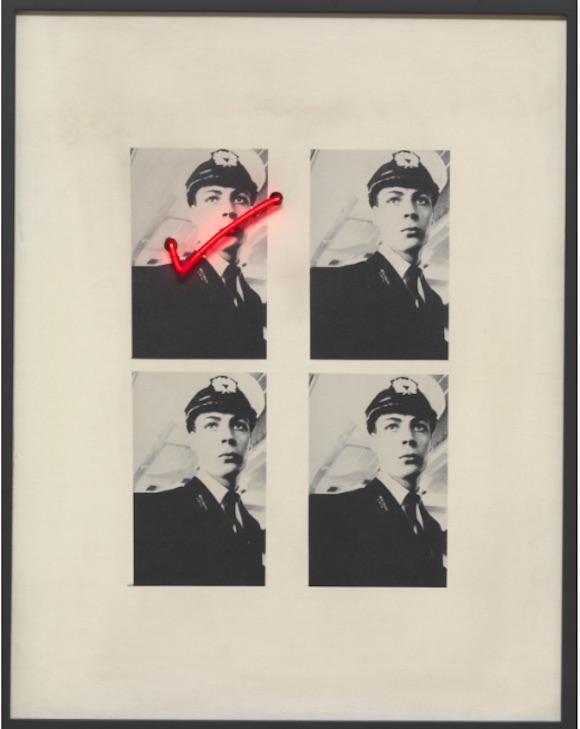
//Relation of Aesthetic Choice to Life Activity (Function) of the Subject, Billy Apple, 1961-2. From Tate Britain//
I’m indebted to Tate Liverpool curator Darren Pih for the connection between a photograph which appeared in ARK 33 – the edition of the Royal College Of Art magazine which was the subject of my last post – and a contemporaneous work by the artist Billy Apple.
//Ben Kelly underneath the Sex sign, 1975. Photo courtesy Ben Kelly//
I’m featuring this image of designer Ben Kelly in his persona of The Photo Kid in my presentation about the design history of 430 at the symposium Dead Or Alive: Popular Culture & The Interior, which takes place today at London’s ICA.
//Portfolio shot of the newly completed Seditionaries, 430 King’s Road, London SW10, December 1976. (c) Ben Kelly//
Interior Design: Dead Or Alive is the title of the symposium being organised by the prominent British designer Ben Kelly at London’s Institute Of Contemporary Arts on March 14.
I am a contributing speaker alongside writer/curator Michael Bracewell, designers Fred Deakin, Ed Barber & Jay Osgerby and Peter Saville, artists Lucy McKenzie and Bridget Smith and David Toop of the London College Of Communications and Tate Britain’s Andrew Wilson.
“We’re going to be taking stock of the ways in which iconic interiors affect and influence the direction of popular culture and the wider world,” says Kelly, who is putting the event together in his capacity as professor of interior design and spatial studies at the University of the Arts London.
//Portfolio shot of the freshly installed Seditionaries name plaque, December 1976. (c) Ben Kelly//
Among Kelly’s designs was the November 1976 transformation of Malcolm McLaren and Vivienne Westwood’s shop Sex at 430 King’s Road into Seditionaries. Knowing that I have researched and produced a substantial document on the history of 430 King’s Road, Kelly has asked me to address this little space with a big impact in terms of its importance as a cultural hub and incubator of often radical ideas.
Produced as the programme for the International Poetry Incarnation held in London in the summer of 1965, this “invocation” performed a similar function to the event, which is seen as the first gathering of the tribes which would form the counterculture.
Compiled by 10 of the participants at the London flat of Alexander Trocchi, the mission statement “maps a new emergent countercultural community”, as art historian Andrew Wilson wrote in 2004.