//George O'Dowd in Street Theatre, 12 Ganton Street, central London, 1978. Photo (c): Boy George Collection//
I’ve been acting as a consultant to artist Lucy Harrison on her latest site specific project Carnaby Echoes, which focuses on the culturally fertile area of central London adjacent to Soho.
With the starting point of the opening of Murray’s Club in Beak Street in 1913, Harrison is mounting her artistic response to 100 years of musical history with archival material and fresh interviews with some of the area’s leading lights.
The Cocoa Song is from the cult British Film Institute-funded multicultural musical Moon Over The Alley, directed by Joseph Despins and William Dumaresq.
Released in 1976 with a score by Galt McDermot, a fellow Canadian who is probably best known for his compositions for Hair, Moon Over The Alley is largely set around London W10; this scene was shot at the top end of Portobello Road market.
//Signed bar menu. Courtesy: Jonathan Ross////Signed back cover of So Alone, Johnny Thunders, Real Records,1978. Courtesy: Jonathan Ross//
As demonstrated by my recent post, the west London house of collector/gallerist Jonathan Ross became a hive for the art/boho/punk crowd flooding the capital in the 70s.
Among the visitors were Johnny Thunders and Iggy Pop, who both left their marks in different ways.
Here are more previously unpublished images from London’s punk demi-monde.
Coincident to receiving Joe Stevens’ photograph of the pre-Pretenders Chrissie Hynde and photographer Kate Simon in Malcolm McLaren’s Sex Pistols Nude Boy shirts, collector/gallerist/Londoner Jonathan Ross supplied me with this fabulous selection of Polaroids taken at his west London house in the same period.
These include Hynde and Simon as well as their fellow Americans-about-town, the performers Judy Nylon and Patti Palladin and artist/tattooist Ruth Marten, writers Tamasin Day-Lewis and Jon Savage, Ross himself, his girlfriend Gina Louthan and Sir John Betjeman.
//Photographer Kate Simon and performer Chrissie Hynde (lifting the front of her mohair jumper from Sex), London, 1976. (c) Joe Stevens//
This photograph – taken by Joe Stevens in early 1976 in Fulham, west London – is featured in the exhibition Just Chaos!, which opens tomorrow (May 7) at Marc Jacobs’ Bleecker Street NYC bookstore BookMarc.
The T-shirts worn by Simon and Hynde were among the first variants of a limited edition designed by Malcolm McLaren to promote the newly formed Sex Pistols. A few were also sold in Sex, the environmental installation/shop operated by McLaren with Vivienne Westwood at 430 King’s Road in World’s End, Chelsea.
“Malcolm dropped the shirts off at my Finborough Road studio; they were freshly silk-screened from a limited edition,” says Stevens, then working for the NME and living with Simon (who was employed by rival music paper Sounds). “Chrissie was living in a squat and cleaning offices for a living. She’d drop by the pad to take showers. I’d hear her singing in there and realised she had a wonderful voice.”
McLaren produced the designs with the express aim of promoting the new group. “This was my first attempt at making a Sex Pistols T-shirt,” he told me in 2006. “I wanted to create something of a stir.”
Dave Robinson, one of the British music business’s towering figures, has sent me this lovely pop-reggae tune from Madness man Lee Thompson’s project.
It’s great for this sunny Bank Holiday; Bitty McLean is on top vocal form.
Fair takes me back to seeing Madness in their North London Invaders incarnation support a jazz-rock trio (!) at Camden Town’s Dublin Castle, and before that the graffito ‘Kix’ emblazoned around 70s teenage nexus Golders Green tube station (courtesy of Thompson).
//Hipgnosis fashion shoot for Club International, 1972//
An antiques restorer friend has pointed out that the early 70s fashion shoot by design studio Hipgnosis I recently featured here calls to mind the preoccupations with the female form of the late German artist Paul Wunderlich.
My friend – who wishes to remain anonymous – has offered as evidence a print of Wunderlich’s work Vor dem Vorhang (“Before the curtain”). The story of how he came by the artwork one squally day in central London seven years ago is remarkable:
Dazed Digital is featuring a précis of my investigation into the roots of the Anarchy Shirt as sold in Sex and Seditionaries at 430 King’s Road in 1976 and 1977.
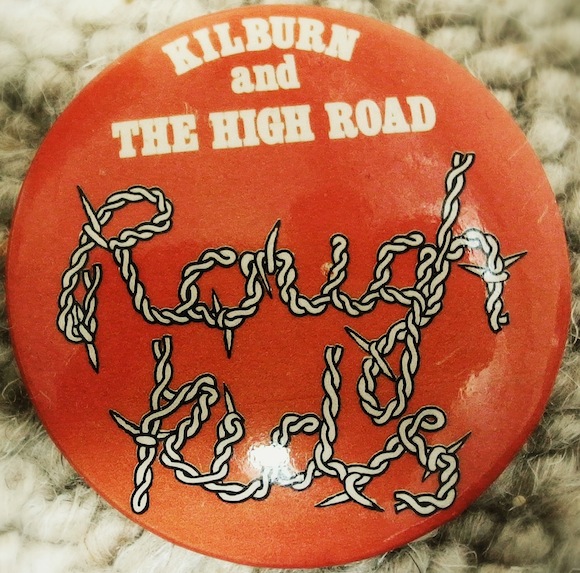
As an addendum to my recent post about the staging of the very special late night London concert given by Ian Dury’s art-rock ensemble Kilburn & The High Roads in 1974, here’s the badge commissioned by manager the late Tommy Roberts to flag up the concurrent release of the group’s single Rough Kids.
Then a neglected pop promotional medium – badges were considered kids’ stuff; the sole prominent champion was Barney Bubbles, who produced a range to go with his branding of space rockers Hawkwind and pub-rock outfit Chilli Willi And The Red Hot Peppers – the pre-punk barbed wire logo button was conceived and executed by Simon Haynes, designer of the ambitious stage set for the Kilburns’ gig at the King’s Road Theatre.
Tonight I am hosting an event at London’s Victoria & Albert Museum: an ‘in conversation’ with Boy George about the importance and influence of popular culture’s greatest manipulator of visual identity, David Bowie.
//George O'Dowd overlooked by Big Brother in his room at a squatted house in Carburton Street, central London, 1978.//