I can’t wait to see documentarist Toby Amies’ envoi to his extraordinary friend Drako Oho Zarhazar.
Over the last year or so when we have bumped into each other socially, Amies has shown me snippets on his phone. Each tasty morsel has increased my hunger for this portrait of the late Brighton dweller Amies describes as “muse for Dali, actor for Jarman, dancer at Les Folies Bergère, outsider interior decorator, hero and legend”.
//Johnny Moped, Dave Berk, Fred Berk, Slimy Toad, 1977. Photo: Chiswick Records//
In an age clogged up with boil-in-the-bag popular music documentaries, I’m looking forward to Fred Burns’ Basically, Johnny Moped, about the unpredictable outsider who emerged via associations with The Damned and Chrissie Hynde during the post-punk period to strut and fret his hour upon the stage.
Moped and his band – Dave and Fred Berk and Slimy Toad – were out and about a lot in 1977 and 1978; I caught them a couple of times, once as part of a bigger bill at Camden Town’s Music Machine (now Koko) and another time in the West End (possibly The Marquee).
Their single Darling, Let’s Have Another Baby was (and remains 35 years later) a stand-out song of the period and Barney Bubbles’ artwork for that and other Moped releases and promotional material sealed the deal.
The Cocoa Song is from the cult British Film Institute-funded multicultural musical Moon Over The Alley, directed by Joseph Despins and William Dumaresq.
Released in 1976 with a score by Galt McDermot, a fellow Canadian who is probably best known for his compositions for Hair, Moon Over The Alley is largely set around London W10; this scene was shot at the top end of Portobello Road market.
//Nick Abrahams (second left) with actor Aidan Gillen (left) and crew, fox and animal trainer shooting Ekki múkk in woods near Amersham, Bucks, last year. Photo: Eva Vermandel.//
Film-maker – and Bloke Of Britain – Nick Abrahams is the much-deserved subject of a retrospective at the ICA over the next two nights.
Tomorrow (January 24) there will be an evening of films and promos by Abrahams, who was recently nominated for the British Council best short for his magical Ekki múkk (which has already won best short film at the London Short Film Festival 2013). Made for Sigur Rós, this starred a snail (voiced by folk singer Shirley Collins), a fox and The Wire’s Aidan Gillen.
//Roberts, right, tries on a military greatcoat at I Was Lord Kitchener’s Valet//
Look out for an appearance by Tommy Roberts – subject of my new book – in the 1967 documentary Three Swings On A Pendulum, currently available for viewing (in the UK at least) on BBC iPlayer.
Last night saw a preview on a giant outdoor screen in Chelsea’s Duke Of York Square of a couple of the new films celebrating the golden age of London boutique culture.
//Frederique Cifuentes photographs Amber Butchart in Chelsea.//
Yesterday we had fun in Chelsea filming fashion historian/DJ Amber Butchart for this summer’s King’s Road Fashion & Music Trail, which is is being launched to visitors to west London’s historic thoroughfare as part of Kensington & Chelsea Council’s InTransit festival in July.
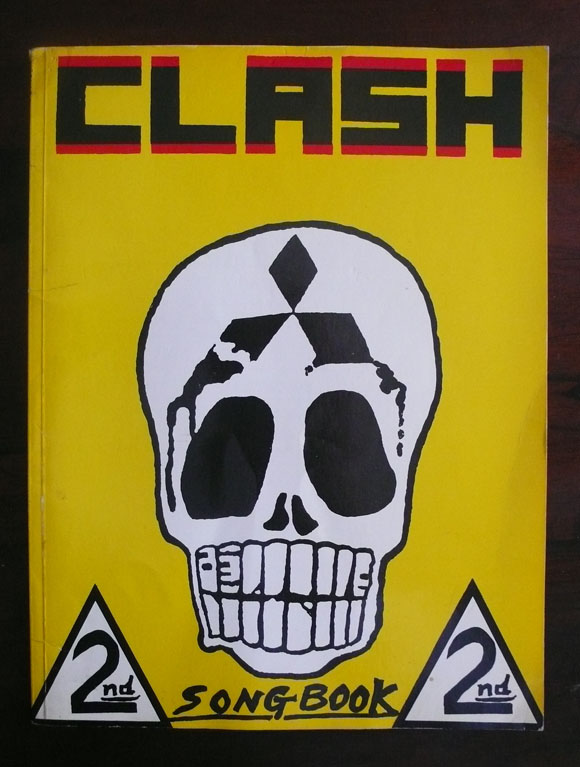
//Front, Clash 2nd Songbook, Music Sales Ltd, 1978. 12" x 9", 60pp (inc covers).//
Artist Derek Boshier’s practice is marked by his engagement with contemporary culture; this has been a consistent aspect of his work since the earliest days of the British Pop movement.
When popular music has invigorated the wider world, Boshier has been present, incorporating Buddy Holly into his painting I Wonder What My Heroes Think Of The Space Race? in Ken Russell’s defining 1962 Monitor piece Pop Goes The Easel, and providing one of the most vivid visual documents of the punk and post-punk era, Clash 2nd Songbook. Continue reading Derek Boshier: David Bowie + The Clash at Pallant House this summer
//Front cover (No Pussyfooting), Fripp & Eno, EG/Island, 1973.//
The final piece in Tate Modern’s current Yayoi Kusama show – her dramatic Infinity Mirror Room – brought to my vinyl-fixated mind one of the greatest record sleeves of all time: the gatefold for (No Pussyfooting), the album released in 1973 by Brian Eno and Robert Fripp.
All of a piece with the music it packages – prismatic, playful, calm, cerebral, oblique – the four-part composition was photographed and designed at Eno’s behest by photographer/filmmaker Willie Christie.