What with Pistol and all, it seems timely to discuss Malcolm McLaren’s place in the scheme of things so tonight journalist Helen Barrett and I will be in conversation at a London Society event about the late cultural iconoclast’s relationship with the city of his birth. Here is a selection of visuals from this evening’s presentation.
In the evening June 9 I’ll be in Soho for a London Society event about the London life of the late cultural provocateur Malcolm McLaren.
At workplace venue Fora in Broadwick Street writer Helen Barrett and I will be discussing the ways in which the man born in Stoke Newington and buried in Highgate Cemetery used the city as the springboard for his dizzying range of creative and subversive activities.
//Fax of treatment sent by Malcolm McLaren to Neal Purvis and Robert Wade on January 9, 1991//
These faded pages constitute a film pitch Malcolm McLaren sent by fax to screenwriters Neal Purvis and Robert Wade way back in 1991.
//The first page of the fax shows that this treatment was completed a couple of weeks before it was sent, on December 20, 1990////From my transcription of the now-very faded fax//
Purvis and Wade are responsible for many film successes including the astounding run of screenplays for the seven James Bond movies from 1999’s The World Is Not Enough to the recently released No Time To Die. I’ve known them for a while and Neal has mentioned their contact with McLaren during preparations for their first feature Let Him Have It, so made sure it was covered in the hardback edition of The Life & Times of Malcolm McLaren.
//Malcolm McLaren between Patti Smith and David Johansen with Cyrinda Foxe and Lenny Kaye, Sheep Meadow, Central Park, May 11, 1975. Photo: Danny Fields////Close up: Malcolm McLaren refreshes himself behind Smith and Johansen//
46 years after music manager Danny Fields took the photograph of a group of New York’s 70s demi-monde at the top of this post I’ve spotted the previously unidentified person behind them: the subject of my latest book, Malcolm McLaren (who appears to be chugging a half-bottle of Smirnoff).
//The two maps are housed in handsome folders////The guide was designed by Ricardo Santos and includes photography of the band, quotes and a card for my Malcolm McLaren biography//
My new guide out with Herb Lester Associates is out now.
A celebration of the London lives of the Sex Pistols and their charismatic – some might say notorious – manager Malcolm McLaren, it comprises two fold-out maps with 100-plus addresses from birthplaces, schools, colleges, art schools, pubs, clubs, venues and boutiques to such diverse places as Buckingham Palace (where the Pistols signed to A&M Records), the Soho gay club Il Duce (frequented by McLaren after leaving art school in the early 70s) and the Shepherds Bush remand home where the teenage Steve Jones resided before being pulled up before various beaks on assorted burglary charges.
//There are nearly 60 entries charting the lives of the Pistols in London////The Pistols map shows how Punk Rock was at its dark heart a London thing//
The Pistols maps covers the group’s 29-month existence and the lives of the five members as they relate to the British capital, while McLaren’s shows how this fourth generation Scottish/Jewish provocateur used the city as a weapon of sex, style and subversion.
//Born in Stoke Newington, McLaren roamed the capital, from Lewisham and Clapham to Chelsea and Notting Hill to Fitzrovia and Oxford Street to Whitechapel and Rotherhithe////No coincidence that some of the major projects of McLaren’s life – a psychogeography of Oxford Street, the shop at 430 King’s Road and his campaign to become Mayor of London – were firmly rooted in the city//
SITUATION VACANT: Sex Pistols and Malcolm McLaren in London is available from Herb Lester Associates here.
//The postcard, which measures 230 x 150mm (6 x 9in), is printed in a numbered limited edition of 150//
“Fashion seemed to be the place where music and art came together. Creating my own clothes was like jumping into the musical end of painting. The shop became a natural extension of my studio.”
Malcolm McLaren. The Look, 2001.
Featuring a rare portrait of Malcolm McLaren displaying his wares inside the recently opened Let It Rock in January 1972, this limited edition large-size postcard is a companion to my biography of the man published earlier this year.
The photograph on the front of the card was taken by the late David Parkinson, who documented the refurb of the premises at 430 King’s Road carried out by McLaren and his art school friend Patrick Casey; the address had previously housed Trevor Myles’ Americana boutique Paradise Garage.
//The postcard arrives clad in black, McLaren’s favourite anti-colour. “Black expressed the denunciation of the frill,” he wrote in the introduction to my book The Look//
The card shows McLaren revealing the detail on a flamboyant drape jacket made to his design by the East End tailor Sid Green, while he is surrounded by the accessories and ephemera which constituted Let It Rock’s environmental installation. Against the black walls, Day-glo socks from Whitechapel wholesaler Kornbluth vie with Frederick Starke red rockabilly shirts, Sun Records 45s, French rocksploitation movie posters and deadstock clothing.
It makes for a beguiling image: the 25-year-old – then still legally Malcolm Edwards – is caught making the leap from art school to fashion retailing by, as he later described it, “jumping into the musical end of painting”.
Limited edition numbered postcard hand-numbered and printed 4/1 col. offset on 350gsm single sided board stock, trimmed to size.
Printing: Something Else.
Price: £12.50 each or £20 for 2. P+P: £5 UK, £10 rest of the world. All postage with tracking and/or signature.
Excerpts from the annual summer music jamboree broadcast as part of UK TV station Channel 4 youth programme The Tube have been posted this week on Youtube.
//Jools Holland interviews McLaren about his “Duck Rocker”, one a number of customised boomboxes McLaren commissioned for promotional appearances//
One clip from the so-called Midsummer Night’s Tube of 1983 features an interview with Malcolm McLaren about his recently released album Duck Rock and single Double Dutch.
To coincide with the US release of my book The Life & Times of Malcolm McLaren I’m taking part in an online event hosted by Atlanta’s premier independent bookstore A Capella next Thursday (September 24).
From 6pm EST (11pm BST) I will be in conversation with US music journalist Chad Radford about McLaren and his creative legacy. Our chat will be followed by a q&a session.
I’ve already signed a bunch of personalised bookplates for those purchasing copies directly from A Cappella.
Look forward to digitally seeing you there – more details from A Cappella.
The Life & Times of Malcolm McLaren is available to buy in the US from next week from all good booksellers as well as amazon.com.
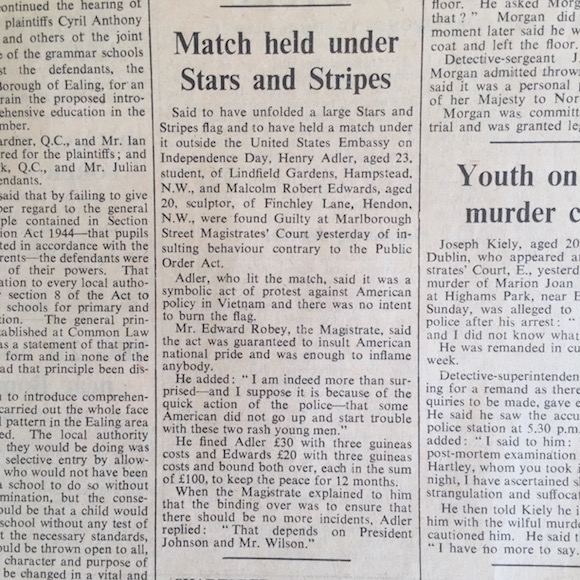
//From The Times, July 29, 1966. Paul Gorman Archive. No reproduction without permission//
The late Malcolm McLaren made his first national media appearance in a 250-word item on the Law Report page of The Times in the summer of 1966.
This is an extract from my biography The Life & Times of Malcolm McLaren:
In 1966 while he was attending a painting course at Chelsea College of Art, Malcolm McLaren – who had been forced to take his step-father’s surname Edwards a few years earlier – came under the influence of Stan, a fellow student whose last name is lost to memory.
“Stan was a Trotskyist who played a mean jazz saxophone and politicised Malcolm,” says Fred Vermorel, a friend of McLaren’s who had been at Harrow art school with him a couple of years previously.
For McLaren, radical politics opened up a world of possibilities when entwined with his investigations into art. Encouraged and initially accompanied by Stan, McLaren began attending rallies and demonstrations protesting on behalf of the causes célèbres of the day: against the war in Vietnam and South Africa’s apartheid regime.
Long gone were the polite CND parades peopled by earnest chaplains and fresh-faced Home Counties youth in duffel coats chanting Kumbaya. Taking their cue from the US uprisings such as that among the African American community on Chicago’s West Side, the British protestors of 1966 brought activism to new heights in direct confrontation with the authorities. A turning point was the July central London rally calling for the British government to disassociate itself from US military policy in south-east Asia.