‘This book solves the mystery of a spell that was cast on a time that won’t fade away’
Hiroshi Fujiwara
2024 has got off to a good start with the news that the Japanese edition of The Life & Times of Malcolm McLaren is going to be published by East Press on January 26, four days after what would have been the great provocateur’s 78th birthday.
This translation includes a new photo selection, the above cover quote from Japan’s style guru Hiroshi Fujiwara and updated text, including much new detail on the visit McLaren made with Vivienne Westwood and Gerry Goldstein to Andy Warhol’s Factory in New York in the summer of 1973.
The Life & Times Of Malcolm McLaren Japanese edition is available to order here.
//Annie Frost Nicholson with the Fandangoe Discoteca. Pic courtesy of anniefrostnicholson.com//
Next week sees the opening at London’s Canary Wharf of artist Annie Frost Nicholson’s Fandangoe Discoteca, the mini-disco installation where we can shake out our grief and help maintain daily mental health – the programme covers all intersections of grief from bereavement to climate angst to political rage to break-ups.
The design of the kiosk was inspired by De Stijl and Ettore Sottsass and holds up to eight dancers at a time.
What with Pistol and all, it seems timely to discuss Malcolm McLaren’s place in the scheme of things so tonight journalist Helen Barrett and I will be in conversation at a London Society event about the late cultural iconoclast’s relationship with the city of his birth. Here is a selection of visuals from this evening’s presentation.
//Painting To Be Stepped On, Yoko Ono, 1961. Photograph: George Maciunas//
“People said Yoko Ono ruined the Beatles, but I think the Beatles ruined her in many ways”
Anne Bean, artist, to The Guardian, 2021.
Saturated as mass culture has recently been by Get Backery, I note the lack of celebration for another significant anniversary: 70 years since Yoko Ono became the first female student to be accepted onto the philosophy course at Tokyo’s Gakushuin University in 1952.
As noted in Inventing Downtown, Melissa Rachleff’s incisive history of New York’s artist-run galleries from the early 50s to the mid-60s, Ono left Gakushuin after two terms to join her parents in Manhattan, where she promptly enrolled at Sarah Lawrence College to study poetry and composition.
//Subscribe exhibition ident////Artist and filmmaker Steve McQueen (right) featured in The Uniform Backlash, The i-D Bible Part 2, 1989. Photography Daniel Kohlbacher, styling Simon Foxton. Paul Gorman Archive//
Beginning in the early 1970s—as under-represented groups were demanding new forms of visibility following the emergence of political movements such as Black Power and the Stonewall Rebellion—a handful of British and American photo-driven alternative magazines came on the scene.
The Face, i-D, Rags, Out/Look, and other new publications amplified marginalized voices, especially those of queer makers and makers of colour, and made room for those makers to question who and what was accepted as mainstream. These publications introduced a hybrid model within the magazine industry: combining the high production standards and engagement with fashion of “powerhouse” publications such as Vogue and Life with the use of collage in zines and the text/image provocations of underground newspapers. In the end, these alternative magazines transformed their industry.
From the introduction to Subscribe.
Two years ago, just as the enormity of the pandemic was emerging, I met American curators Solveig Nelson and Michal Raz-Russo in London to discuss making a contribution to an exhibition at the Art Institute of Chicago about the significance of alternative magazines to Western culture.
A few years back over dinner in New York when I was working on The Story of The Face, the British artist and filmmaker Steve McQueen mentioned that he (“well, it was mainly my back and my arse”) had appeared in an i-D fashion shoot when he was a student. Continue reading When Steve McQueen modelled for i-D
//Maquette for Great Big Biggest Wide London, 1958. 5.6 x 61cm////Robyn Denny, 1961. Photo: Bernard Jacobson Gallery//
The late British abstract artist Robyn Denny is best known for his large-scale works, such as Great Big Biggest Wide London, the giant 1959 mural for menswear company Austin Reed’s Regent Street store.
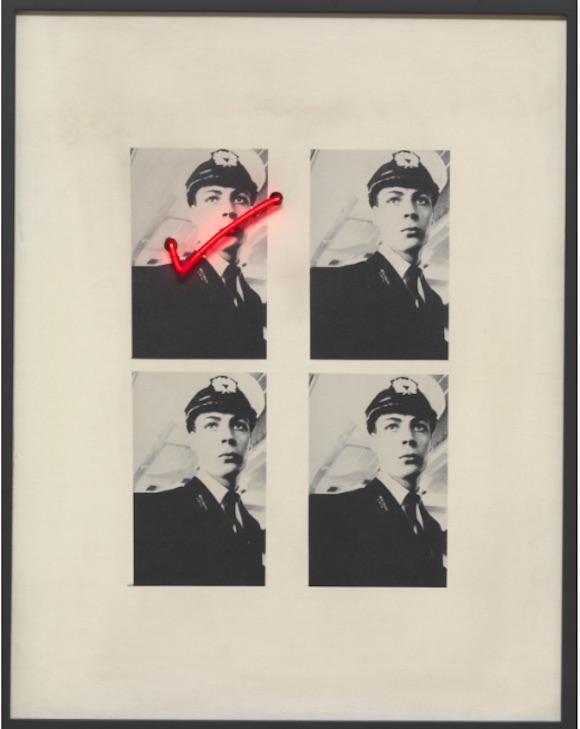
//Relation of Aesthetic Choice to Life Activity (Function) of the Subject, Billy Apple, 1961-2. From Tate Britain//
I’m indebted to Tate Liverpool curator Darren Pih for the connection between a photograph which appeared in ARK 33 – the edition of the Royal College Of Art magazine which was the subject of my last post – and a contemporaneous work by the artist Billy Apple.
The new issue of international interiors magazine apartamento includes my feature about British artist Duggie Fields and his extraordinary mansion flat in inner west London neighbourhood Earl’s Court.
//Front, Run To Me catalogue, 25 x 20cm, 44pp////Unconditional Love, Sam Jackson, 2017//
In the exhibition Run To Me – opening tomorrow at Old Street’s Charlie Smith London – curator Faye Dowling presents a quizzical visual exchange between painter Sam Jackson and photographer Derek Ridgers.
//First part of my essay faced with Tanya, The Batcave, Derek Ridgers 1983//