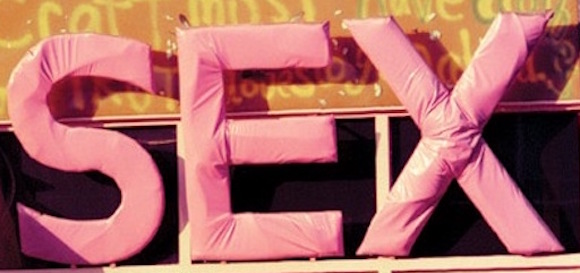
//Detail, clad signage for Georg Jensen, 601 Madison Avenue, late 60s. From Herb Lubalin: Typographer, Unit Editions, 2016////Detail, shop signage designed by Malcolm McLaren, made by Vick Mead, 430 King’s Road, London, 1975. From a photograph by Peter Schlesinger//
Was the late Malcolm McLaren inspired by one of the greats of 20th century graphics in his creation of the astonishing signage for Sex, the fetishistic fashion boutique and incubator of punk rock he operated with Vivienne Westwood at 430 King’s Road in west London between October 1974 and November 1976?
//The Lava Lady on La Brea Boulevard, Los Angeles, 1990s. Photo: http://antebellumgallery.blogspot.co.uk//
Sad to note the passing of Suzan Strauss, whose intriguing, otherworldly presence illuminated the streets around Melrose and La Brea in Los Angeles in the 80s and 90s.
Choosing to walk the otherwise empty pavements in her ever-changing extraordinary outfits, she was known as The Lava Lady since her residence on Detroit was clad in black lava rock (and apparently the interior was not lit by electricity, but candles). In my circle Strauss was known as That Lady, as in “I was parking in Ralph’s and saw That Lady” or “I nearly spoke to That Lady at Fairfax High flea market but didn’t want to disturb her”.
//Voodoo and Magic Practices, Jean Kerboull, Barrie and Jenkins, 1978. Translated from the French by John Shaw//
This is the book which inspired the late Malcolm McLaren to unite the design ideas he developed with Vivienne Westwood for their Autumn/Winter 1983 fashion collection Witches.
At the time McLaren was completing his album Duck Rock, which was conceived as an ethnological travelogue and modelled on the LP series Dances Of the World’s Peoples released on the ethnographic Folkways label; in fact, Duck Rock was originally titled Folk Dances Of The World and the incorporation of an illustrated insert containing track-by-track explanations was taken from the one which appeared in the 1958 albums.
As part of west London’s recent INTransit festival, artist Emma Alonze staged a series of chaotic public interventions in and around Chelsea’s King’s Road under the title I’m Waving.
//Cakewalking: Alonze with Alexander James Turner, Andy Becker, James Batley and Mandi Goodier. This and other cake parade photos: Claire Poulter//
The two-and-a-half mile thoroughfare has all but lost its reputation as the wellspring for creative activity so Alonze’s acts – by turn absurd, impulsive and surprising – were most welcome in the neighbourhood where property values rather than artistic considerations top the agenda.
And I’m Waving was achieved against resistance from the local council, which deemed six of Alonze’s 10 planned acts “not suitable”.
//Cover, Man About Town SS16. Otto in Buffalo hat and Rigby & Peller bra (prototype for Nostalgia Of Mud, 1982). Photography: Alasdair McLellan. Styling: Olivier Rizzo//
//Above left: Frankie in Buffalo hat, white Nike socks and my George Cox Diano creepers. Right: Natalie in Malcolm McLaren’s Chico hat (Witches, 1983), Buffalo jacket (Nostalgia Of Mud, 1982) and Bondage Trousers (Seditionaries, 1976). Photography: Alasdair McLellan. Styling: Olivier Rizzo. Hair: Duffy: Make Up: Lynsey Alexander. Man About Town SS16//
On a warm London afternoon last July I enjoyed a meeting with Ben Reardon, editor-in-chief of the biannual Man About Town, the magazine’s senior fashion editor Danny Reed and Young Kim of the Malcolm McLaren Estate.
//Le Macabre, 23 Meard Street, London W1. Photo: Unknown//
“When I started working as the Saturday boy at Let It Rock (in 1973), Malcolm McLaren used to take me around these strange places which played a part in early rock & roll. One time we went to Le Macabre. I don’t know how he knew about it, but it was the real thing. The tables were coffin lids and the jukebox only had songs to do with death.”
Glen Matlock, interview transcript for The Look, 2000.
A chance encounter on eBay spurred artist Robert Rubbish into creating one of the key elements of his current exhibition Spiritus Soho Volume Zero.
Rubbish – who is one of many mourning the recent death of his friend and documentary subject, the poet Jock Scot – is known for deep associations with central London’s Soho, and has celebrated its sleazy past and uneasy present in his own work and with the other members of the art collective Le Gun.
//Dilly Boys, Robert Rubbish, 2016////The Sailor And The Mermaid, Robert Rubbish, 2016//
//Anna Piaggi – The Eccentric, Hormazd Narielwalla, 2016//
God Save The Queen is the title of collage artist Hormazd Narielwalla’s new exhibition opening at east London furniture and lighting specialists Salt & Pegram’s showroom on Thursday (April 21).
//Warhol poses for photographer Jon Naar on the famous red couch in his studio on E. 47th Street in midtown Manhattan, 1965//
Designer Ben Kelly, chair of interior and spatial design at University of the Arts London, has chosen this photograph of Andy Warhol’s Silver Factory for his exhibition 111 Inspirational Interiors.
Kelly has curated the show – which opens tomorrow at Windows Gallery 1 at Central Saint Martins in Kings Cross, North London – after inviting 111 creatives to each select an image of an interior which is important to them.
//Interior, 430 King’s Road, west London, designed by Patrick Casey and Malcolm McLaren for the retail outlet Let It Rock and photographed by David Parkinson in January 1972. No reproduction without permission//
I have elected the above image for inclusion in the exhibition 111 Inspirational Interiors, which opens tomorrow in the Windows Gallery 1 at Central Saint Martins in Kings Cross, north London.
The show is curated by designer Ben Kelly in his role as chair of interior and spatial design at University of the Arts London as part of his project Popular Culture And The Interior; the 1972 David Parkinson photograph stems from my participation in Kelly’s ICA symposium last year, Dead Or Alive – Interior Design.
For the exhibition, Kelly invited 111 people to contribute “an image of an interior that has been important and influential in their creative and intellectual development”. The image I chose was taken on the completion of the refurbishment of the ground floor of 430 King’s Road from the premises of boutique Paradise Garage into Teddy Boy culture emporium Let It Rock in late 1971 by the late Malcolm McLaren and his fellow former Harrow Art School student Patrick Casey.
//Details of Judy Blame jewellery with Helen Bullock bag////Bullock’s window for The Conformist at Belmacz, 45 Davies Street, London W1////Curator Paul Kindersely with wall of David Parkinson photographs 1970-75//
“So great to see an eclectic range of images and objects that challenge norms and play with moral codes” The Courtauld’s Documenting Fashion blog
The Conformist – artist Paul Kindersley’s celebration of great British non-conformity of expression – is now entering its final few days.
If you have the opportunity, I recommend a visit to this fascinating exhibition (at Mayfair’s art/jewellery space Belmacz) which joins the dots between Emma, Lady Hamilton and Punk Rock, via Judy Blame, Leigh Bowery, Helen Bullock, Jennifer Campbell, Marvin Gaye Chetwynd, Paul Housley, Malcolm McLaren & Vivienne Westwood, Julie Verhoeven, Rose Wylie and many other glittering and creative creatures.