//Starr on location in Let It Rock drape. Note bust darts. From the front page of Disc & Music Echo, December 16, 1972. Photo: Uncredited//
In the autumn of 1972 the small King’s Road boutique Let It Rock, which had been open for less than a year, received a fillip when the owners Malcolm McLaren and Vivienne Westwood were asked to contribute costumes to the production of 50s Britrock movie That’ll Be The Day.
//Ben Kelly underneath the Sex sign, 1975. Photo courtesy Ben Kelly//
I’m featuring this image of designer Ben Kelly in his persona of The Photo Kid in my presentation about the design history of 430 at the symposium Dead Or Alive: Popular Culture & The Interior, which takes place today at London’s ICA.
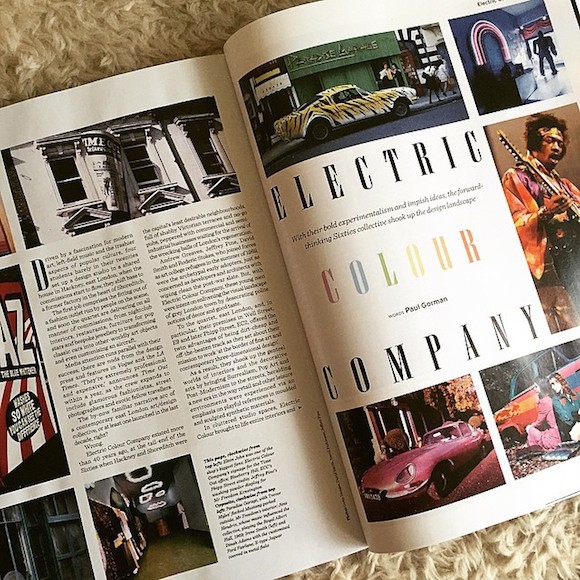
/Left: Andrew Greaves of Electric Colour Company in the back of Paradise Garage, May 1971. Right: Vivienne Westwood in the back of Let It Rock, January 1972. Photos: David Parkinson//
Preparation for my paper at Ben Kelly’s interior design symposium Dead Or Alive has coincided with the refurbishment of the Worlds End shop at 430 King’s Road in Chelsea.
The address is the subject of my talk; I’ll be detailing the history of 430 and how and why it was an important social and cultural locus over a number of decades.
//Back wall of 430 King’s Road on the opening of Mr Freedom, September 1969. Interior: Electric Colour Company. Photo: David Parkinson//
//A US vintage company is unwittingly featuring this forgery as an original t-shirt from Seditionaries on its Instagram feed. The unpleasant item is an example of the accelerating trade in McLaren/Westwood fakes, where previously non-existent designs – often with repellent overtones – are touted as ultra-rare one-offs//
//Banal content: More examples of previously non-existent designs marketed as McLaren/Westwood originals – complete with Seditionaries-style labels – from a Chinese retailer’s site last year. Note the design at bottom left has a fake label whereas the one at the top of this post does not//
//Above: A selection of more of the crude new designs touted as original garments on Japanese auction site Seditionaries Shop, which claimed more than 300 sales at prices averaging £150//
Since Malcolm McLaren’s death nearly five years ago there has been a palpable rise in the plundering of the designs – in particular the graphics produced for t-shirts – he created with Vivienne Westwood in the 1970s.
//Roxy, 25 Kensington Church Street, 1972. Photo: Masayoshi Sukita////Inside Roxy, 1972: Shelley Martin in a flamenco dress designed by Dinah Adams. Photo: Masayoshi Sukita////Some of the Roxy crowd photographed around the corner from the shop (from left): The late Granny’s co-owner Marty Breslau, whose ensemble includes a Wonder Workshop top; Louise Doktor; Shelley Martin; John Knight. Photo: Masayoshi Sukita//
I’ve been aware of the existence of the Kensington boutique Roxy for some time, particularly since the store name was used as the title of the feature on London street fashion in a 1972 edition of Japanese magazine An An.
But my curiosity was pricked recently while browsing that same issue of An An which appears in Freddie Hornik’s scrapbook (see last post).
These jaunty photographs were taken by Barry Plummer in the spring of 1979 for a Melody Maker interview with Malcolm McLaren about the just-released soundtrack for the Sex Pistols’ biopic The Great Rock N Roll Swindle (beset by financial and creative difficulties, the film wasn’t released for another year).
McLaren was accompanied by Vivienne Westwood; they made a striking pair in mixed and matched one-off and traditional pieces with a selection of clothing from their King’s Road shop Seditionaries. By now the transition away from punk – left behind when the Sex Pistols split a year earlier – was becoming evident.
//The simulation of the Seditionaries facade in industrial materials provided the entry and exit point for models on the runway today////With rings representing the positions where designer Ben Kelly exposed air conditioning vents to view, Kim Jones replaced the diagonal bar which occupied the central square over the door with the trademark Vuitton ‘V’////Ben Kelly’s portfolio shot of the facade he designed and installed at 430 King’s Road in December 1976//
Amid the references to the late Christopher Nemeth in today’s Paris show of the Louis Vuitton A/W 15 menswear collection (see my last post), artistic director Kim Jones used the staging to pay subtle homage to the two great maverick figures of London street culture – namely Malcolm McLaren and Vivienne Westwood and specifically their 70s punk store Seditionaries.
//Malcolm McLaren in a previously unpublished shot wearing original 50s George Cox Bingley D-ring brothel creepers to match his detail-perfect Teddy Boy garb. Photo taken inside Let It Rock, 430 King’s Road, January 1972. (c) David Parkinson//
//Left, Saint Laurent point-toed patent brothel creepers, A/W 2014. Right: George Cox Buckle Diano made to the 1950s last//
Last season’s foregrounding by Saint Laurent of the pointed brothel creeper is just one of a run of examples of fashion brands plugging into the purity of this quintessentially British rock & roll style minted in 1949 by the UK independent footwear company George Cox.
Among the first stylistic innovators to take the design out of Teddy Boy revivalism and apply it to contemporary fashion was Malcolm McLaren, who had been selling creepers for a couple of years at Let It Rock, the boutique he operated with Vivienne Westwood, by the time he visited the Cox factory in Northampton in November 1973. Here he ordered samples for six styles, some of which went into production for sale at 430 King’s Road.