//Robert Watts in front of Products by Implosions Inc. Photographer: unknown//
Malcolm McLaren’s adaptation of the infamous Tits t-shirt is one of punk’s most familiar designs, as applied by he and Vivienne Westwood to shirts sold in SEX and Seditionaries, worn by members of the Sex Pistols and replicated hundreds of thousands of times since.
Such is its distorting androgynous power that a version was chosen along with another McLaren/Westwood design – the Cowboys shirt – to represent the core aesthetic of the movement when the forthcoming Costume Institute exhibition Punk: Chaos To Couture was announced earlier this month.
I’m quoted in today’s article in UK Sunday newspaper The Observer about the factual failings surrounding the punk clothing collection of the New York Metropolitan Museum Of Art’s Costume Institute.
//Harold Harris with 10ft tall display item designed by Rod Stokes, Mr Freedom, 1971. Photo courtesy Andrew Greaves.//
Something of a legend in 70s British boutique circles, here is Harold The Ted in all his glory accompanying one of the extravagant display items at Mr Freedom in Kensington Church Street: a 10 foot tall cut-out representation of a glowering boy scout made by Electric Colour Company’s Rod Stokes.
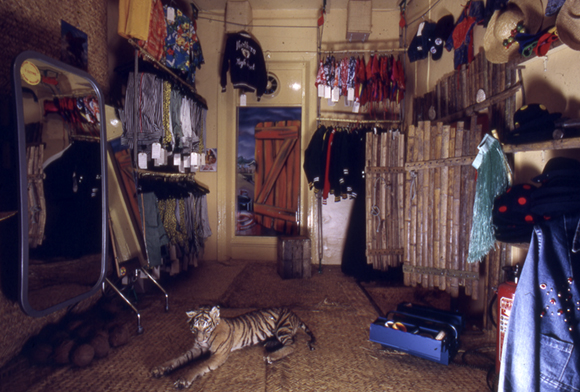
//Interior, 430 King's Road, Chelsea, May 1971. Note coconut matting, shack-style dressing room doors, trompe de l'oeil gate painted on stockroom door... and fake tiger. Photography: David Parkinson.//
I first wrote about Electric Colour Company – the design studio formed in the East End by four fine art students in the late 60s – in The Look and then in more detail here.
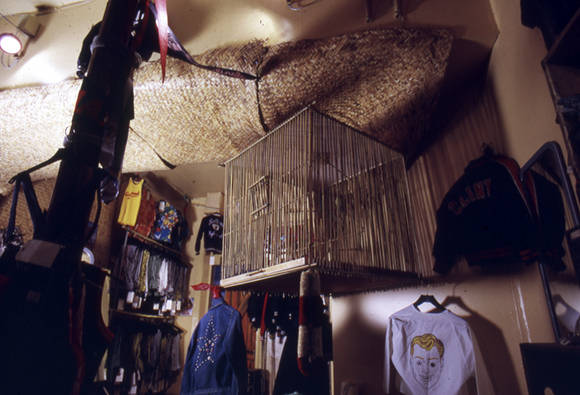
//Amid the singlets, printed sweatshirts and appliqued denim, a bamboo cage housed birds of paradise, suspended from the matting covered ceiling.//
In my view, ECC deserves much greater recognition for executing some very clever work in the field of retail design and interiors in the period 1969-1973.
This just in from Joe Stevens, following yesterday’s post about his new website: the story behind the photo with Johnny Rotten above, taken in London in 1978.
We were at his Gunter Grove digs in Fulham. Malcolm (McLaren) had left his grotty leathers in my flat in NYC during the Sid and Nancy murder doings. I had them dry cleaned. Never got the $90 for that one.
He had Glitterbest problems in London. So did Rotten. I was over there to do pictures of Public Image Limited.
He made a nice curry. I crashed there with him and Nora (Forster). Ari (Up, Forster’s daughter) would pop by often.
We watched her and The Slits record Heard It Thru The Grapevine and Chrissie (Hynde) rehearsing with her new Pretenders.
Yeah, he’s holding up his trousers with a strand of white cord.
I was later a witness at the High Court trial involving the band versus Glitterbest.
I tried on Malcolm’s leather trousers. Fell in love. It was a first. Went to London in them. Never took them off. Returned two weeks later to NYC wearing them.
Had them cleaned again. This time they didn’t survive. All I got back was swatches of leather in a bag.
//Marrion Womble + Barbara Trentham in City Lights Studio clothes, London, 1973.//
Herb Schmitz proudly describes himself as a photojournalist.
From the start of his career in London in the late 60s, the Dusseldorf-born Schmitz has turned an unerring eye to all manner of subject matter: seascapes,Turkish gangsters, the WW2 head of the Polish government in exile, the social scene in latterday Shoreditch (where he has operated a studio for more than 25 years)…
//Ika Hindley models Hamnett bangles, 1973.//
In the wake of a recent exhibition at Amsterdam’s Unseen Photo Fair, Schmitz has opened his archive of early 70s fashion photography for me, revealing images of a lost London demi-monde clad by such hallowed enterprises as City Lights Studio (the Covent Garden boutique operated by the subject of my latest book, Tommy Roberts) and Katherine Hamnett’s label Tuttabankem.
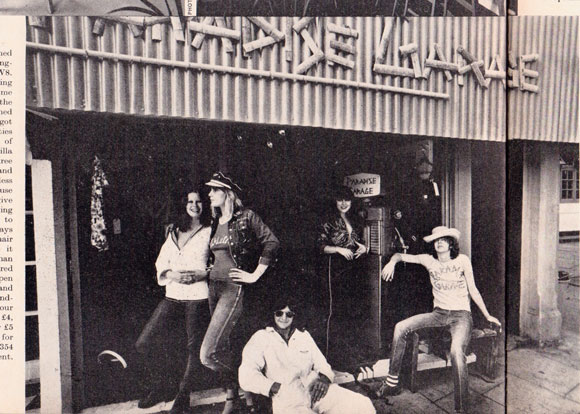
Harpers & Queen ran this photograph of the short-lived but significant World’s End boutique Paradise Garage in the Shopping Bazaar section of the September 1971 issue.
//Photo detail (from left): SEX customers Danielle, Alan Jones + Chrissie Hynde; Vivienne Westwood; assistant Jordan.//
As a follow-up to my recent post about the rarely seen 1975 interview with Malcolm McLaren in soft porn mag Gallery International, here is another exclusive: for the first time since publication in June 1976, the full article featuring McLaren and Vivienne Westwood’s shop SEX in British sex guide Forum.
//Detail, Ian Dury's Billy Bentley boxing gown, commissioned from Sex, 1974. Photographer: Adrian Turner.//
Ian Dury was as much a visual as verbal stylist.
The late performer’s wordsmithery comes into focus in daughter Jemima’s soon-to-be-released book ‘Hallo Sausages’, which also conveys his rich and idiosyncratic sartorial presence.
Published by Bloomsbury on October 28, ‘Hallo Sausages’ presents lyrics to 170 of Dury’s songs, some scribbled and heavily anotated, others meticulously typed and displayed to best effect in the book design by another member of Dury’s extended family, Jake Tilson (brother of Dury’s widow Sophy; their father is the eminent British artist Joe Tilson).
Making a merit of the archival jumble Dury left behind on his death in 2000 (a bunch of lyrics were found in a carrier bag bearing Barney Bubbles’ familiar Blockhead logo), this is a lovingly put-together document, the songs and Jemima Dury’s reminiscences adorned by a bank of rare, personal and professionally-taken images.
To celebrate the publication of ‘Hallo Sausages’, here’s a selection of key items from Jemima’s Dad’s wardrobe with some background material sourced from my recent book about one-time Kilburn & The High Roads manager Tommy Roberts. Jemima has also contributed a couple of images from her own archive.
Meanwhile, at the end of this post, there’s an opportunity to win a signed copy of ‘Hallo Sausages’.
//Onstage at London's Lyceum, 1981. Photographer: David Corio.//
Pearly King jacket
Rooted as he was in London lore, Dury added this authentic Pearly King jacket to his stage ensemble in the late 70s. According to Sophy Dury, he later found out it had belonged to an Eastender named John Snow (hence “JS Of Mile End” on the back). Snow’s mother had loaned the jacket to her friend Mrs. E. Rainbird, who wore it on VE Níght.
In a 1985 letter to the BBC radio broadcaster Libby Purves (who interviewed Dury that year) Mrs Rainbird wrote that she recognised the jacket from his TV appearances. Purves complied with her request to pass the letter outlining the provenance to Dury, who put it in one of the jacket pockets, where it remains.
Tomorrow (October 11) is the publication date of The Look Of London, my map collaboration with the pre-eminent modern guide-makers Herb Lester Associates.
“This map is a reminder that London, with all its individuality and character, is still very exciting,” writes Paul Smith in the foreword; he opened at 44 Floral Street WC2 in 1979.