It sums up everything that was wonderful about this unique space, where Pete established a hub for like-minded souls. With staff including Edwin Pouncey (aka Savage Pencil), Pete also released otherwise hard-to-find records via his own independent imprints. These included Heartland, 5 Hours Back and MoFoCo for Julian Cope’s towering LP Droolian.
//Droolian’s back cover////Zippo’s distinctive price label (this from The Many Faces Of Gale Garnett, an obscure 1965 release on RCA)//
I bought a lot of music and also an example of every one of the short-run t-shirts Zippo sold, including my favourite, this MC5 number (other owners, and there can’t be many because they were printed in very limited numbers, include Bobby Gillespie).
As a local I was a Zippo regular with our Battersea hound Tom. Pete christened him “The Conqueroo Dog” after the four-legged friend on the cover of his reissue of the Austin band’s 1968 release From The Vulcan Gas Company.
//Front cover, From The Vulcan Gas Company, The Conqueroo, 1968/reissued 1987 on 5 Hours Back//
When Zippo closed I bought a whole load of stock and had a few happy years trading in vinyl as a sideline, until my back gave out.
Pete’s still at it, running Soho Music which is now on eBay – see here.
I bumped into Edwin P a couple of years back; he was in the company of another great person who was also a former Zippo staffer. Can’t for the life of me recall his name but hopefully he’ll see this and get in touch.
//1, 2, 3, 2004. Giclée Iris print on museum board. 91 x 120cm////Black Depths (1), 1974. Black and white print and Letraset on museum board, 2 parts. 72 x 72cm//
The exhibition Disobedient Objects opens at the V&A tonight; here curator Catherine Flood – who originated the concept for the show – talks me through five exhibits which embody the spirit of contemporary protest.
TEAR GAS MASKS MADE FROM WATER BOTTLES
//How To guide: Makeshift Tear-Gas Mask. Illustrated by Marwan Kaabour at Barnbrook//
Disobedient objects are often those which are simply to hand and waiting to be re-purposed. These masks made from water bottles were used during last year’s Gezi Park protests in Istanbul as a response to the unprecedented amounts of teargas used against protestors in Taksim Square, and became symbolic – they were featured in street art and graffiti and there are photographs of whirling dervishes wearing them.
One of the key points of the exhibition is to demonstrate that excellent design can emerge from people with limited resources and not much time but brilliant ideas. These also show that design doesn’t have to be about professional practice or commercial purpose but can still make a wide impact; people also tweeted images from local chemists of the products which could be bought to make up a survival kit when gassed. As an accessible form of design we chose it for one of our “how to” guides because it is a great example of “swarm” design, documented by one group so that others can use them in different contexts.
PLACARDS IN THE DIGITAL AGE
//A message to you Vladimir. Gay rights activist protests at Putin’s re-election in 2012: “We won’t give it to Putin a third time.”////Protestor – who has subsequently had to leave Russia – with his placard, which was collected by Flood herself. She was in Moscow taking an exhibition down when the protests were on//
This placard was made for demonstrations against Putin’s re-election in 2012 and marked a different style of protest in Russia: rather than a crowd united under by one slogan, hand-painted placards were produced with personal, sometimes witty messages. There’s nothing especially innovative about hand-rendered placards but this time they were used in conjunction with social media so were a bit like tweets, conveying pithy messages which were photographed and put on Twitter.
This was created by a gay rights activist and says: “We won’t give it to Putin a third time,” apparently quite a crude reference in Russia and playing on his homophobia. The protestor told us that this was the first time the LGBT Rainbow colours were used in public. He has subsequently had to leave the country.
INFLATABLES
//Testing an inflatable hammer made by Eclectic Electric Collective at the Berlin Mauer Park, 2010. Photo: Jakub Simcik//
The Berlin-based Eclectic Electric Collective (now called Tools For Action) produce inflatables of protest objects such as cobblestones and hammers. When they’re thrown at police lines they change the dynamic of demonstrations; the police either become distracted by the big shiny thing or they throw it back and the exchange turns into a game, like a surreal version of volleyball.
It’s a really interesting way of occupying public space. This element of unruliness upsets the authorities because the protestors are not abiding by protocol and the accepted rules of engagement. The clever use of props – giant puppets have been used elsewhere – allows the protestors to wrest control.
In the same section of the show we have “bloc books”, painted shields in the form of giant works of literature and philosophy made by students protesting at education cuts. When they demonstrated, the students were effectively being defended by culture, and by striking the shields, the police not only invoked the destruction of books but were also forced into a performance without realising it.
This started off in Italy and was taken up in Britain and America by students who had seen them on social media.
The Eclectic Electric Collective made us a cobblestone for the exhibition. This is an issue with this material, because quite often it is destroyed in the process of protest.
EMBROIDERY
//Dónde están nuestros hijos (“Where are our children?”). Chilean Arpilleras wall hanging, Roberta Bacic collection. Photo: Martin Melaugh//
We start in the 70s and the rise of neo-liberalism; among the earliest objects in the show are Chilean appliqued textiles produced by women in workshops during the Pinochet regime. These documented the social realities of the disappearances, the tortures, the economic hardships. These worked on a number of levels.
Made from scraps of material, these were sold, so provided economic support, and in the act of gathering to make them, the women found solidarity and collective strength.
There are accounts of women saying that it was only when they had their eyes down on their sewing that they felt safety in confronting what was going on and were able to document what they were otherwise proscribed against speaking about.
These textiles often left the country, and were seen as innocent by the authorities because of their resemblance to folk art, but carried letters and communicated with the outside world. This technique spread, and we have examples from Colombia in 2010. It was also used in Ireland by women protesting against the use of Shannon Airport in extraordinary rendition.
THE TIKI LOVE TRUCK
//The Tiki Love Truck, Art Car Parade, Manchester, 2007. Photo: Paul Herrmann//
This is one of the biggest objects in the exhibition. Made by British ceramic and mosaic artist Carrie Reichardt, The Tiki Love Truck protests against the US death penalty. It’s an incredibly powerful piece, not least because it features the death mask of John Joe “Ash” Amador, who had corresponded with her and asked Carrie to be a witness at his execution.
Her friend Nick Reynolds went with her and cast the mask, which was woven into the truck and driven in the Art Car Parade in Manchester 10 days after the execution.
Disobedient Objects runs until February 1, 2015. More info here.
//Jacket photograph Terry Richardson with shots from Walrod’s Instagram feed//
Design authority Jim Walrod wears a deep and wide-ranging understanding of his subject – specifically that pertaining to modernism in furniture, interiors, product design and architecture – lightly.
This is refreshing in a field populated by bloodless experts and humourless know-alls. The founder of important 90s/00s store Form & Function, Walrod – described as “the ultimate design raconteur” by André Balazs and “the furniture pimp” by the Beastie Boys – is above all an enthusiast.
//Cover: Boy George with Mica + Jade, styling David Mignon, photography Thomas Krygier//
From time to time I’m going to be turning over information and images here as I go through the process of writing my book Legacy: The story of The Face.
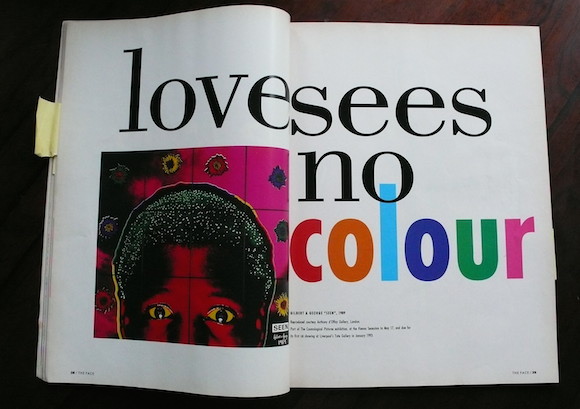
Today I spent an enjoyable and enlightening few hours interviewing former editor Richard Benson; during our conversation it became clear that one of the turning points in the history of this significant magazine occurred with the spring 1992 publication of the issue headed Love Sees No Colour.
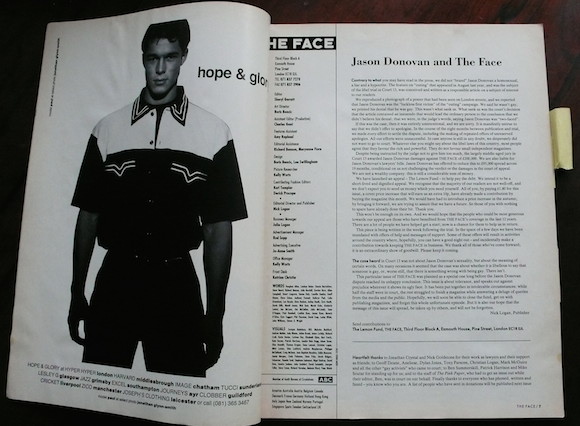
This coincided with the High Court judgment against the magazine in the unfortunate libel case brought by actor/singer Jason Donovan on the grounds that he had been branded a liar and a hypocrite as a result of the inference that he was gay.
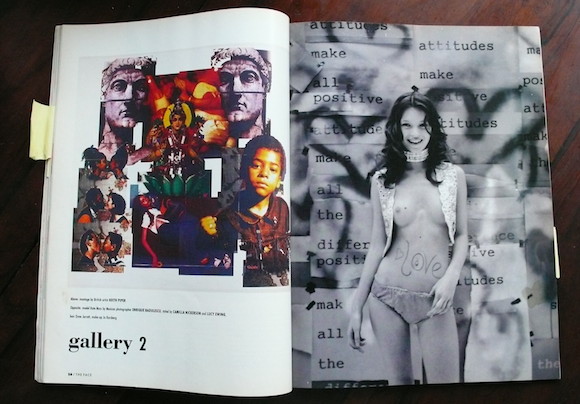
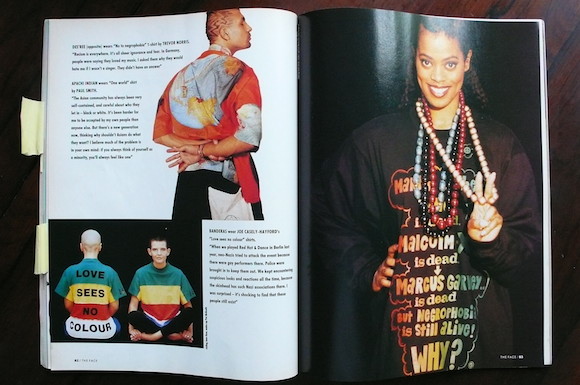
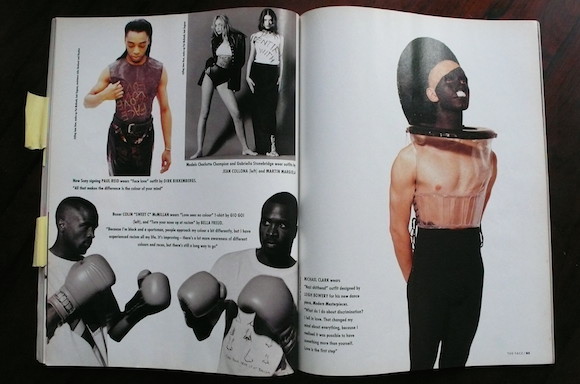
//The Face May 1992, pp6-7: Nick Logan’s editorial on the right////PP58-59: Left, montage by Keith Piper/Right, Kate Moss by Enrique Badalescu, styling Camille Nickerson + Lucy Ewing////PP38-39: Seen, Gilbert & George, 1989//
The theme of tolerance had been hatched by Benson’s predecessor Sheryl Garratt long before the dispute reached, in publisher Nick Logan’s words, “its unhappy conclusion”.
In terms of the magazine’s narrative, the issue affirmed The Face’s position as the lightning rod of the progress of popular culture in the inclusive 90s.
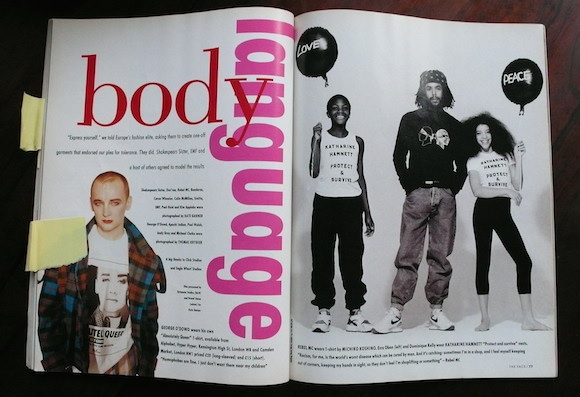
//PP76-77: Left, George O’Dowd in his Absolutely Queer T-shirt – “Homophobes are fine. I just don’t want them near my children.”/Right, Rebel MC in Michiko Koshino T-shirt, Ezra Oban + Dominique Kelly in Katharine Hamnett Protect + Survive vests. Photos: Kate Garner + Thomas Krygier////PP82-83: Left (top), Apachi Indian in One World shirt by Paul Smith, (below) Banderas in Love Sees No Colour shirts by Joe Casely-Hayford,/Right, Des’Ree in No To Negrophobia T-shirt by Trevor Norris. Photos: Kate Garner + Thomas Krygier////PP84-85: Left, (top left) Paul Reid in Face Love outfit by Dirk Bikkembergs, (top right) Charlotte Champion + Gabriella Stonebridge in Jean Colonna and Martin Margiela, (below) Colin “Sweet C” McMillan in Love Sees No Colour T-shirt by Gio Goi and Turn Your Nose Up At Racism by Bella Freud/Right, Michael Clark in Nazi Shithead outfit by Leigh Bowery. Photos: Kate Garner + Thomas Krygier//
Designed by Boris Bencic and Lee Swillingham, the issue tipped the hat to those figures who had played a part in the 80s story – Boy George, Paul Smith, Leigh Bowery – and also hit the mark with the generation setting the pace for the new decade, whether it be Joe Bloggs, Kate Moss or Martin Margiela.
Produced in an all-hands-to-the-pump atmosphere, with Logan and Garratt in daily court attendance and the all-too-real prospect of forced closure as a result of the huge legal bills resulting from the Donovan case, The Face May 1992 is a cracking issue, one which stands up as a consummate example of journalistic excellence achieved under duress.
Legacy: The story of The Face is published by Thames & Hudson in autumn 2017.